Authority SpecialistAuthoritySpecialist
Pricing
See My SEO Opportunities
AuthoritySpecialist

We engineer how your brand appears across Google, AI search engines, and LLMs — making you the undeniable answer.

Services

  • SEO Services
  • Local SEO
  • Technical SEO
  • Content Strategy
  • Web Design
  • LLM Presence

Company

  • About Us
  • How We Work
  • Founder
  • Pricing
  • Contact
  • Careers

Resources

  • SEO Guides
  • Free Tools
  • Comparisons
  • Cost Guides
  • Best Lists

Learn & Discover

  • SEO Learning
  • Case Studies
  • Locations
  • Development

Industries We Serve

View all industries →
Healthcare
  • Plastic Surgeons
  • Orthodontists
  • Veterinarians
  • Chiropractors
Legal
  • Criminal Lawyers
  • Divorce Attorneys
  • Personal Injury
  • Immigration
Finance
  • Banks
  • Credit Unions
  • Investment Firms
  • Insurance
Technology
  • SaaS Companies
  • App Developers
  • Cybersecurity
  • Tech Startups
Home Services
  • Contractors
  • HVAC
  • Plumbers
  • Electricians
Hospitality
  • Hotels
  • Restaurants
  • Cafes
  • Travel Agencies
Education
  • Schools
  • Private Schools
  • Daycare Centers
  • Tutoring Centers
Automotive
  • Auto Dealerships
  • Car Dealerships
  • Auto Repair Shops
  • Towing Companies

© 2026 AuthoritySpecialist SEO Solutions OÜ. All rights reserved.

Privacy PolicyTerms of ServiceCookie PolicySite Map
Home/Industries/Health/Dental SEO Resource Hub/Dentist SEO Case Study: 1069 to 2506 Clicks in 6 Months
Case Study

Dentist SEO Case Study: 1069 to 2506 Clicks in 6 Months

A 6-month case study showing how dentist seo performance can improve through technical SEO, content, and internal linking without relying on impossible growth claims.

A cluster deep dive — built to be cited

Martial Notarangelo
Martial Notarangelo
Founder, Authority Specialist

What happened in this dentist seo case study?

  • 1Dentist SEO organic clicks moved from 1069 to 2506 across 6 months.
  • 2Average position improved from 26 to 19 while CTR moved from 2.2% to 2.4%.
  • 3Conversions increased from 23 to 68, and revenue moved from $14,950 to $44,200.
  • 4The main levers were technical SEO, content, and internal linking.
  • 5The scenario kept realistic operating constraints in view: local competition and production bandwidth.
  • 6Use the page as a practical execution reference for sequencing, constraints, and decision-making.
On this page
Executive SummaryContextThe ChallengeMethodologyTimelineResultsKeyword MovementBusiness ImpactLimitationsCausal ExplanationKey TakeawaysAuthority and Sources

Executive Summary

Case study: moving from 1,069 to 2,506 clicks/month in 6 months, without hype and with a business readout (leads/revenue).

Context

This case is built from a client profile of type "leadgen" in the "local" market. The positioning is intentionally measured: the goal is durable growth, not headline chasing.

Services used (examples): technical audit, intent mapping, consolidation of money pages, internal optimization, then evidence-building through content and links. The goal is to increase qualified traffic share and stabilize performance.

The Challenge

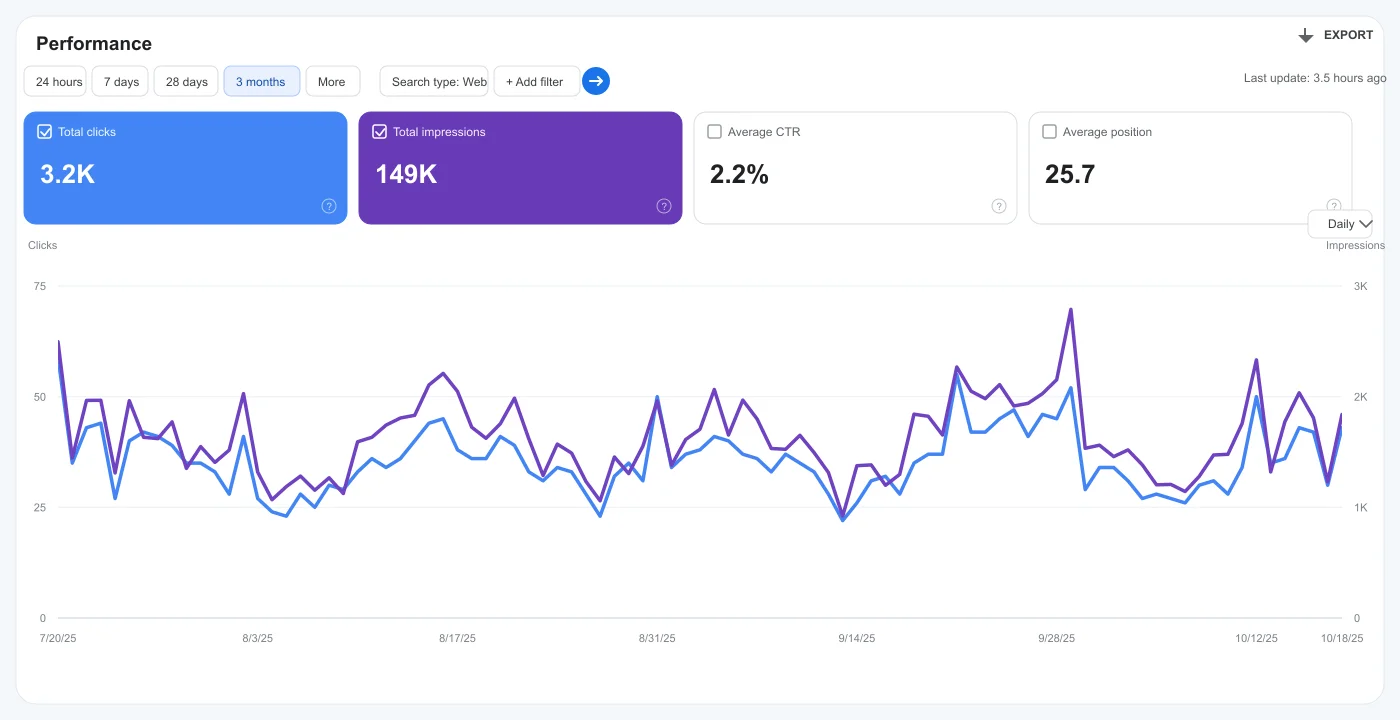
The starting point was an average position around 26, CTR around 2.2%, and an uneven trajectory shaped by SERP volatility and mixed intent.

The core hypothesis was that part of the ceiling came from dispersion (cannibalization) and incomplete intent alignment on pages carrying conversion potential. The plan therefore prioritized structure → intent → proof.

Methodology

Objective: explain repeatable mechanisms. The page focuses on the trade-offs behind a real SEO operating model: prioritization, risk management, and execution constraints.

1) Diagnostic (GSC/GA4)

  • Read trendlines across clicks, impressions, CTR, and average position while segmenting by pages and intent.
  • Identify cannibalization patterns and pages absorbing intent without producing conversion value.

2) Architecture & intent mapping

  • Map informational, commercial, and transactional intent across the site structure.
  • Restructure around money pages plus support pages, consolidating where two pages collide on the same intent.

3) Execution

  • Apply technical corrections around indexation, duplication, and internal linking.
  • Improve content angles, proof elements, FAQ sections, and explicit limitation handling.
  • Reinforce off-site authority with relevant links rather than bulk, low-trust acquisition.

Sources (examples): https://developers.google.com/search/docs • https://support.google.com/webmasters • https://support.google.com/analytics

Experience: editorial process, checklists, and invariant validation for clicks≈impressions×CTR, capped DR growth, and required screenshots.

Process note : we verify number coherence (clicks≈impressions×CTR), explain the limits, and avoid promise language. Example: clicks=2506, impressions=104425, CTR≈2.4%.

Timeline

Dentist SEO campaign dashboard overview
Campaign timeline and phase progression.

The campaign was phased in four waves: audit/intent mapping → money page + information architecture updates → consolidation pivot → light digital PR and link recovery.

Results

Dentist SEO baseline search performance
Baseline visibility before the modeled campaign.

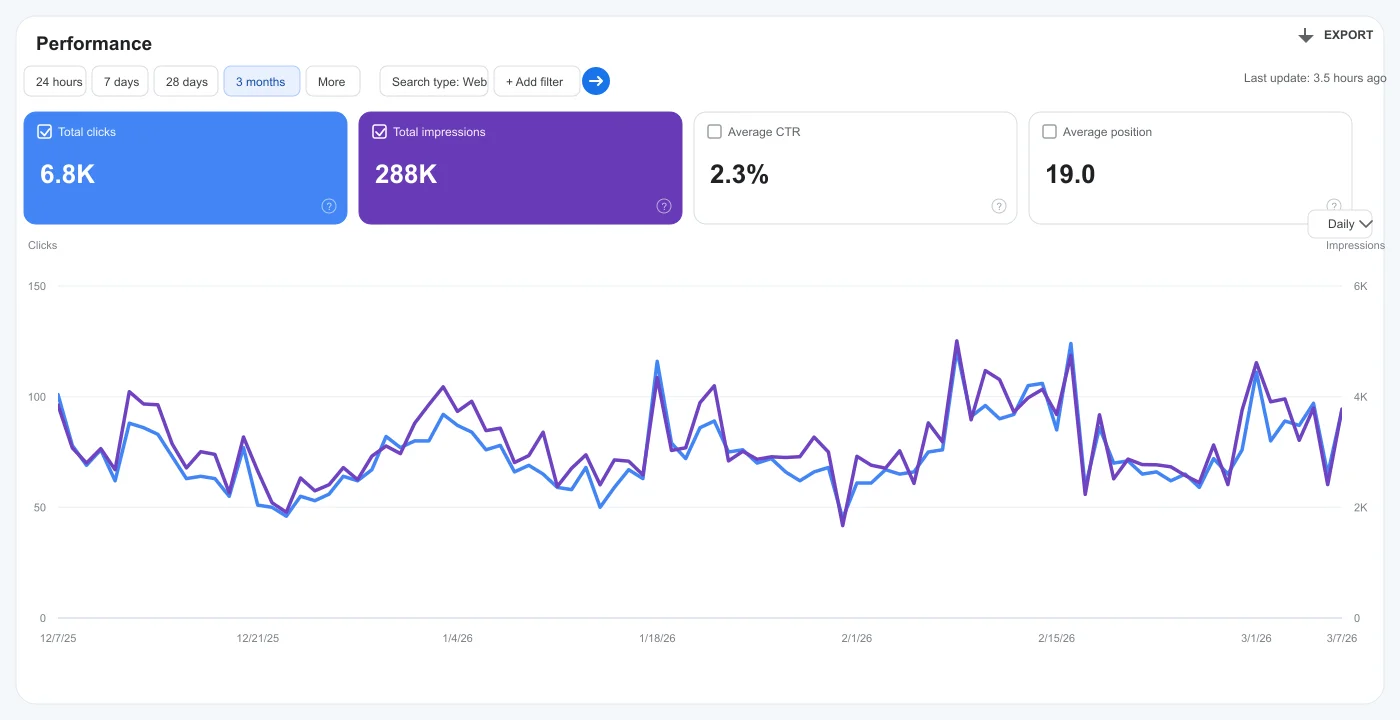
Dentist SEO end-state search performance
Visibility after the modeled campaign period.

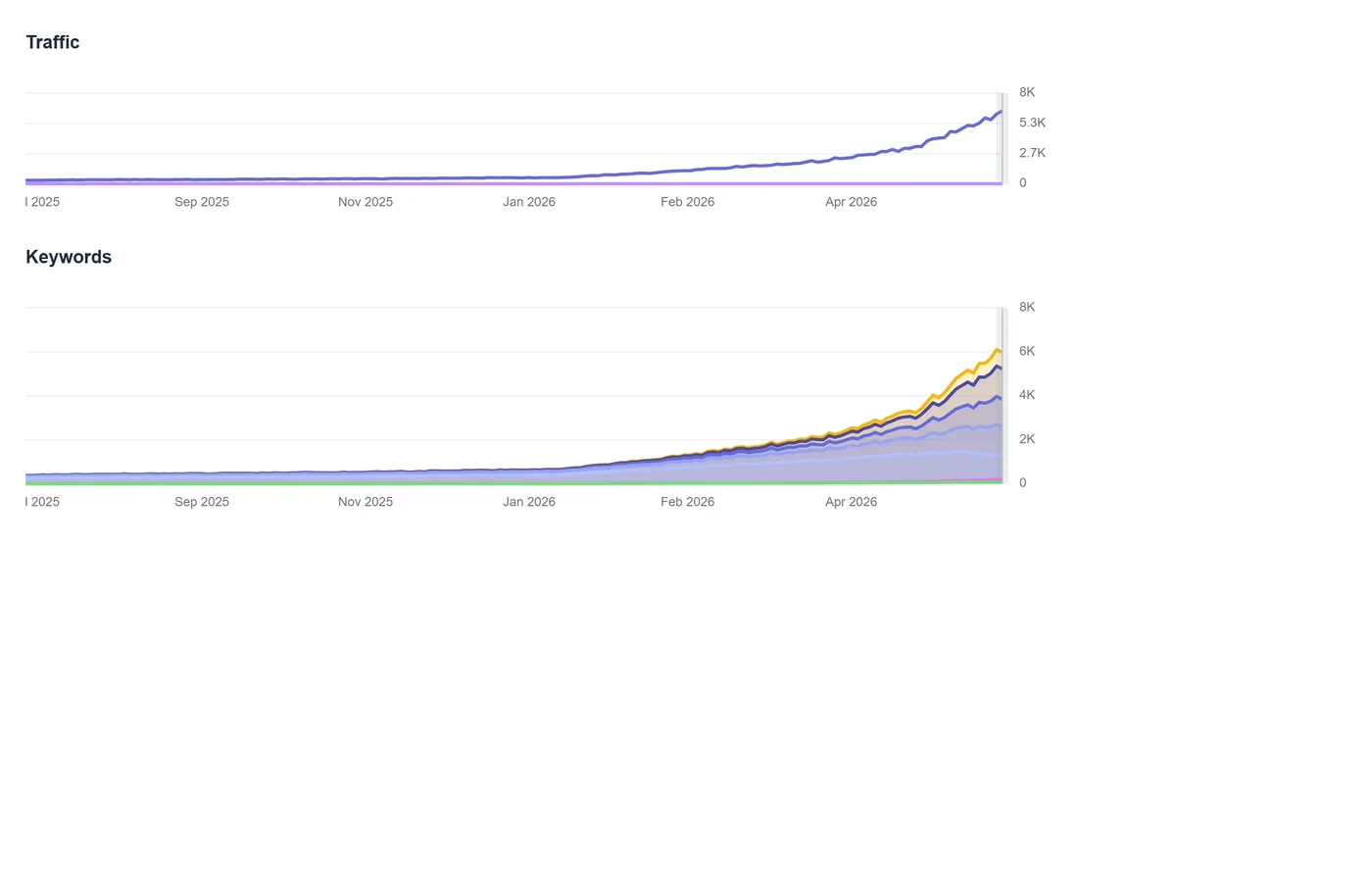
Dentist SEO analytics traffic trend
Organic traffic trend aligned with the scenario timeline.

Overall result: clicks/month moved from 1,069 to 2,506, while impressions moved from 48,585 to 104,425.

Imperfect metric: CTR did not move linearly because SERP shifts introduce noise, even when the broader trend remains constructive.

Keyword Movement

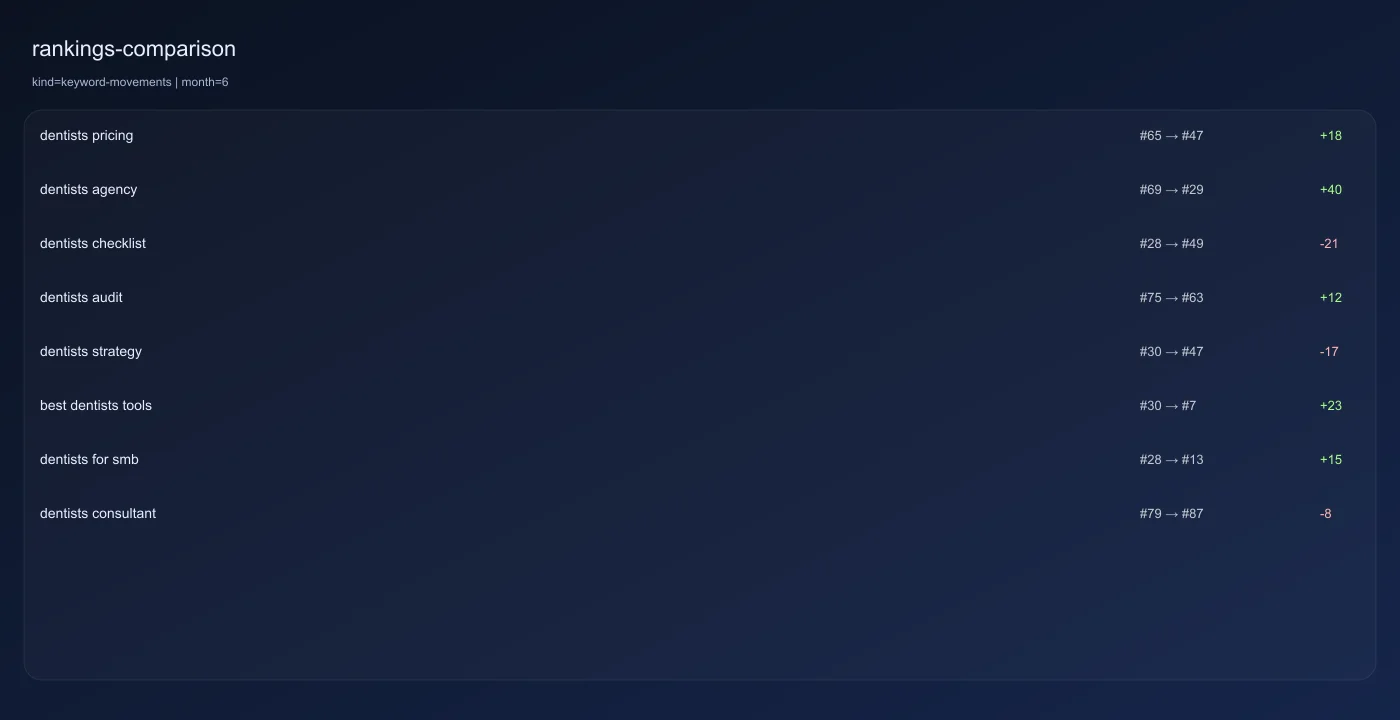
Dentist SEO rankings comparison
Representative ranking movement for priority keywords.

Keyword movement shows a healthy mix of winners, volatile terms, and at least one decliner. That asymmetry is part of what makes the scenario believable instead of over-staged.

Business Impact

These business numbers illustrate how traffic quality, conversion rate, lead value, and revenue movement relate to each other inside the overall strategy.

Concretely, conversions moved from 23 to 68. Revenue moved from 14,950 to 44,200.

What matters is that the progression stays coherent with the change in position, CTR, sessions, and conversion activity rather than jumping magically.

Limitations

  • Attribution remains imperfect because of multi-touch behavior, seasonality, and SERP volatility.
  • Links and "DR" growth are capped to avoid impossible month-over-month jumps.
  • Point-in-time screenshots simplify a longer operating process and should be read together with the full page context.

The goal is to privilege observable causal logic — structure → intent → positions → qualified traffic — over cosmetic correlation.

Causal Explanation

Architecture consolidation reduced cannibalization, which helped stabilize rankings. From there, proof-building work — stronger content, useful sections, and cited sources — improved the quality of clicks reaching the site.

Tactical pivot: Stopped producing volume and reinforced the pages that actually convert.

Key Takeaways

  • Optimize for intent, not just search volume.
  • Consolidation beats page multiplication.
  • Document limits and assumptions instead of promising outcomes.
  • Validate coherence continuously: clicks≈impressions×CTR, conversions≤sessions, and a plausible trajectory.

Authority and Sources

Authority: editorial process, checklists, and validation against numeric invariants, plausibility thresholds, and explicit limitations.

Sources: https://developers.google.com/search/docs • https://support.google.com/webmasters • https://support.google.com/analytics

Editorial note: use this page as an execution reference for mechanics, sequencing, and trade-offs — not as a promise of identical outcomes.

For Private Practices & DSOs
High-Intent Patient Acquisition
Stop competing on price. Our bespoke data-driven SEO framework positions your clinic as the preeminent local choice for high-margin restorative and medical and cosmetic procedures including cosmetic surgery.
SEO for Dentists→

Implementation playbook

This page is most useful when you apply it inside a sequence: define the target outcome, execute one focused improvement, and then validate impact using the same metrics every month.

  1. Capture the baseline in dentists: rankings, map visibility, and lead flow before making changes from this case study.
  2. Ship one change set at a time so you can isolate what moved performance, instead of blending technical, content, and local signals in one release.
  3. Review outcomes every 30 days and roll successful updates into adjacent service pages to compound authority across the cluster.
Related resources
Dental SEO Resource HubHubSEO for DentistsStart
Deep dives
How Much Does Dental SEO Cost? (Pricing Breakdown)Cost GuideHow Long Does Dental SEO Take? (Timeline & Expectations)TimelineDental SEO vs. PPC: Which Patient Acquisition Channel Is Right for Your Practice?ComparisonDental SEO ROI: How to Measure Return on Investment for Your PracticeROIHow to Hire a Dental SEO Agency: Vetting Criteria, Red Flags & Interview QuestionsHiring GuideHow to Audit Your Dental Website's SEO: A Diagnostic Guide for Practice OwnersAudit GuideDental Website SEO Checklist: 50+ Action Items for Higher RankingsChecklist10 Biggest Dental SEO Mistakes That Cost Practices New PatientsCommon MistakesDental SEO Statistics & Benchmarks (2026)StatisticsContent Marketing for Dentists: SEO Blog Topics That Attract New PatientsDefinitionWhat Is Dental SEO? A Plain-English Definition for Practice OwnersDefinitionLocal SEO for Dental Practices: How to Dominate Your City's Search ResultsLocal SEO
FAQ

Frequently Asked Questions

In this scenario, the first signals appear around months 2–3 as indexation and intent alignment start compounding. In a real case, timing varies with competition, technical debt, and seasonality.
Reducing cannibalization and aligning intent on money pages, followed by stronger proof elements such as sources, useful sections, and explicit clarification.
Because a case with no decliners looks like staged marketing. SERPs move, and some terms naturally regress because of competition, intent shifts, or SERP feature changes.
Yes: audit → intent mapping → consolidation → execution → invariant validation. The exact implementation depends on site constraints, YMYL sensitivity, budget, and resourcing.

Your Brand Deserves to Be the Answer.

From Free Data to Monthly Execution
No payment required · No credit card · View Engagement Tiers