Search visibility is local. Our system travels.
Explore market-specific authority strategies built around how people search, compare, and choose in each location.
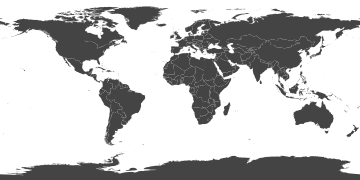
Choose the market the business can actually support
Use this location directory to decide which country or city deserves focused SEO planning. Start with the market the business genuinely serves, not with every place that could be named on a page. Confirm how customers are reached, which services are available there, whether a real location or service area exists, which languages matter, and who can keep local information accurate. A country route is useful for broad market orientation and navigation, while a city route is appropriate when the business can provide meaningful, supportable information for that specific city.
Before recommending local content, listings, or technical changes, inspect the evidence visible in the market itself. Review the pages already representing the location, business contact details, relevant public listings, map and organic search results, review platforms, nearby competitors, address conventions, and the paths customers use to contact or convert. Treat search demand and visibility as market-specific observations. Do not assume a national pattern applies to a city, and do not treat a directory entry as proof that demand, competitiveness, or ranking opportunity has already been established.
After selecting a market, define its operating boundary so later decisions stay consistent. Record where the business can serve customers, which services apply, the intended language and audience, the existing pages tied to the market, the local evidence available, and the observations that will be monitored. Reuse shared service information only when it remains accurate, and reserve local details for facts that can be supported in that place. Create a dedicated location page only when there is a genuine location or a useful location-specific case to explain, rather than generating interchangeable pages around nominal markets or city names.
Research is one part of what we do
We also provide the managed SEO service.
Use the library to understand your options, or explore how Authority Specialist plans technical priorities, content and visibility work for an agreed scope.
Market directory
Go straight to the market that matters.
Search the full coverage index or move by region. The directory opens on the strongest location clusters instead of dropping every country into one long list.
United States
863 local coverage pages
United Kingdom
249 local coverage pages
India
53 local coverage pages
Australia
52 local coverage pages
Canada
45 local coverage pages
Netherlands
26 local coverage pages
France
12 local coverage pages
South Africa
11 local coverage pages
Ireland
9 local coverage pages
All country pages
- United States
- United Kingdom
- India
- Australia
- Canada
- Netherlands
- France
- South Africa
- Ireland
- Italy
- New Zealand
- United Arab Emirates
- Spain
- Pakistan
- Philippines
- Malaysia
- Mexico
- Bahrain
- Belgium
- Brazil
- China
- Curacao
- Germany
- Jordan
- Kuwait
- Malta
- Morocco
- Nepal
- Palestine
- Papua New Guinea
- Portugal
- Saudi Arabia
- Singapore
- Sweden
- Tanzania
- Thailand
- The Bahamas
- Zimbabwe
- Monaco
Decide how each market should be represented
- Should I plan around a country or a city first?
- Start with the smallest market that matches how the business actually operates and serves customers. Use a country route when national context or navigation is the useful level, and use a city route when the business can support distinct local information, service details, evidence, and measurement for that city.
- Does inclusion in the directory mean the market has proven SEO demand?
- No. Inclusion only shows that the market is represented in the location inventory. Confirm demand with current observations from that market, and keep national interest separate from city-level searches, map results, competitive conditions, and business performance.
- Can one location page be copied across several cities?
- Shared service information can be reused when it is accurate everywhere it appears, but city-specific claims, logistics, regulations, examples, proof, and audience needs require local support. Swapping a place name into otherwise identical copy does not provide meaningful location-specific information.
- What should I verify before making an SEO plan for a location?
- Verify the real service area or location model, relevant public listings, map and organic search results, language, nearby competitors, reviews, existing market pages, contact and conversion paths, and the date and geographic coverage of any demand or performance evidence used in the decision.
- How should a business coordinate SEO across multiple locations?
- Give each market a clear route, service scope, operational owner, local evidence source, and measurement boundary. A central team can maintain shared standards, while people responsible for each market confirm the details that differ by country or city and keep those details current.
Start with a secure workspace.Build toward your Growth Report.
Secure SMS begins the path. Then confirm your email, create a password, add your workspace context, and complete your Growth Brief. Your Growth Report presents the available evidence and clearly marks what is still missing; Google connections remain optional.