
This case follows an anonymized single-location repair business that began with an average position near 28, 96 non-branded clicks, and 12,021 impressions. At the later measurement point, the same modeled scenario showed 797 clicks, 27,475 impressions, and 27 tracked conversions associated with roughly $8,640 in modeled job value, compared with 3 conversions and $960 at the baseline. The decision-useful part is the order of work: remove structural ambiguity, align commercial pages to search intent, build useful supporting coverage, connect that coverage internally, and only then add broader authority work. The case also records the workstream that was reduced when weaker pages stopped earning their place, plus the query groups that did not improve.
Executive Summary
Context
The client is presented as a single-location auto repair shop competing in a local automotive market. The starting site looked less like a deliberately planned search asset and more like a property that had accumulated pages over time: average rankings sat in the high 20s, non-branded demand was inconsistent, and commercial service pages had limited informational support.
The baseline made the decision problem concrete. 12,021 impressions generated 96 clicks at a 0.8 percent click-through rate. That combination suggested the site was appearing for relevant searches without winning enough visits from those appearances. Sessions were 81 and tracked conversions were 3. The domain metric recorded for the scenario was 16, with 27 referring domains, so the plan did not begin with an assumed need for aggressive link acquisition.
The operating constraints mattered as much as the metrics: the market was locally competitive, the shop had limited capacity to help produce content, and unsupported service claims were off-limits. That limit on what the pages could claim shaped how service pages, supporting articles, entity information, and editorial review were handled.
The Challenge
The audit separated the site problem into three decisions. The first was which URL should own each commercial intent. Several legacy pages overlapped with broader service pages, creating competing targets for similar searches. The second was whether the landing page matched the searcher's job-to-be-done. Some local and transactional searches reached pages that were related but not specific enough to the implied choice or action. The third was whether commercial pages had enough contextual support. The site had little explanatory content around repair questions, maintenance decisions, warning signs, and service expectations, leaving fewer natural opportunities to connect relevant informational pages back to service pages.
The operating choice was to delay broad publishing until architecture and indexation were clearer. Adding more URLs before deciding which existing pages should remain authoritative could have increased overlap. The sequence therefore became: resolve technical and consolidation issues, map intents to destination pages, add useful supporting coverage, connect it through internal links, and then layer authority-building work where the evidence justified it.
Methodology
The engagement used six workstreams, with the order designed to reduce ambiguity before increasing surface area.
1. Technical SEO and indexation cleanup (months 1 to 3)
The first pass covered crawl and indexation triage, canonical and redirect review, template duplication, Core Web Vitals checks, renderability, structured data validation, and internal status-code issues. The purpose was not to promise a ranking lift from any single technical fix. It was to make priority pages easier to interpret, remove avoidable duplication, and create a more dependable base for later changes. Ranking movement became less erratic from month 3 onward in this scenario, but that timing should be read as an observation from the case, not a universal recovery window.
2. Authority content and intent alignment (months 2 to 4)
Commercial queries were grouped by intent, destination pages were rewritten or clarified where needed, and supporting topics were planned around actual repair-shop decisions. Across the full period, the program published 34 articles across 7 topic clusters covering areas such as maintenance, braking and suspension, diagnostics, seasonal checks, pricing questions, shop-selection questions, and common repair explanations. Each cluster was designed to answer a useful owner question and create a relevant path to the corresponding service page when that next step made sense.
The internal topical authority index recorded in the scenario moved from 27 to 67, while the tracked informational footprint reached 674 informational keywords. These measurements are useful as internal evidence that the site's subject coverage changed. They do not prove that any one article or internal link caused a particular commercial ranking, so the relationship is treated as a supporting explanation rather than a guaranteed mechanism.
3. Information architecture and internal linking (months 2, 3, 5)
A hub-and-spoke structure was mapped, anchor text was diversified around natural context, overlapping pages were consolidated where one destination better matched the intent, and click paths to service pages were shortened. Orphaned or weak pages were reviewed for pruning or merging. The practical objective was to turn the 34 articles into a connected resource instead of leaving 34 isolated URLs competing for crawl attention and user attention.
4. Entity, schema, and LLM presence (months 3 to 5)
Organization and Service structured data were checked for consistency with visible page information, author and reviewer references were aligned where applicable, citation consistency was reviewed, and answer-ready summaries were added without inventing service claims. The work also considered how well-structured, source-aligned content might be interpreted by ChatGPT, Claude, Perplexity, Google AI Overviews, and other AI answer surfaces. No special AI markup or guaranteed citation mechanism was assumed.
5. Digital PR, citations, and link recovery (months 4 to 6)
Lost-link opportunities, relevant citation consistency, unlinked mentions, and limited resource outreach were reviewed with a quality threshold before placement. Referring domains moved from 27 to 46 and the recorded Domain Rating moved from 16 to 21. In this case, link growth was intentionally gradual and was treated as reinforcement for a site whose architecture and content had already been reworked.
6. Brand voice and editorial QA (months 1, 2, 4)
Approved pages were sampled for tone, claim boundaries were documented, a reviewer checklist was used, and content was checked before publication. For an auto repair shop, this meant avoiding unsupported repair outcomes, invented credentials, misleading pricing certainty, or claims that went beyond the evidence available on the site.
Timeline
Months 1 to 2 - foundation and re-evaluation. During technical review, consolidation, and intent mapping, clicks moved from 96 to 74 and tracked conversions from 3 to 2. Average position shifted from 27.7 to 28.5. The correct reading is not that consolidation always causes a dip, but that this case experienced a short-term decline while changed URLs and redirects were being reprocessed.
Month 3 - clearer destinations and first support cluster. With the main consolidation work completed and the first supporting content live, impressions reached 18,315 and clicks reached 183. Average position moved from 28.5 to 20.7, while conversions reached 7. This stage is where the case begins to show a practical payoff from pairing clearer architecture with better intent matching.
Month 4 - broader support and stronger internal paths. With 21 articles published and the internal-link structure more mature, clicks reached 327 and average position moved to 13.0. Tracked conversions reached 10, with modeled job value at $3,200. The useful decision point here was to keep strengthening pages that served a clear search and customer purpose rather than treating article count as the objective.
Month 5 - consolidation over output. The team reduced the emphasis on publishing after reviewing pages that were thin, weakly differentiated, or not contributing enough. Those pages were consolidated, pruned, or reinforced according to their role. Clicks reached 398, sessions reached 390, and conversions reached 15. This was a quality-control stage, not a claim that fewer pages inherently produce better results.
Month 6 - mature structure with authority reinforcement. By the later measurement point, clicks reached 797, impressions reached 27,475, and average position reached 6. CTR reached 2.9 percent, with 27 conversions and modeled job value of $8,640. Digital PR and link recovery were active at this stage, but the case does not isolate those activities as the sole reason for the final movement.
Results
The most useful comparison is the search profile at the baseline and at the later measurement point, with the screenshots read as anonymized views built for this composite case.
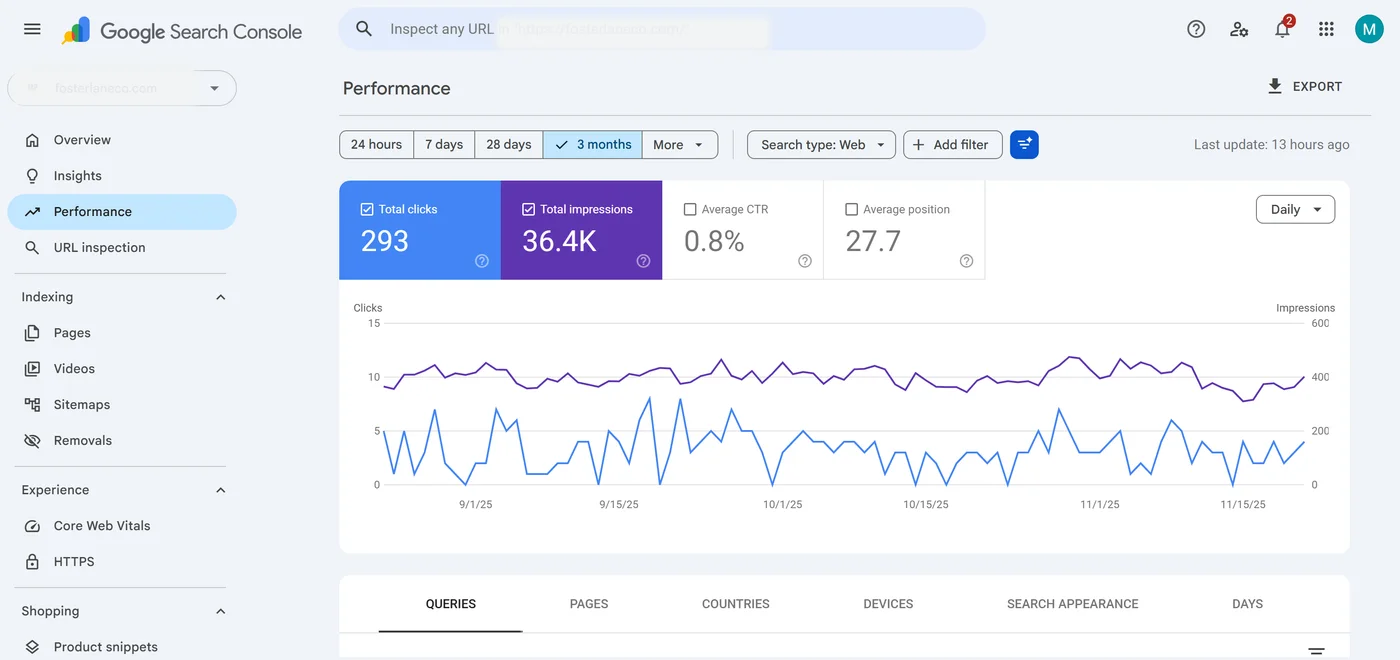
Month one: 12,021 impressions, 96 clicks, a 0.8 percent CTR, and an average position of 27.7. The practical issue was not a total absence of visibility; it was that existing visibility was producing relatively few clicks.
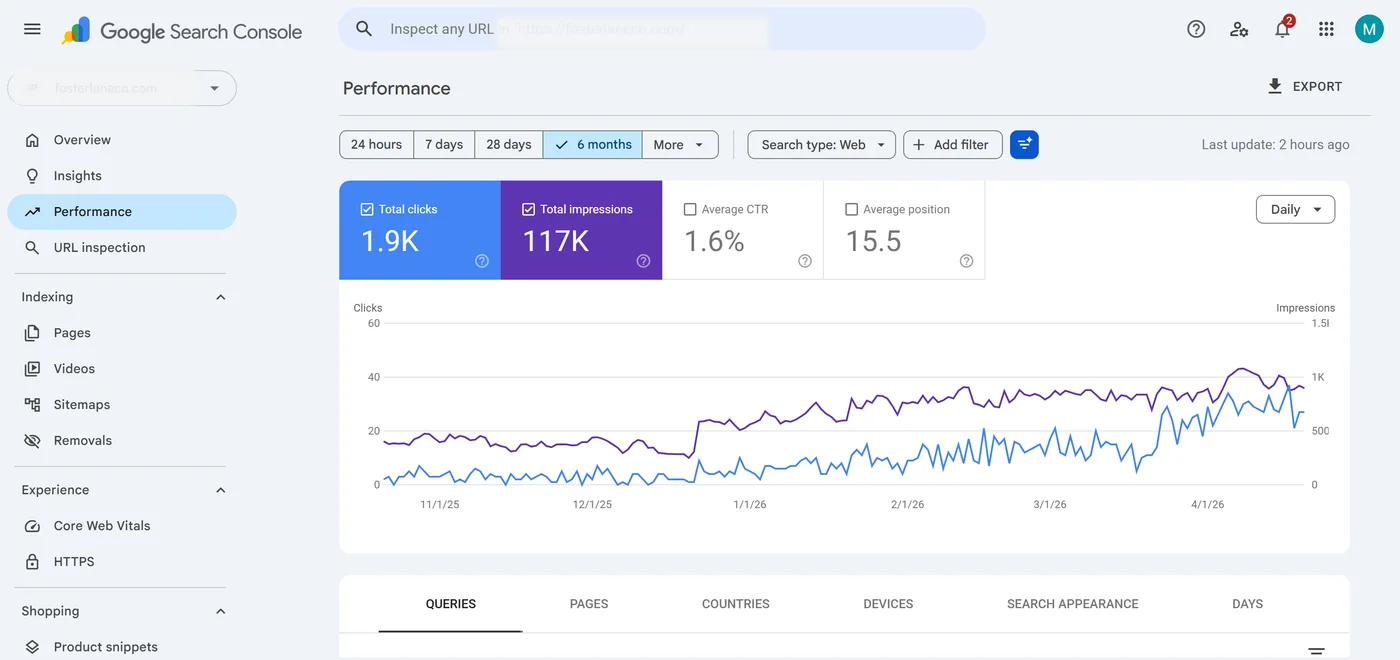
Month six: 27,475 impressions, 797 clicks, a 2.9 percent CTR, and an average position of 6. The scenario shows both greater visibility and a higher share of clicks from that visibility. Because the case is anonymized and representative, the figures should be used to understand the pattern and the sequence of decisions rather than as a promise of repeatable growth.
Across the same comparison, sessions moved from 81 to 728, tracked conversions from 3 to 27, and modeled job value from $960 to $8,640. Those metrics moved in the same general direction, which makes the scenario internally coherent, but the value model is not a substitute for reconciled booking, close-rate, or CRM revenue data.
Keyword Movement
Keyword review was organized by intent so gains and losses could be judged by their business relevance instead of by a single headline ranking.
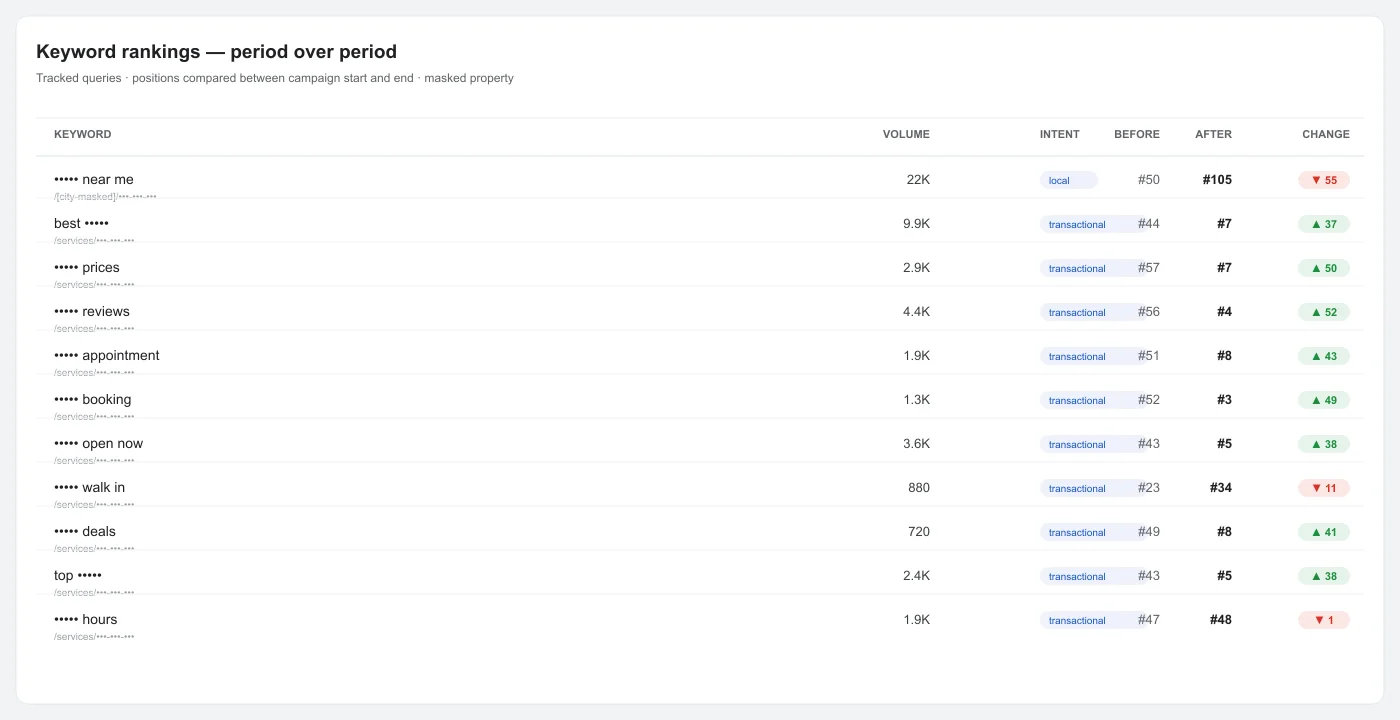
The masked query table retains the scenario's original volumes, intent labels, and tracked positions while withholding the client-identifying term.
| Query structure | Intent | Volume | Before | After |
|---|---|---|---|---|
| ••• near me | local | 22,000 | 50 | 105 |
| best ••• | transactional | 9,900 | 44 | 7 |
| ••• prices | transactional | 2,900 | 57 | 7 |
| ••• reviews | transactional | 4,400 | 56 | 4 |
| ••• appointment | transactional | 1,900 | 51 | 8 |
| ••• booking | transactional | 1,300 | 52 | 3 |
| ••• open now | transactional | 3,600 | 43 | 5 |
| ••• walk in | transactional | 880 | 23 | 34 |
| ••• deals | transactional | 720 | 49 | 8 |
| top ••• | transactional | 2,400 | 43 | 5 |
| ••• hours | transactional | 1,900 | 47 | 48 |
| local ••• | local | 3,600 | 35 | 8 |
| affordable ••• | transactional | 1,600 | 42 | 11 |
| ••• specials | transactional | 590 | 24 | 42 |
| ••• membership | transactional | 480 | 39 | 2 |
| ••• services | transactional | 1,000 | 33 | 5 |
The higher-value comparison and action-oriented structures were among the strongest movers in the scenario: terms corresponding to 'best', 'top', 'reviews', 'booking', 'appointment', and 'membership' moved from the 40s and 50s into much stronger tracked positions. That is consistent with the campaign's decision to consolidate commercial intent around a clearer destination page, but the table alone does not prove which individual change produced each movement.
Not every tracked term improved. The 'walk in' structure moved from 23 to 34 and the 'specials' structure from 24 to 42 after narrower legacy pages were consolidated or pruned. Those terms represented volumes of 880 and 590 in the scenario. The 'hours' structure moved from 47 to 48 and remained outside the priority set. These losses matter because consolidation should be evaluated as a portfolio decision: removing overlap can improve focus while still sacrificing visibility for some narrower variants.
The highest-volume local query is the clearest example of why one tracked position should not be overinterpreted. The 'near me' structure, recorded at 22,000 searches, moved from 50 to 105. The related 'local •••' structure moved from 35 to 8. Near-me results can vary with location, proximity, result type, and the local pack, so this case treats the tracked organic movement as volatile rather than converting it into an unsupported claim about total local visibility.
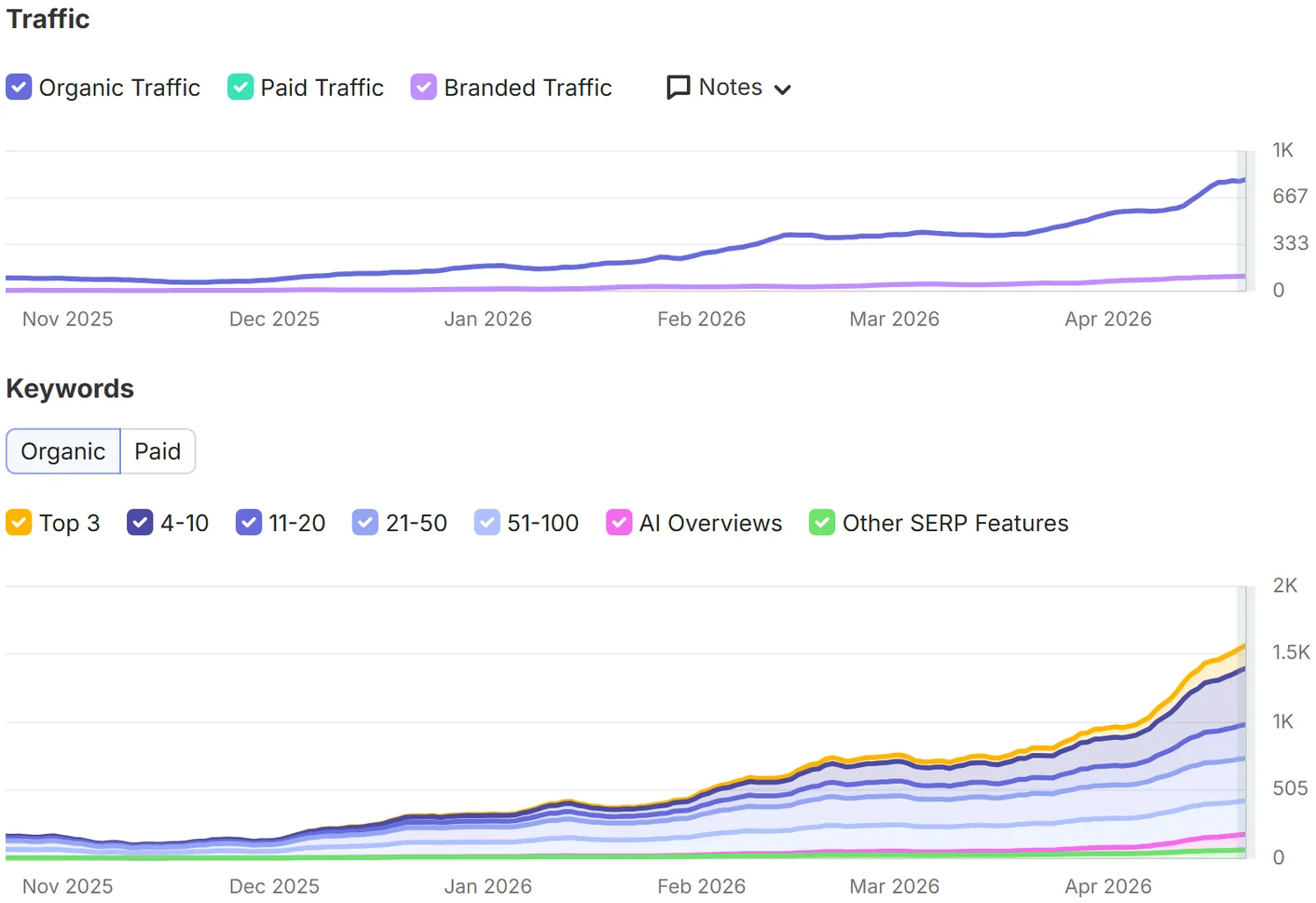
The third-party visibility view is a modeled view built for this composite scenario. Its direction is consistent with the internal topical authority index moving from 27 to 67 and the informational footprint reaching 674 keywords, but those measurements should not be represented as independently verified third-party proof.
Business Impact
The business-facing metrics moved with the search metrics, but they need the right caveats. Tracked conversions moved from 3 to 27, while modeled job value moved from $960 to $8,640. The revenue model uses an assumed average job value rather than reconciled CRM or booking revenue, so it is best used for directional planning instead of financial reporting.
The 34 articles across 7 clusters had two practical roles. They created useful entry points for owners researching repair and maintenance questions, and they created contextually relevant paths into commercial service pages. That can help a shop meet potential customers earlier in the decision process, but informational visits should not be described as guaranteed future bookings.
The tracked informational footprint reached 674 keywords. That footprint can continue attracting visits without a direct per-click media charge, although ongoing search visibility can rise or fall as competitors, content quality, search systems, and local demand change. The same 674-keyword figure therefore represents an asset to maintain, not traffic that is permanently secured.
The engagement also prepared answer-ready summaries and consistent entity information for search and AI answer surfaces. That work can improve clarity for systems that summarize web content, but it does not create a documented entitlement to inclusion in ChatGPT, Claude, Perplexity, Google AI Overviews, or any other response surface.
Limitations
This case has several boundaries that should shape any decision based on it. The early decline occurred during a period of consolidation and redirects, but the scenario cannot establish that those actions were the only cause. The tracked 'near me' position moved in the wrong direction, and local visibility cannot be reduced to one organic rank because proximity and local result formats can change what a searcher sees. Two narrower transactional variants also regressed after consolidation.
The value figures are modeled rather than reconciled to the client's booking system or close-rate data. Conversion timing may lag the first search visit, automotive demand can be seasonal, and third-party authority metrics are not business outcomes. This is also an anonymized composite case built from modeled metrics, so its screenshots and measurements are not externally verified client records. AI citation readiness is a design consideration, not a measured result.
Causal Explanation
A useful way to read the case is as a sequence of plausible contributions rather than a proof that one tactic caused every later metric.
Technical cleanup reduced avoidable ambiguity. Indexation, canonical, redirect, and duplication work aimed to give search systems clearer page versions to evaluate. In the scenario, average position became less erratic from month 3 after the earlier changes in months 1 and 2.
Consolidation and intent alignment gave commercial searches clearer destinations. The baseline showed 12,021 impressions and 96 clicks. The campaign reduced overlapping targets and rewrote destination pages around more specific intent groups so an impression had a better chance of reaching a page built for that decision.
Supporting content broadened the site's useful subject coverage. The 34 articles across 7 clusters coincided with the internal topical authority index moving from 27 to 67 and the footprint reaching 674 informational rankings. Those relationships support the working theory that stronger contextual coverage and internal linking helped commercial pages, but they do not by themselves establish direct causation.
Commercial ranking gains were associated with more sessions and a higher CTR. Several tracked comparison terms moved from the 40s and 50s into stronger positions while sessions moved from 81 to 728 and CTR reached 2.9 percent. That alignment is useful evidence that the traffic mix changed alongside ranking visibility.
Tracked conversions increased with the stronger traffic profile. Conversions moved from 3 to 27. Because the scenario does not include complete customer-level attribution, the correct conclusion is that conversion volume improved during the same period, not that SEO alone can be proven to have caused every booking.
Authority links were added later in the sequence. Digital PR and link recovery were active in months 4 to 6, while referring domains moved from 27 to 46. In this case design, those activities reinforced a structure that had already been consolidated rather than serving as the first intervention.
Key Takeaways
- Resolve overlapping commercial intent before expanding the site. New content is easier to evaluate when the existing destination pages already have distinct jobs.
- Use supporting content to answer real repair-owner questions. The 34 articles across 7 clusters were useful because they served concrete informational needs and connected naturally to service decisions.
- Review weak pages instead of treating publishing volume as the KPI. The later pivot focused on consolidation, pruning, and reinforcement where the page inventory had become less useful.
- Judge consolidation by the whole keyword portfolio. Some narrower terms can decline even when more valuable commercial groups improve, so the decision should account for trade-offs rather than celebrate only winners.
- Separate measurable search results from harder-to-measure local and AI visibility. Tracked rankings, local result exposure, and AI answer inclusion are different surfaces and should not be collapsed into one claim.