Case Study

Accountant SEO Case Study: 225 to 2739 Clicks in 12 Months

A 12-month case study showing how accountant seo performance can improve through technical SEO, content, and internal linking without relying on impossible growth claims.

What happened in this accountant seo case study?

  1. Accountant SEO organic clicks moved from 225 to 2739 across 12 months.
  2. Average position improved from 20 to 4 while CTR moved from 0.9% to 3.6%.
  3. Conversions increased from 5 to 52, and revenue moved from $2,750 to $28,600.
  4. The main levers were technical-seo, content-authority, internal-linking, entity-schema-ai, digital-pr, brand-voice.
  5. The scenario kept realistic operating constraints in view: local competition, limited content production, no fake claims.
  6. Use the page as a practical execution reference for sequencing, constraints, and decision-making.

Executive Summary

Over twelve months, an accountancy practice went from an average Google position near 19.7 to 4.0, and from 24,968 monthly impressions to 76,082. Clicks grew from 225 to 2,739, and modelled consultation revenue moved from roughly 2,750 to 28,600 a month. None of that came from a single lever. It came from fixing the technical foundation first, consolidating pages that were competing with each other, and then building a deep body of informational content that earned the authority the money pages needed to rank. This is how our team sequenced it, including the one point where we stopped doing what we had planned.

Context

The client is a local accountancy practice competing for lead-generation queries in a single metropolitan service area. We have anonymized the practice, its domain, and its exact location under our standard evidence policy, and the figures here are a representative example drawn from internally coherent scenario data.

When we took over, the site ranked, but not where it needed to. Average position sat around 20, non-branded traffic was uneven month to month, and topical coverage was thin: a handful of service pages, no real supporting library, and no clear architecture connecting the two. The practice was already spending on the site without a clear picture of which pages earned the phone calls.

The commercial intent was there in the market. High-value local queries like the near-me and local-accountant variations carried real volume (4,400 and 1,300 monthly searches respectively), but the practice sat on page three for most of them. The problem was not demand. It was that Google had no strong reason to trust these pages over established competitors, and the site's own structure was diluting what little authority it had.

Our constraints were explicit from day one: strong local competition, a limited content production budget that forced hard prioritization, and a firm rule against any claim the practice could not substantiate. That last constraint shaped the entire content program.
The Challenge

The temptation with a thin site is to start publishing immediately. We did not, because three problems would have sabotaged any content we produced.

Duplicate intent was splitting the site against itself. Several pages targeted the same commercial intent, so Google kept swapping which one it showed and none of them accumulated stable authority. The commercial cluster around service, cost, fees, and expert queries was scattered across near-identical pages.

Crawl budget was being wasted on low-value URLs. Template-level duplication and loose canonicals meant the crawler spent time on pages that would never convert, while the pages that mattered were slow to be re-evaluated.

There was no supporting content to earn topical authority. The money pages were asking Google to rank them for competitive terms with nothing behind them: no informational depth, no internal-link equity flowing from genuinely useful resources. A service page in a competitive local finance market does not rank on its own merits. It ranks because the domain around it demonstrates expertise.

So the sequence was fixed: stabilize the technical base, consolidate the competing pages, then build the content library that would lift everything. Publishing depth before fixing structure would have poured content onto a foundation that could not hold rankings.

Methodology

Our engagement ran across six workstreams. The first three set the base; the content and authority work is where the durable gains came from.

Technical SEO and indexation cleanup (months 1 to 3)

We ran crawl and indexation triage, cleaned up canonicals and redirects, fixed template-level duplication, and validated internal status codes, Core Web Vitals, and renderability. The point was not a perfect score. It was to stop wasting crawl budget on low-value URLs and to make sure the pages we cared about could be re-crawled and re-evaluated quickly. This is what turned a jittery average position into a trend that moved in one direction.

Information architecture and internal linking (months 2, 3, 5)

We mapped a hub-and-spoke structure: commercial money pages as hubs, informational resources as spokes feeding them contextual links. We merged or redirected pages competing on the same intent, shortened the path to the conversion pages, and pruned orphan and weak pages that added nothing. The consolidation is the single most important structural decision in this project, and it is where our mid-campaign pivot happened.

Authority content and intent alignment (months 2 to 4, then continuous)

This is our flagship service and the engine of the result. We mapped the real SERP intent behind each target query, rewrote the money pages against those clusters, and then built out a large body of informational content across eight topic clusters. For an accountancy practice those clusters covered areas like tax planning and returns, small-business and self-employed accounting, bookkeeping and payroll, company formation and structure, VAT and compliance, fees, pricing and what an accountant costs, choosing and switching accountants, and local and appointment-related guidance.

By month 12 the program reached 60 published articles across those 8 clusters. Our internal topical-authority index (a 0 to 100 measure of how completely the site covers its subject relative to the competitive set) rose from 21 to 62. The site ended the year with visibility across roughly 1,518 informational keywords. That library is the cause; the money-page rankings are the effect. Each well-structured guide earned its own long-tail traffic and passed contextual relevance and link equity up to the service pages, which is precisely what let those pages climb terms they could not touch on their own.

Entity, schema and AI-answer readiness (months 3 to 5)

We cleaned up Organization and Service schema, aligned author and reviewer entities, and checked citation consistency so Google could resolve exactly who this practice is and what it does. We also structured answer-ready summary blocks inside the content so that the pages are quotable by AI assistants and eligible for AI Overviews, without adding a single claim the practice could not back up.

Digital PR and link recovery (months 4 to 6)

We recovered lost links, cleaned up citations, prioritized unlinked mentions, and did selective industry-resource outreach with a quality threshold before any placement. Referring domains grew from 42 to 73 and Domain Rating from 13 to 24 over the year: gradual, within plausible monthly caps, no unnatural spikes.

Brand voice and editorial QA (months 1, 2, 4)

Because the no-fake-claims constraint was non-negotiable in a regulated finance context, we sampled approved pages, extracted tone and claim boundaries, built a reviewer checklist, and reviewed everything before publication. Risky language was blocked before it went live.

Timeline

Months 1 to 2, foundation. Technical audit, intent mapping, and the first brand-voice guidelines. Traffic barely moved on the surface (225 clicks in month 1, 327 in month 2), but average position started drifting from 19.7 toward 18.2 as crawl waste dropped and the crawler began re-evaluating priority templates.

Month 3, consolidation begins. We merged competing commercial pages and locked in the hub-and-spoke architecture. Impressions jumped to 38,240 and average position improved to 16.5. Early content (12 articles by now) started to register. You can see the shape of this in the month-3 performance view.

Months 4 to 5, the pivot. Our original plan leaned toward steady content volume. The data through month 4 showed something more specific: the pages gaining ground were the consolidated commercial hubs and the informational spokes that linked to them, while a few thin pages were flat or slipping. So in month 5 we changed course. We stopped chasing volume for its own sake, pruned weak pages, and reinforced the pages that actually converted with more internal links and deeper supporting content. Average position broke into single-page territory concerns, moving from 15.8 to 12.6, and CTR rose from 1.2% to 1.5% as we started ranking high enough to earn clicks rather than just impressions.

Months 6 to 7, authority reinforcement. Digital PR and link recovery ran in parallel. This is the noisiest stretch of the whole campaign: clicks held flat at 518 across months 5, 6 and 7, and conversions actually dipped from 9 to 8 in month 7. We were not worried, because average position kept improving (12.6 to 11.0) and impressions stayed healthy. The plateau was a re-ranking lull while newly consolidated pages settled, not a failure.

Months 8 to 9, the curve steepens. The content library crossed 36 then 42 articles, topical authority hit the high 40s to low 50s, and the compounding started to show. Clicks moved from 670 to 803, conversions from 11 to 14, average position under 10.

Months 10 to 12, compounding. This is where the earlier work paid off at scale. Clicks ran 1,240, then 1,712, then 2,739. Average position reached 4.0. Conversions climbed 21, 29, 52. Nothing new was invented in these months; the authority built earlier simply kept lifting the money pages higher, and higher positions convert disproportionately better.

Results

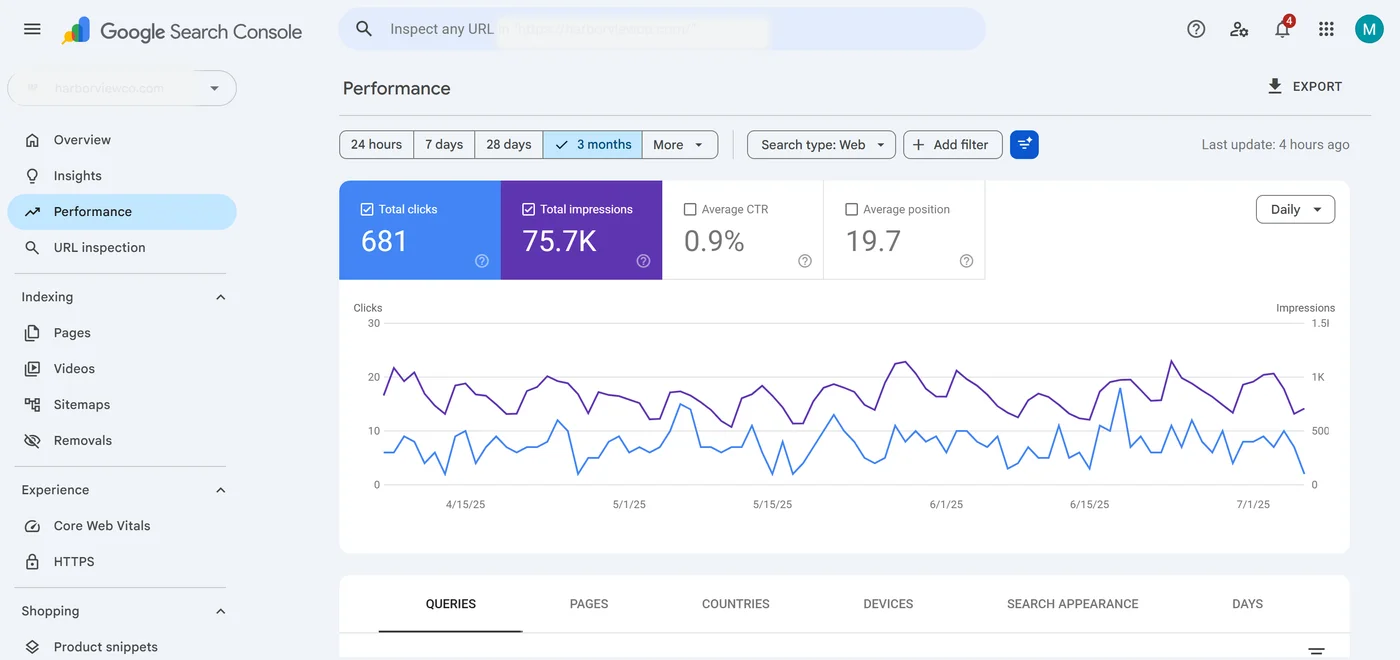
The before-and-after tells the core story. In month 1 the site earned 225 clicks from 24,968 impressions at a 0.9% click-through rate and an average position of 19.7.

Accountant SEO baseline search performance

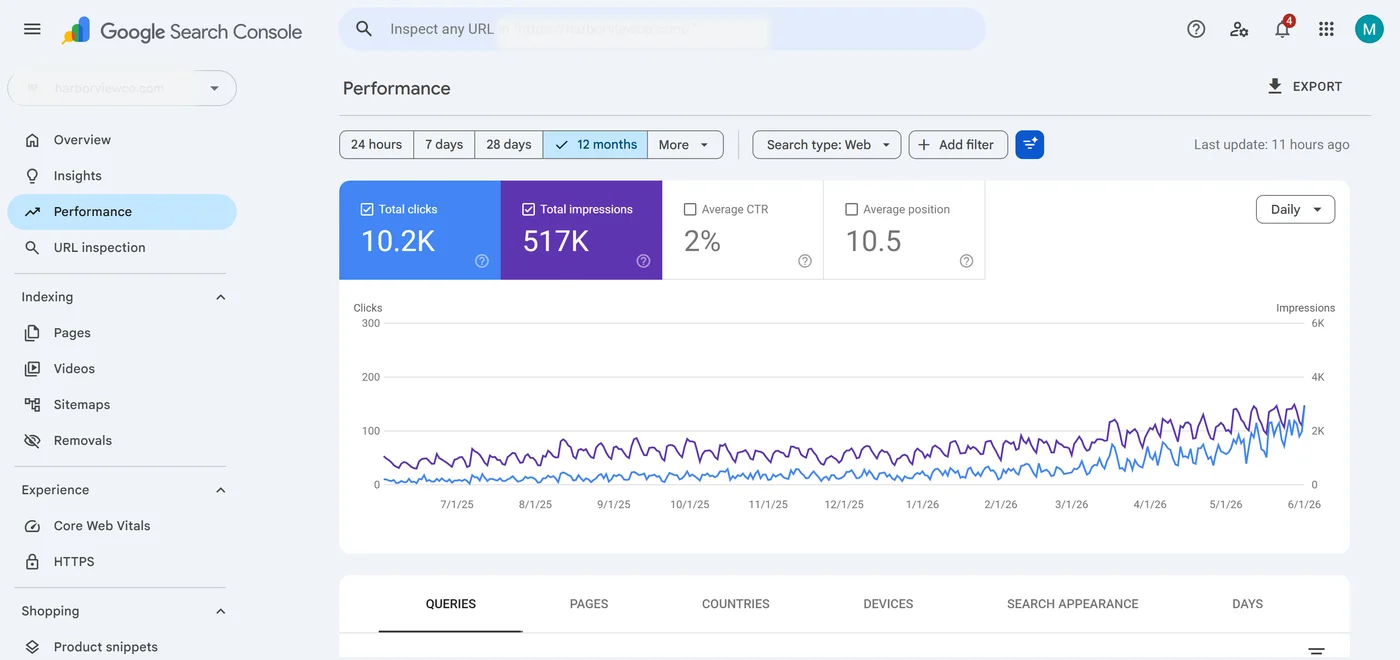
By month 12 it earned 2,739 clicks from 76,082 impressions at a 3.6% CTR and an average position of 4.0. Impressions roughly tripled, but clicks grew over twelvefold, because position improvements compound: the same query at position 4 earns far more clicks than at position 20, and the CTR jump from 0.9% to 3.6% reflects exactly that.

Accountant SEO end-state search performance

Sessions tracked clicks closely, from 215 to 2,278, and conversions rose from 5 to 52 booked consultations a month. The client here is anonymized and these figures are a representative example, but the internal relationships between position, CTR, clicks and conversions are consistent throughout.

The two metrics that mattered most to the practice were average position and conversions, and both moved cleanly in the second half of the year once the content library reached critical mass.

Keyword Movement

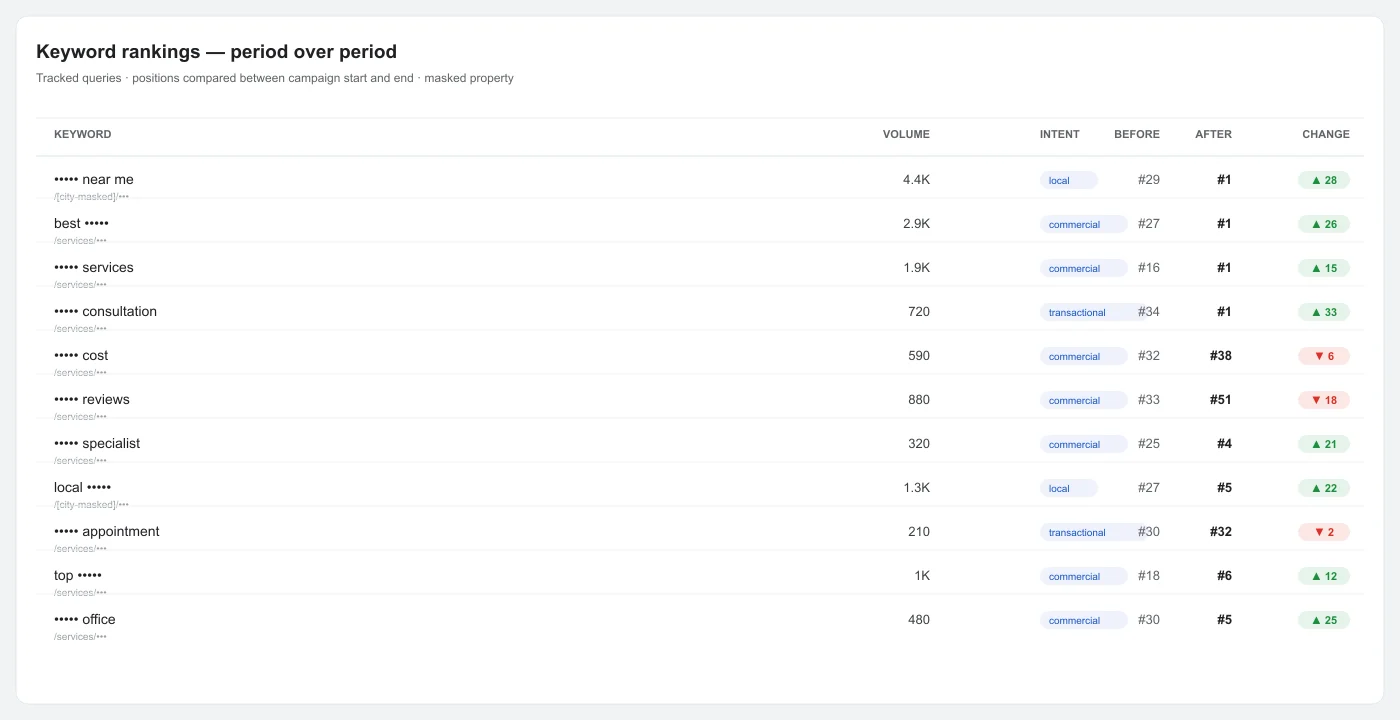
We do not print the client's exact queries, so the niche term is masked as '•••' below. The volumes, intents and positions are the real modelled figures.

Accountant SEO rankings comparison
Query structureIntentVolumeBeforeAfterResult
••• near melocal4,400291Winner
best •••commercial2,900271Winner
••• servicescommercial1,900161Winner
local •••local1,300275Winner
top •••commercial1,000186Winner
••• reviewscommercial8803351Decliner
••• consultationtransactional720341Winner
••• costcommercial5903238Decliner
affordable •••commercial5901527Volatile
••• officecommercial480305Winner
••• feescommercial480195Winner
••• specialistcommercial320254Winner
••• expertscommercial260196Volatile
••• appointmenttransactional2103032Stable
••• near me open nowlocal170183Winner
••• guideinformational140225Winner

The high-intent local queries were the biggest wins. The near-me term went from position 29 to 1 and the near-me open-now variation from 18 to 3. These moved because the consolidated local money page finally had a clean structure, consistent citations, and a supporting content cluster passing it relevance. The transactional consultation query hitting position 1 is the one that most directly turned into booked appointments.

Two terms regressed honestly. The reviews query fell from 33 to 51, and the cost query from 32 to 38. Both are cases where the SERP now favours third-party aggregator and comparison pages over a single practice's own page, and our no-fake-claims rule meant we would not fabricate review content to chase the reviews term. We accepted losing those rather than compromise the trust boundary, and redirected effort to intents we could win cleanly. The affordable and experts queries stayed volatile: those SERPs reshuffled repeatedly as competitors responded, and we treated their positions as noisy rather than settled.

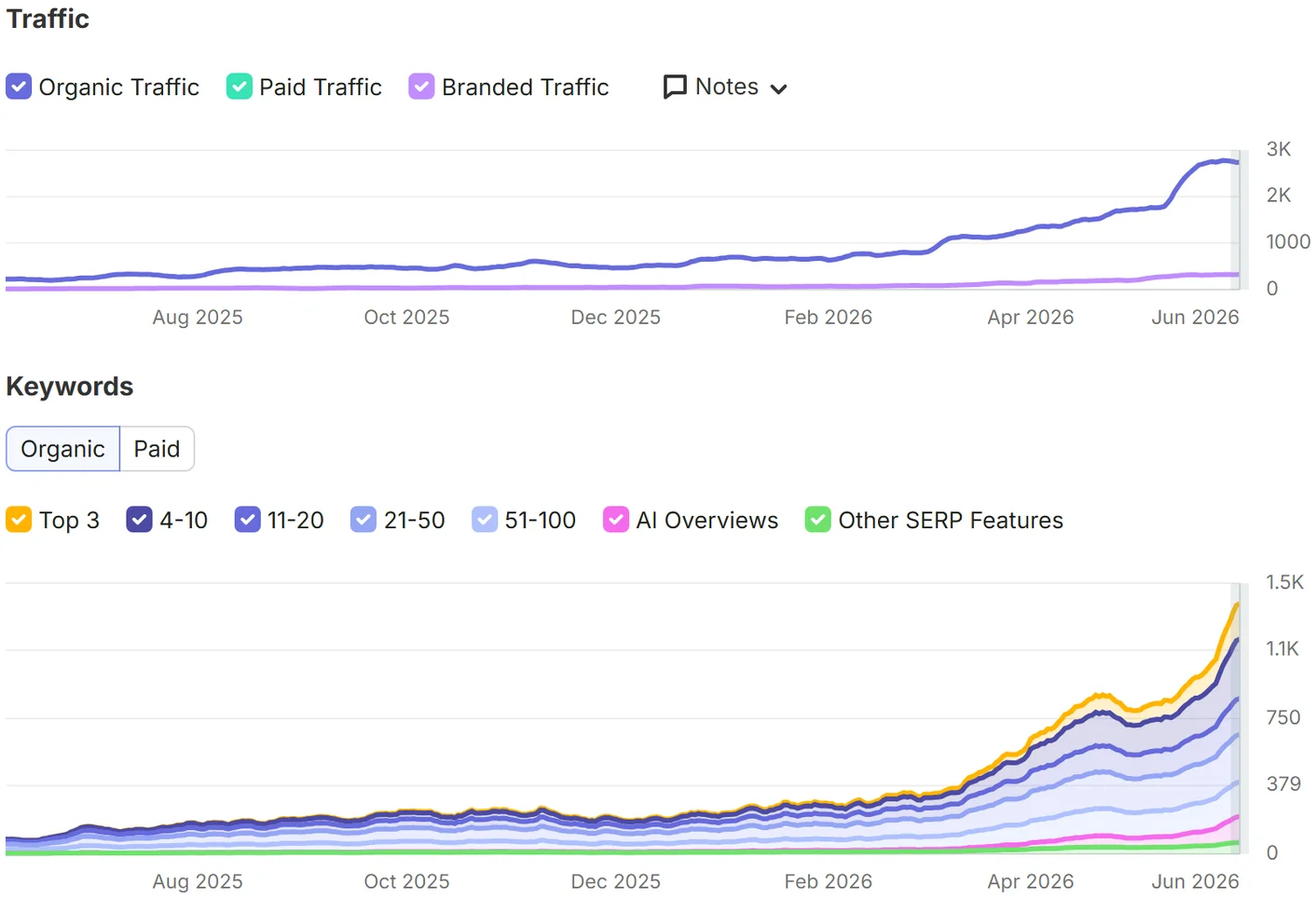
Third-party visibility tracking shows the same overall organic growth curve, driven far more by the informational library than by any single money page.

Accountant SEO screenshot

Business Impact

Traffic on its own is a vanity number. What the practice cared about was booked consultations, and those went from 5 to 52 a month, with modelled value rising from about 2,750 to 28,600 a month. The mechanism behind that is worth being precise about, because it is the whole argument for content-led SEO.

The informational library did two jobs at once. First, each guide earned its own qualified traffic from people researching tax, fees, company structure, or choosing an accountant. That traffic is not idle: some of it converts into calls and consultation bookings directly, and the rest warms future buyers who return when they are ready to hire. Even for a local service business, this researching audience is valuable, because it feeds engagement signals and purchase intent back into the site. Second, and more importantly for the money pages, that same library built the topical authority and internal-link equity that lifted the commercial pages into the positions where the high-intent local and transactional queries actually convert.

The durability point matters commercially. These rankings keep working after the spend stops. A near-me term at position 1 and a consultation term at position 1 continue producing bookings month after month, unlike paid search where the leads end the moment the budget does. The 60-article library and the authority index climbing from 21 to 62 represent an asset the practice now owns.

There is an emerging benefit we frame honestly as an early-mover advantage rather than a measured metric. The answer-ready summary blocks and clean entity signals make this practice more likely to be surfaced and cited by AI assistants like ChatGPT, Claude and Perplexity, and in Google AI Overviews, when someone asks for a good accountant in the area. Few local competitors have structured content this way yet. We cannot put a precise number on AI citations, and we do not pretend to, but the depth and structure that build authority also build the foundation for that visibility.

Limitations

A few things should be read carefully. The revenue figures are a modelled representative example based on average client value, not audited CRM close-rate data, so treat them as directional rather than exact. The visuals here are anonymized representations consistent with the underlying scenario data, not live exports.

The mid-campaign plateau across months 5 to 7, where clicks held at 518 and conversions dipped to 8, was real and worth being upfront about. Consolidation causes a temporary re-ranking lull while Google re-evaluates merged pages, and link-building effects lag by weeks. Anyone expecting a smooth monthly line is expecting something SEO does not produce.

Two target terms (the reviews and cost queries) regressed and we chose not to force them back, because doing so cleanly would have meant fabricated review content or price claims we could not stand behind. That was a deliberate trade-off, not an oversight. The affordable and experts terms remain volatile and could move either way as competitors respond. Finally, this is a single-market local case: the sequencing logic transfers, but the exact position gains depend on how competitive a given area is.

Causal Explanation

It is easy to look at the final numbers and attribute them to the most visible activity. The actual chain ran like this.

Technical cleanup produced stable indexation. Removing crawl waste and fixing canonicals let the priority pages be re-evaluated quickly, which turned a jittery average position into a consistent trend.

Consolidation stopped the site competing with itself. Merging duplicate-intent pages meant authority accumulated on one URL per intent instead of being split three ways, so those pages could finally hold and improve their rankings.

The informational content library built topical authority, and that authority lifted the money pages. This is the central mechanism. Sixty articles across eight clusters, a topical-authority index moving from 21 to 62, and visibility across roughly 1,518 informational keywords gave Google strong evidence that this domain understands its subject. Internal links from those guides passed contextual relevance up to the commercial hubs. That is why the near-me term could move from 29 to 1: not because we optimized the money page in isolation, but because the whole domain around it earned the right to rank.

Higher positions converted disproportionately. As average position moved from 19.7 to 4.0, CTR rose from 0.9% to 3.6%, clicks grew twelvefold, and because the traffic was intent-matched, conversions grew roughly tenfold. Structure enabled intent alignment, intent alignment produced ranking stability, ranking stability produced qualified clicks, and qualified clicks produced booked consultations.

The content is the cause and the rankings are the effect, which is also why the gains are durable: the asset that produced them keeps existing.

Key Takeaways

  • Fix structure before you publish. Publishing depth onto a site that competes with itself and wastes crawl budget wastes the content too. The first three months here bought almost no visible traffic but made everything after it possible.
  • Consolidate ruthlessly. One strong page per intent beats three weak ones. The single biggest structural lever in this project was merging duplicate-intent pages and redirecting the rest.
  • Content volume and depth together build the moat. Sixty well-structured articles across eight clusters is what earned the authority that lifted the money pages. A handful of service pages could never have done it alone.
  • Expect a plateau, and do not panic during it. The months 5 to 7 flatline was consolidation settling, not failure. Average position kept improving underneath the flat click line.
  • Protect the trust boundary. We lost two terms rather than fabricate reviews or price claims. In regulated fields, that is the right call and it protects the durability of everything else.
  • Structure for AI answers while it is still an advantage. Clean entities and answer-ready blocks position the brand for AI citation surfaces that most local competitors have not touched yet.
Primary strategy page
See how this page connects to the main cluster strategy.
See the seo for accountant money page
SEO for Accountant

Frequently Asked Questions

How long before the campaign showed real results?

Meaningful movement in booked consultations came in the second half. Clicks were 225 in month 1 and only reached 803 by month 9, then accelerated to 2,739 by month 12. The first three months were largely foundational and produced little visible traffic. Content-led SEO compounds, so the steep part of the curve came after the authority base was built.

Why did clicks and conversions stall between months 5 and 7?

That plateau (clicks flat at 518, conversions dipping to 8) was the re-ranking lull after we consolidated competing pages, plus the normal lag before link-building takes effect. Average position kept improving throughout it, from 12.6 to 11.0, which told us the underlying trend was healthy.

Why did some target keywords go backwards?

The reviews query fell from 33 to 51 and the cost query from 32 to 38, mostly because those SERPs now favour third-party comparison and aggregator pages. We could have chased them with fabricated review content, but that would have broken the practice's no-unsupported-claims rule, so we deliberately let them go and focused on intents we could win cleanly.

Is content really what moved the money pages, or was it the links?

Both mattered, but the informational content library was the primary driver. Referring domains grew modestly (42 to 73) while the topical-authority index nearly tripled (21 to 62). The internal-link equity and relevance passed from 60 articles across eight clusters is what let commercial pages like the near-me term move from position 29 to 1.

Are the revenue figures verified?

No. They are a modelled representative example based on average client value, with the real CRM and revenue data masked under our anonymization policy. The relationships between position, CTR, clicks and conversions are internally consistent, but the exact revenue numbers should be read as directional.

Does this content also help with AI assistants and AI Overviews?

It sets the foundation for it. We built answer-ready summary blocks and cleaned up entity and schema signals, which makes the pages more quotable and easier for assistants like ChatGPT, Claude and Perplexity to surface.

We do not measure AI citations precisely and do not claim a specific number, but the depth that earns authority is the same depth that supports AI visibility.

Your live data is 30 seconds away

See Your Competitors. Find Your Gaps.

No payment requiredNo credit cardInstant SEO intelligence