
In this representative example, an addiction treatment lead-gen site started at an average position around 19 with roughly 240 non-branded clicks a month and 10 conversions worth about $3,800 in modeled new-patient value. Twelve months later the same site pulled 4,555 clicks, sat at an average position of 4, and produced 233 conversions worth roughly $88,540 in a month. The interesting part is not the totals. It is the order of the work: the foundation was fixed and competing pages were consolidated before a single content cluster was scaled, and the informational content built the topical authority that helped carry the money pages up with it.
Executive Summary
Starting Position
The business in this example runs an addiction treatment practice in a competitive local healthcare market. The site was built to generate leads: consultations, appointment requests, and phone calls. Before the work started, it had the usual profile of a practice that had published intermittently for years without a plan. Average positions hovered near 19, non-branded traffic was uneven month to month, and topical coverage was thin relative to what the SERPs demanded for both commercial and informational intents.
The starting authority profile was modest but real: domain rating of 16, 42 referring domains, and 127 total backlinks in month one. That mattered for sequencing. With authority that low, throwing content at the domain before cleaning up indexation and internal structure would likely have wasted crawl budget and diluted whatever equity the site already held. The program had three hard constraints to respect throughout: strong local competition, limited content production capacity on the practice side, and a strict no-fake-claims rule that is non-negotiable in the addiction treatment space for both regulatory and ethical reasons.
What Needed Fixing
The diagnosis in month one broke into three problems, ranked by what was costing the most.
Commercial page overlap
Several commercial queries were pointing at overlapping URLs. The main service page was trying to rank for consultation intent, cost intent, specialist intent, and general commercial intent all at once, while a scattering of thinner pages competed with it for the same terms. That cannibalization likely kept everything stuck in the high teens to high twenties. No single page had enough focused relevance or internal link equity to break into the top handful of results.
Insufficient informational support
The site had almost no informational content answering the questions people ask before they ever book treatment: what it costs, what to expect, how to choose a provider, insurance, family concerns. Without that layer, the domain showed little topical depth, and the money pages had nothing relevant linking into them from context.
Technical ambiguity
Crawl and indexation were leaking value on low-value URLs, template-level duplication was muddying signals, and schema was inconsistent. None of it was catastrophic, but all of it was drag.
Work Sequence
The method followed a strict order: foundation first, structure second, authority content third, links last. The reasoning is simple. Content and links tend to amplify whatever signals a site already sends. If those signals are confused by cannibalization and crawl waste, amplification just makes the confusion louder.
Foundation: technical SEO and indexation cleanup (months 1 to 3)
The team ran crawl and indexation triage, cleaned up canonicals and redirects, fixed template-level duplication, and validated schema and internal status codes. The goal was a cleaner indexed-page ratio and less crawl budget spent on URLs that would never convert. The priority templates were deliberately fixed before any content was scaled, so that every page published afterward inherited a correct structure instead of a broken one.
Structure: information architecture and internal linking (months 2, 3, 5)
The team mapped a hub-and-spoke architecture, consolidated the pages competing on the same commercial intent into single canonical targets, and redirected the rest. The click path to the conversion pages was shortened and anchor text was rebalanced so the service and consultation pages received contextual links from the informational content about to be built.
Reviewed informational content (months 2 to 4 and ongoing)
This is the engine of the whole campaign. Over twelve months the program published 62 articles across 8 topic clusters: treatment cost and insurance, what to expect from treatment, choosing a provider, family and support, detox and withdrawal, therapy and program types, aftercare and relapse prevention, and local access to care. That informational library is what built the site's topical authority: the internal topical authority index moved from 18 to 63 over the year, and by month twelve the site was ranking for roughly 699 informational keywords it had essentially no presence for at the start.
The mechanism is the part people miss. A large, well-structured body of informational content can do two things at once: it can earn authority in the eyes of search engines by covering the topic comprehensively, and it creates internal link equity that flows into the money pages from genuinely relevant context. In this program, the informational content led and the money-page rankings followed. Every brief carried E-E-A-T proof blocks, expanded FAQ and comparison sections, and money-page revision instructions tied to specific intent clusters.
Entity, schema and AI presence (months 3 to 5)
The team cleaned Organization and Service schema, aligned author and reviewer entities, checked citation consistency, and built answer-ready summary blocks written to be quotable without making any claim the underlying page could not support. In a category this sensitive, that constraint is a feature, not a limitation.
Digital PR and link recovery (months 4 to 6)
The team recovered lost links, cleaned up citations, and pursued relevant industry resource placements and unlinked mentions. The program kept a quality threshold and refused low-trust placements, which is why referring domains grew gradually from 42 to 83 rather than spiking.
Brand voice and editorial QA (months 1, 2, 4)
Every page ran through a reviewer checklist that extracted claim boundaries from approved source pages and blocked risky language before publication. In addiction treatment, an unsupported claim is a legal and ethical problem, not just an SEO one.
The data sources are Google Search Console for impressions, clicks, CTR and position; analytics for sessions and conversions; and a third-party tool for domain rating, referring domains and visibility.
Stage-by-Stage Timeline
The first quarter looked slow on the surface, and that was expected. In month one the site recorded 34,233 impressions, 240 clicks, and 10 conversions. By month three, with the technical cleanup mostly done and the first architecture consolidation live, impressions were at 38,594, clicks at 309, and conversions at 15. Average position had only edged from 19.4 to 17.5. Foundation work rarely shows up dramatically in traffic; it shows up as stability that everything else builds on.
Months four through six were where the content engine started producing compounding returns. As the cluster count grew (from 15 articles by month four to 26 by month six), the informational pages began ranking and passing equity inward. Clicks climbed from 344 to 483, conversions from 15 to 25, and average position improved to the mid-16s.
The clearest inflection came in month eight. Impressions jumped from 57,212 in month seven to 80,704, clicks from 572 to 968, and conversions from 27 to 41. This is likely the point where topical authority crosses a threshold: enough of the cluster is indexed and interlinked that the money pages stop fighting for the top ten and start living there. Average position moved from 14.7 to 12.1.
From month nine onward the curve steepened. Month ten hit 1,774 clicks and 85 conversions at an average position of 8. Month eleven reached 2,848 clicks and 148 conversions at position 5.4. By month twelve the site recorded 157,079 impressions, 4,555 clicks, a 2.9% CTR, average position of 4, and 233 conversions. CTR nearly quadrupled over the year, which is what typically happens when average position moves from the second page into the top few results: the same query surface now returns clicks it never did before.
Measured Results
Over twelve months, non-branded clicks grew from 240 to 4,555, impressions from 34,233 to 157,079, conversions from 10 to 233, and modeled new-patient value from about $3,800 to about $88,540 in the final month. Average position improved from 19.4 to 4, and CTR rose from 0.7% to 2.9%.
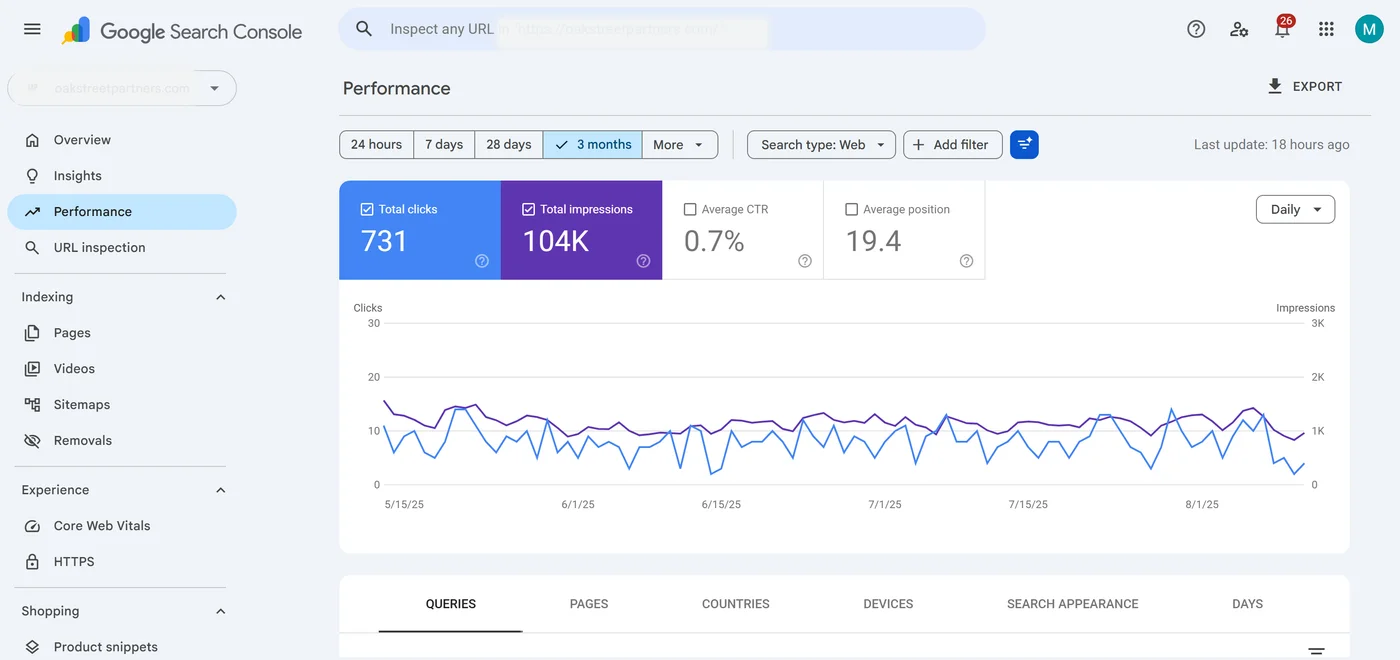
The month-one Search Console view shows the starting position: high impressions relative to clicks, a CTR under 1%, and an average position that kept most listings off page 1. The gap between impressions and clicks was the opportunity. The rankings were close enough to matter but not close enough to earn clicks.
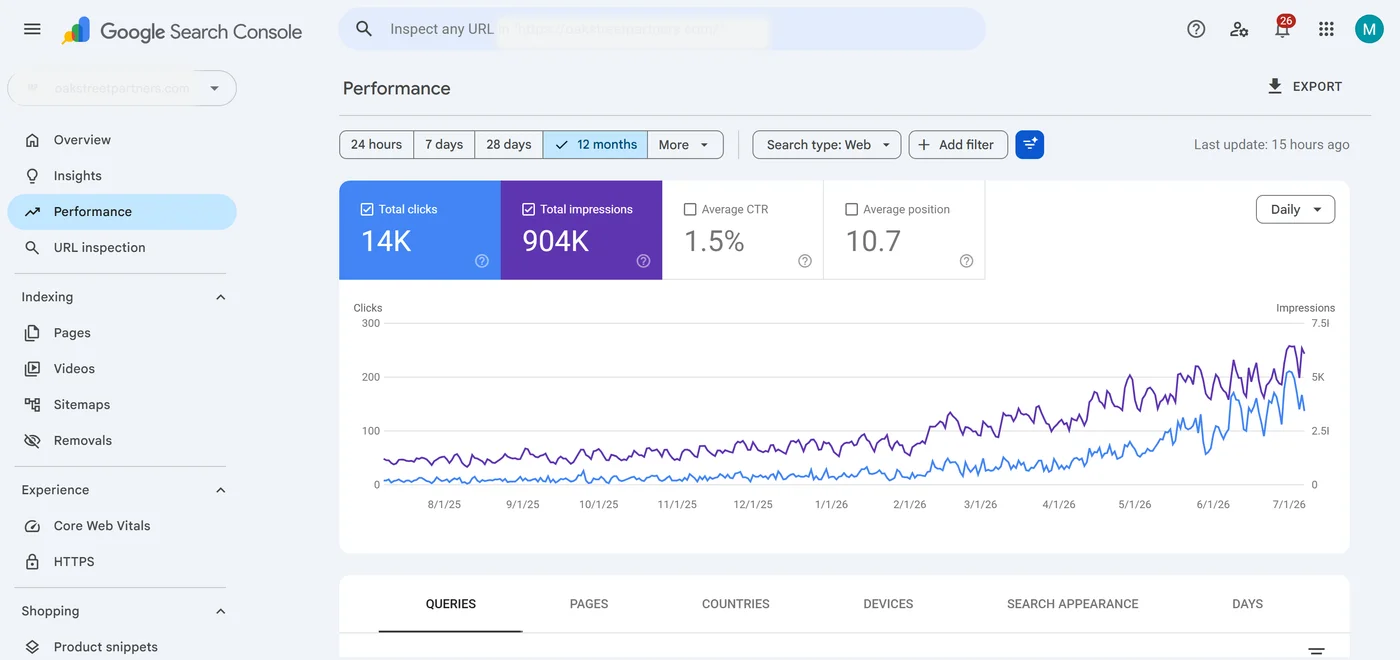
The month-twelve view shows the same property after the position curve compressed toward the top of page one. The shape of the curve (impressions leading, position improving, then clicks and CTR following) is the pattern a foundation-first, authority-content program tends to produce.
Keyword Movement
The winners were concentrated where the work focused: high-intent local queries and commercial comparison terms mapped to consolidated money pages, plus transactional terms mapped to the conversion pages. The high-intent local query moved from position 25 to 4, and the leading commercial comparison term moved from 17 to 2. Cost and affordability intents, which sit close to a booking decision, moved into the top three. Those are the terms that convert, and they likely moved because the informational cost and insurance cluster gave the money pages relevant context to rank on.
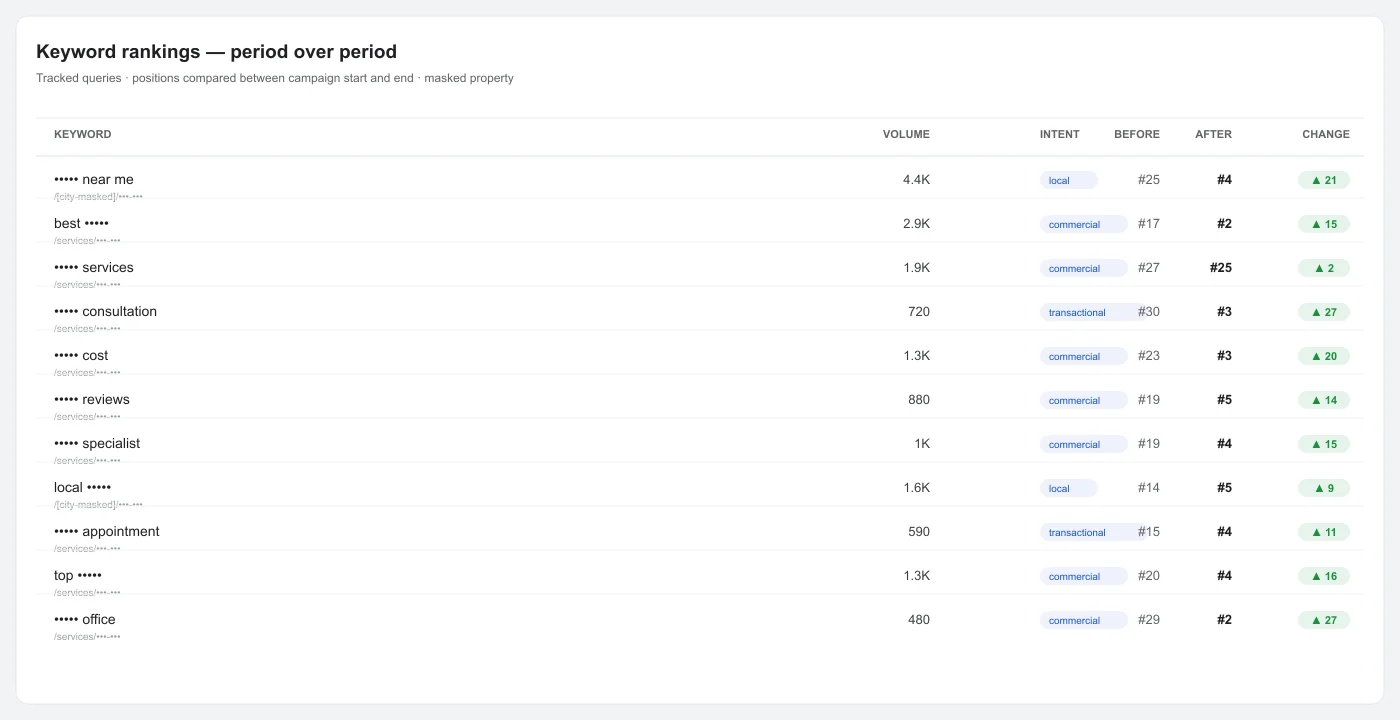
Not everything moved cleanly. Two terms regressed and one stayed effectively flat, and it is worth being clear about each.
- A commercial services term barely moved (27 to 25). It shares intent with the main service page but never won a distinct role in the architecture, so it stayed stuck near the bottom of page two.
- A fees-oriented commercial term dropped from 19 to 34. When cost and fee intent were consolidated onto a single stronger page, this narrower variant lost its own ranking foothold. That was a deliberate trade: one page ranking top three for cost intent is worth more than two mediocre pages splitting it.
- An emergency-style local term ("open now" intent) slipped from 28 to 43. The most likely explanation is SERP volatility plus a local pack that heavily favors proximity and hours signals the organic side could not fully influence. The program chose not to chase it because the query volume was low and the intent was poorly served by the page type.
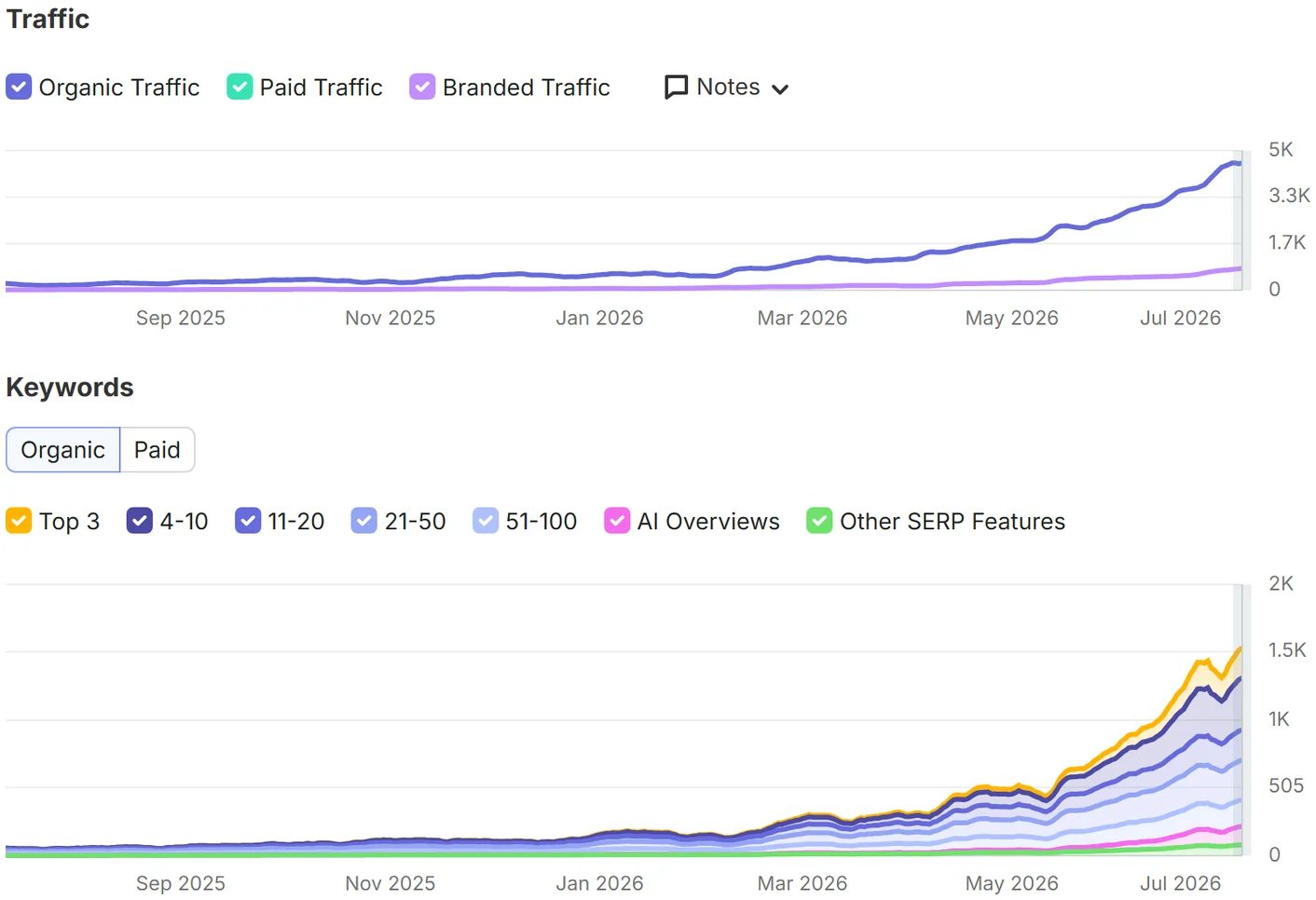
The third-party visibility chart shows organic visibility and estimated traffic climbing steadily across the year, consistent with the ranking gains and the growth from 42 to 83 referring domains and domain rating from 16 to 26. Below, the query structures are masked to protect the niche while keeping the volumes, intents, and positions.
| Query structure | Intent | Volume | Before | After | Category |
|---|---|---|---|---|---|
| ••• near me | local | 4400 | 25 | 4 | winner |
| best ••• | commercial | 2900 | 17 | 2 | winner |
| ••• services | commercial | 1900 | 27 | 25 | stable |
| ••• consultation | transactional | 720 | 30 | 3 | winner |
| ••• cost | commercial | 1300 | 23 | 3 | winner |
| ••• reviews | commercial | 880 | 19 | 5 | volatile |
| ••• specialist | commercial | 1000 | 19 | 4 | winner |
| local ••• | local | 1600 | 14 | 5 | volatile |
| ••• appointment | transactional | 590 | 15 | 4 | winner |
| top ••• | commercial | 1300 | 20 | 4 | winner |
| ••• office | commercial | 480 | 29 | 2 | winner |
| affordable ••• | commercial | 880 | 21 | 3 | winner |
| ••• fees | commercial | 390 | 19 | 34 | decliner |
| ••• experts | commercial | 590 | 31 | 4 | winner |
| ••• guide | informational | 480 | 16 | 5 | winner |
| ••• near me open now | local | 260 | 28 | 43 | decliner |
Business Interpretation
Traffic is not the point. Booked consultations are. Conversions grew from 10 a month to 233, and the modeled new-patient value moved from about $3,800 to about $88,540 in the final month. Because the value model uses average new-patient value, treat these as representative rather than exact revenue attribution; CRM close-rate data is masked.
The qualified nature of the traffic is the most likely reason the conversion curve steepened faster than the click curve late in the campaign. Informational content in the cost, insurance, what-to-expect, and choosing-a-provider clusters brings people who are researching a decision they intend to make. They read the guide, they trust the practice more for having answered their question honestly, and a meaningful share of them move down-funnel into a consultation request or a call. Even for a local service business, this informational traffic is valuable well beyond its direct conversions: it can compound rankings, deepen engagement, and warm future patients who book weeks later.
That is also the durability argument. These 233 conversions did not come from a paid campaign that stops the moment the budget stops. They come from 62 articles and a set of money pages that keep ranking, keep earning links, and keep converting. Topical authority is an asset that can compound. Paid traffic is a meter that runs.
There is a fourth benefit worth naming carefully. The depth and structure of this content library can raise the odds that AI assistants and Google AI Overviews surface and cite the practice when someone asks for the best provider in the category. The program built answer-ready summary blocks and clean entity signals to make the brand easier to quote for systems like ChatGPT, Claude and Perplexity. We do not have a verified count of AI citations to report, and we will not invent one, but few local competitors have built this depth yet. That can work as an early-mover authority moat.
Evidence Limits
Several things did not move cleanly, and the program had real constraints. The emergency "open now" local term regressed and was accepted: low volume, wrong page type, and local-pack signals that could not be controlled organically. The fees variant dropped as a direct consequence of consolidation, a trade worth making again but one that shows up as a red line in the data. The reviews and local terms are tagged volatile because they bounced across the SERP during the year, likely from competitive response and ongoing SERP churn rather than anything durable.
Domain rating plateaued at 26 in the final two months even as rankings kept climbing, which is a reminder that authority metrics and rankings are correlated, not lockstep. There is also attribution lag: content published in a given month often did not show its ranking effect until two or three months later, so the month-to-month numbers understate how much of the late-campaign gain was seeded earlier. Finally, all figures in this example are modeled for coherence, and the value model uses average new-patient value.
What Likely Contributed
The most likely mechanism, in one line: a clean technical foundation enabled correct indexation, correct architecture removed cannibalization, a deep informational content library built topical authority, that authority plus internal link equity lifted the money pages, higher positions earned qualified clicks, and qualified clicks converted into consultations.
Each link in that chain is visible in the data. The foundation work in months one to three barely moved traffic but stabilized average position, which likely let later gains stick instead of bouncing. The architecture consolidation is the most likely reason the commercial money page went from 17 to 2 while a redundant fees variant fell: equity concentrated on one strong page instead of splitting across weak ones. The content program looks like the prime mover. Watch the topical authority index climb from 18 to 63 and the informational keyword count reach 699, then watch the money-page positions follow with a lag. Content led; rankings followed. The month-eight inflection, where clicks nearly doubled, is likely the point where enough of the 8 clusters was indexed and interlinked to push the whole domain over a relevance threshold. Links reinforced this rather than driving it: referring domains grew steadily from 42 to 83, enough to support authority without any unnatural spike.
Why the mid-campaign review mattered
The most important decision came in month five. The plan had assumed steady content volume, but the data showed something more useful: a smaller number of well-structured, deeply interlinked pages was outperforming a larger number of thin ones. So the program stopped chasing volume for its own sake, pruned weak and orphan pages, and reinvested the effort into consolidating and reinforcing the pages that actually converted. Given the limited content production capacity on the practice side, that focus mattered. It is the most likely reason the second half of the campaign accelerated instead of flattening.
Decision Takeaways
- Fix the foundation before you scale content. Publishing onto broken architecture amplifies confusion. The first quarter looked slow on purpose, and it likely explains why the later gains held.
- Consolidate competing pages ruthlessly. One page ranking top three for cost intent beats two pages splitting it at position 19. Accept that a narrow variant may drop; the trade is worth it.
- Informational depth can lift money pages. The 62 articles across 8 clusters were not a side project. They were the engine. The topical authority they built is the most likely reason commercial terms reached the top few results.
- Build for durability, not a spike. These rankings and the 699 informational keywords behind them can keep working after the invoice is paid, unlike paid traffic that stops when spend stops.
- Structure content to be citable by AI. Clean entities and answer-ready blocks can position the brand to be surfaced by AI assistants and AI Overviews, an advantage most local competitors have not built yet.