
The baseline showed 74 clicks and 2 tracked conversions from 9,263 impressions. The central issue was unclear commercial page ownership rather than a simple shortage of content. At the later checkpoint, the anonymized account recorded 271 clicks, 239 sessions and 8 booked consultations, while average position changed from 25.5 to 11. The useful lesson is the sequence: technical ambiguity and overlapping intent were addressed before the reviewed resource library expanded, and relevant internal paths were concentrated on one surviving commercial destination. The case keeps flat and declining queries visible so the observed change is not mistaken for a universal consolidation rule. Search performance also remains separate from clinical efficacy, safety or suitability.
Executive Summary
Starting Position
The scenario concerns a single-location anti-aging and longevity practice in a competitive metropolitan market. The site supports consultation enquiries, but booked appointments are lead events rather than clinical outcomes. Average positions sat around 25 and the editorial footprint was shallow, leaving prospective patients with limited reviewed information around services, diagnostics and pre-consultation questions.
Publishing capacity was constrained by medical review. The clinic could support a limited stream of carefully checked content, so prioritization mattered more than raw output. A page needed a clear purpose, evidence-aware wording and an owner capable of keeping it accurate after publication.
The authority profile remained modest: Domain Rating moved from 18 to 20 by month 3, referring domains from 25 to 32, and total backlinks from 121 to 154. Those figures help bound attribution because the broader search movement occurred without a dramatic link-profile jump. They are context, not a guaranteed explanation.
What Needed Fixing
The audit in month 1 produced three findings, each pointing to a different decision rather than a generic request for more pages.
Commercial intent was divided. Several URLs answered substantially the same service question. A tracked commercial query could appear around position 31 and then rotate as another URL was selected, so page ownership needed clarification.
Indexation and internal paths were noisy. Parameterized duplicates, redirect chains and 4xx destinations made preferred paths less explicit. Adding new material before cleaning that structure would have expanded an already ambiguous crawl and internal-link graph.
The educational layer was missing. Prospective patients had few reviewed resources explaining services, diagnostics, cost differences or pre-consultation questions. That reduced informational usefulness and the number of relevant internal paths into the primary service page.
The baseline of 2 tracked conversions reinforced the priority: resolve architecture and claim boundaries before asking a constrained clinical-review workflow to produce more material.
Work Sequence
Month 1: establish preferred URLs and review boundaries
The first sprint covered crawl and indexation triage, canonical cleanup, redirect simplification, template duplication, renderability, Core Web Vitals review and internal status-code validation. Existing schema was checked for conflicting entity information. The objective was to make preferred pages clearer before more healthcare content entered the site.
Each tracked query was then assigned exactly one intended destination. Commercial intent went to one surviving service page, local intent to the genuine location page, and educational questions to the resource library. This turned a vague cannibalization concern into explicit page ownership.
Editorial boundaries were also set before drafting. Reviewers worked from approved material to define acceptable wording around services, expected experiences, credentials and outcome-sensitive claims. Search optimization does not validate medical statements, so appropriate clinical review remained necessary.
Months 1 to 3: build six connected themes rather than isolated posts
The program published 15 articles across 6 topic clusters: hormone and endocrine health, skin and aesthetic rejuvenation, metabolic and weight management, IV and nutrient therapy, longevity diagnostics and lab panels, and cost, financing and insurance questions. Five pieces landed in month 1, four more in month 2, and six in month 3. The aim was reviewed coverage around real research needs rather than output for its own sake.
The modeled informational footprint reached 165 keywords, while an internal topical-authority measure moved from 27 to 36 by month 2 and 45 by month 3. Those figures are internal operating diagnostics, not official search-engine scores. Their value is to show that subject coverage became more organized.
The primary service page was revised to answer commercial research intent more directly with clearer fee explanation, reviewer context, comparison structure and frequently asked questions. Those elements were selected for reader usefulness rather than as presumed ranking triggers.
Month 3: merge overlap, prune weak pages and reinforce trusted paths
The architecture decisions from month 1 were implemented. Overlapping pages were merged or redirected, thin keyword-holder pages were removed, and the path from supporting content to the booking flow was shortened. Internal anchors were diversified to describe context naturally.
Entity and Service markup were cleaned up, citation consistency was reviewed, and concise answer summaries were added only where the underlying page supported the wording. A limited link-recovery and citation effort added 7 referring domains in the observed window. That modest change is treated as one concurrent factor, not as a sufficient explanation for the search movement.
Stage-by-Stage Timeline
Phase one: technical cleanup before expansion
Month 1 was treated as a setup period rather than a ranking success story. The work was indexation triage, canonical and redirect cleanup, the template duplication fix, and the intent map. The only content shipped was the first five cluster articles, deliberately weighted toward diagnostics and hormone health because those clusters had the clearest question sets and the least reputational risk. Average position was still deep in the twenties at the end of the month.
Phase two: reviewed coverage begins to register
Through month 2, the informational library expanded and the first internal linking pass went live. Impressions grew because the site began appearing for question queries it had never touched, and average position improved as the cleaned templates let the priority URLs be crawled consistently. CTR moved from 0.8 percent to 1.0 percent, which is a small number that mattered: it confirmed that improved positions were reaching ranges where people actually click, rather than the site simply appearing more often for irrelevant terms.
The pivot: move limited capacity from breadth to consolidation
Our original plan for month 3 was more articles. The query review supported a different allocation. Query-level review showed the newest thin posts accumulating impressions with almost no clicks, while the cluster hubs that had been expanded with comparison tables and fee explanations were pulling both clicks and assisted conversions. At the same time, the tracked superlative comparison query was sliding, and the SERP for it had filled with third-party roundup pages the clinic cannot appear in.
So we changed the allocation. Part of the month-3 publishing budget went into consolidation and pruning instead: merging duplicate-intent pages, retiring pages that existed only as keyword holders, and deepening existing hubs rather than starting new ones. We also stopped writing toward the superlative comparison query entirely and moved that effort to cost, affordability and reviews intents, where a first-party page could answer the question directly without unsupported superiority claims.
Phase three: the merged architecture begins to settle
The remaining month-3 work was the architecture merge, the entity and schema cleanup, and the link recovery pass. This is the month where the ranking distribution changed shape: instead of a dozen queries clustered in the thirties, the commercial set spread across positions 2 to 17, and the booking flow began receiving more traffic from commercially relevant queries rather than only broad research demand.
Measured Results
The two Search Console snapshots use the same anonymized account and non-brand filter.
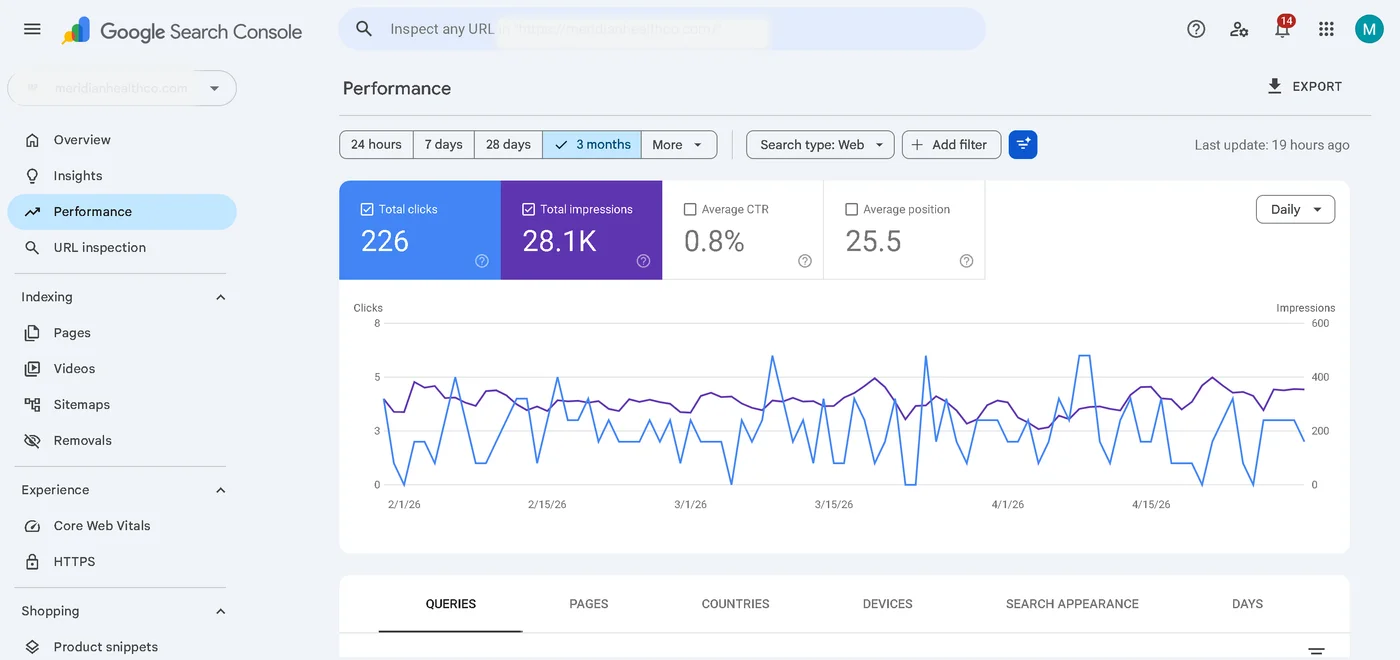
Month 1 baseline: 9,263 impressions, 74 clicks, 0.8 percent CTR, average position 25.5. Analytics recorded 68 sessions and 2 tracked conversions. That profile is consistent with a site receiving visibility while many listings remained outside strong organic click positions.
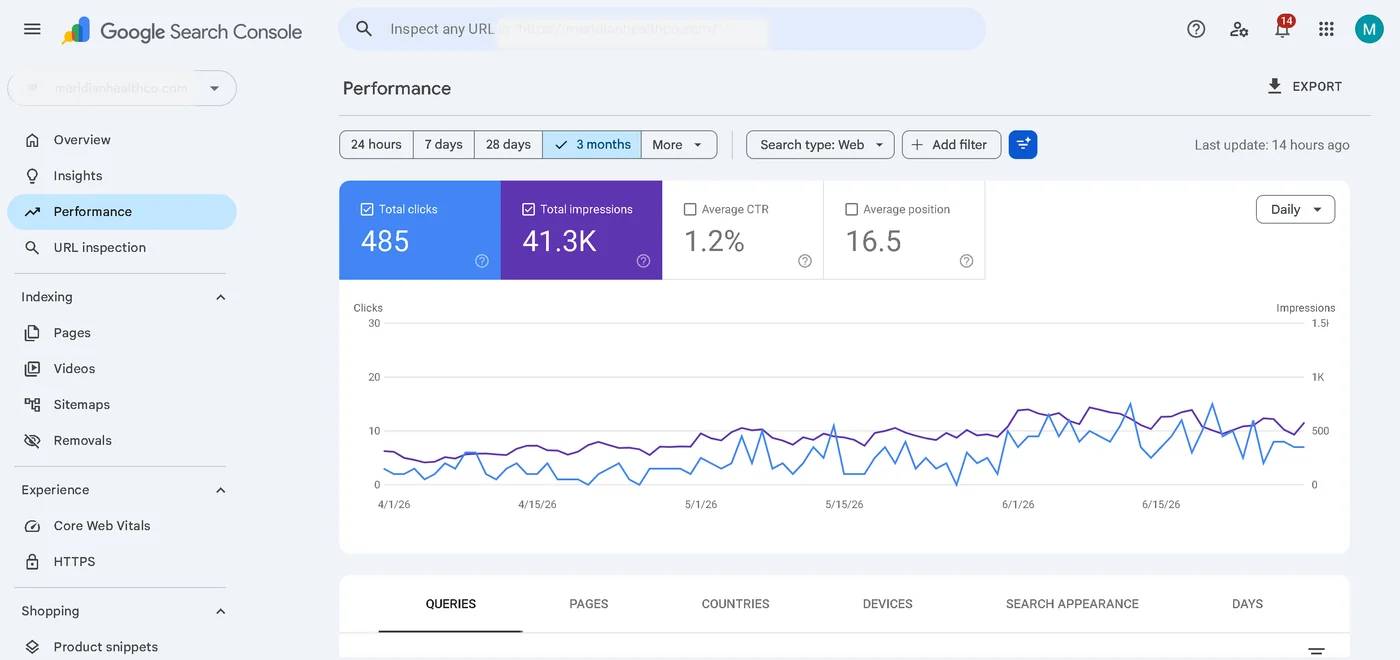
Month 3: 18,035 impressions, 271 clicks, 1.5 percent CTR, average position 11, with 239 sessions and 8 tracked conversions. Clicks were 3.7x the baseline while the impression base also expanded. That pattern is consistent with broader query coverage and stronger average visibility, but it does not isolate one cause.
The account remains anonymized, and the figures are representative of the observed scenario rather than independently verified third-party proof.
During the same period, Domain Rating moved from 18 to 20, referring domains from 25 to 32, and total backlinks from 121 to 154. A 2-point authority change alongside a 14-position average movement is one reason the case treats technical work, architecture, content and links as concurrent contributors rather than reducing the story to backlinks.
Why clicks and sessions do not match
Sessions (239) are lower than clicks (271) in month 3. Search clicks and analytics sessions use different measurement systems, so the discrepancy was retained rather than artificially reconciled. It did not change the page-level decisions made from the broader pattern.
Keyword Movement
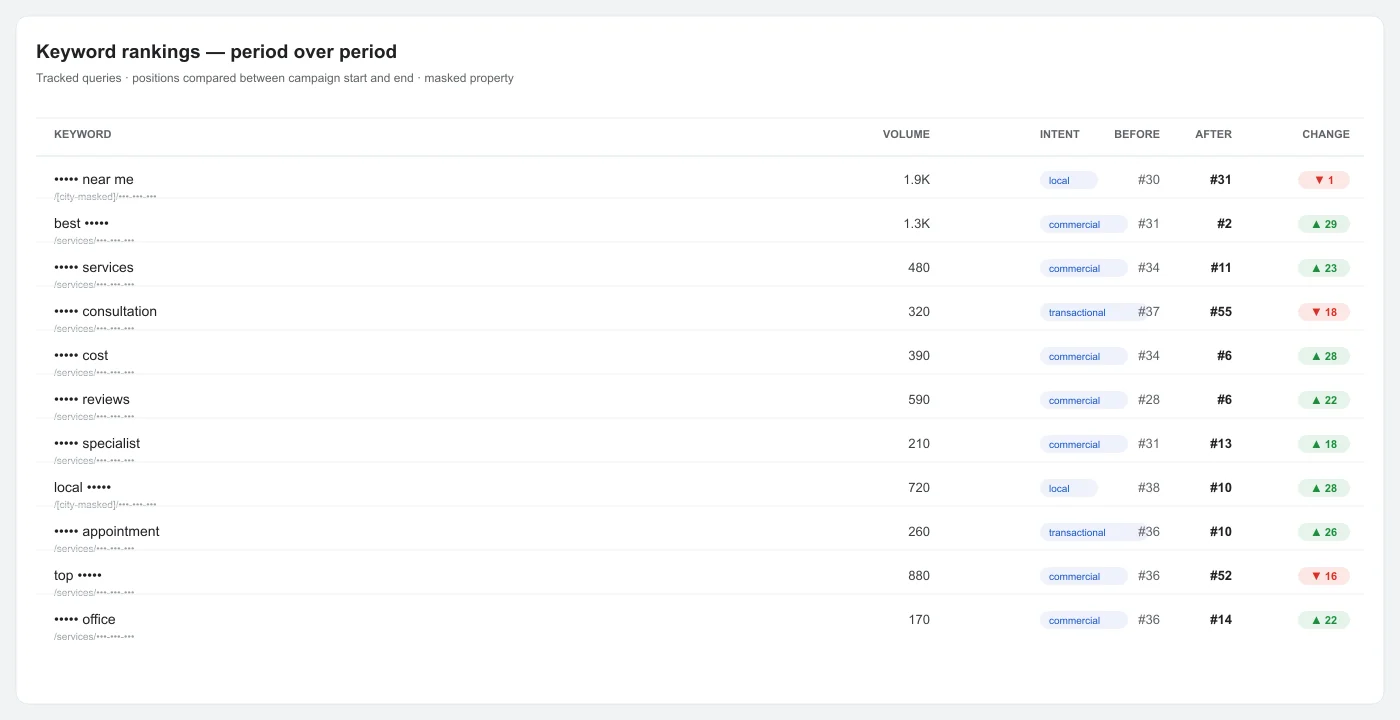
The niche wording remains masked, while the table preserves the supplied volumes, intents and tracked positions so improvements, flat terms and regressions can be evaluated together.
| Query structure | Intent | Volume | Before | After | Read |
|---|---|---|---|---|---|
| best ••• | Commercial | 1,300 | 31 | 2 | Consolidated page became the tracked commercial destination |
| ••• near me | Local | 1,900 | 30 | 31 | Essentially flat in this organic snapshot |
| top ••• | Commercial | 880 | 36 | 52 | Deprioritized after third-party roundups dominated the observed SERP |
| local ••• | Local | 720 | 38 | 10 | Local and commercial page roles were separated |
| ••• reviews | Commercial | 590 | 28 | 6 | Improved in the same period as stronger reviewer context |
| ••• services | Commercial | 480 | 34 | 11 | Service intent consolidated on one URL |
| ••• cost | Commercial | 390 | 34 | 6 | Cost explanation and supporting content expanded |
| affordable ••• | Commercial | 390 | 37 | 9 | Related price framing improved in the same period |
| ••• consultation | Transactional | 320 | 37 | 55 | Dedicated page was merged and redirected |
| ••• appointment | Transactional | 260 | 36 | 10 | Volatile; snapshot-dependent |
| ••• fees | Commercial | 260 | 34 | 17 | Volatile, still stabilizing |
| ••• specialist | Commercial | 210 | 31 | 13 | Tracked alongside clearer reviewer and entity context |
| ••• office | Commercial | 170 | 36 | 14 | Improved with the consolidated commercial destination |
| ••• near me open now | Local | 140 | 29 | 6 | Longer local variant improved |
| ••• experts | Commercial | 140 | 25 | 6 | Strongest starting position, retained a top-10 endpoint |
| ••• guide | Informational | 110 | 18 | 10 | Informational hub expanded with reviewed depth |
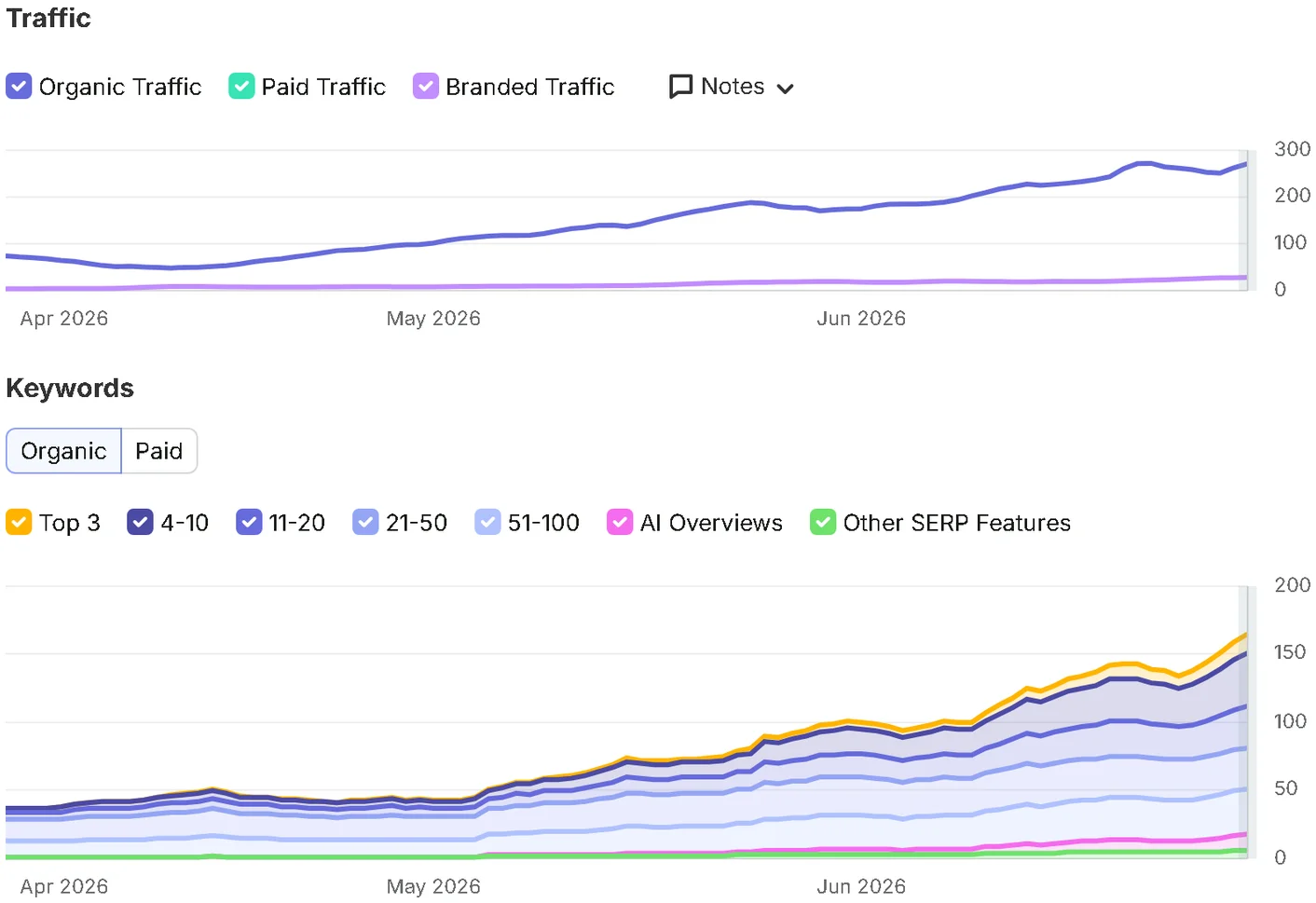
The third-party-style visibility view covers the same period and is best treated as a directional cross-check rather than independent verification of causation.
Reading the trade-offs
The commercial set shows broad improvement after the page-role changes, but the table should not be read as proof that one structural change caused every movement. Price, affordability, review and expertise queries all changed during the same window as the cluster and internal-link work, so the most defensible interpretation is a contribution pattern rather than a single-factor result.
The regressions remain part of the decision record. The transactional consultation query dropped from 37 to 55 because we retired its dedicated page. The trade-off was accepted because the redirected traffic lands on a page that now ranks 2 for the highest-volume commercial term, and the transactional variant of the same intent recovered to position 10 on its own. The superlative comparison query fell from 36 to 52 because we stopped working on it after the SERP shifted to aggregator content; that decline reflects the allocation decision rather than an attempt to manufacture a superlative claim.
The flat head local term needs separate diagnosis. At 1,900 monthly searches it is the most valuable query in the set, and it did not move (30 to 31). The observed result includes a prominent map-pack environment, so organic position alone does not represent total local visibility. Two longer local variants moved sharply (38 to 10, and 29 to 6) within those separate organic result sets. Any next phase should evaluate review, profile and proximity-related local factors separately instead of assuming more informational content will solve the head term.
Business Interpretation
Tracked booked consultations move from 2 to 8 per month, while modeled value moves from 760 to 3,040 using the practice's stated average new-patient value. The model is directional rather than reconciled revenue, and it does not represent clinical outcomes.
Clicks are 3.7x the baseline while the strongest price-oriented terms end at positions 6 and 9. That combination suggests a larger share of search traffic was arriving through commercially relevant queries, but the case does not assume every visitor became a patient or that ranking position alone caused a booking.
The informational library reaches 165 tracked keywords and contains 15 articles across 6 clusters. Its practical role is to answer common research questions before a consultation and create relevant internal paths into commercial pages. The internal topical-authority measure moves from 27 to 36 to 45, but it remains an internal operating metric rather than a documented search-engine score.
For a clinic with constrained review capacity, the decision lesson is to favor reviewed depth and clear page roles over raw output. Useful information, medical claim boundaries and maintainable architecture matter more than assuming content will compound indefinitely.
AI visibility remains unmeasured. Clear entity information, reviewer context and attributable summaries may improve machine interpretation, but this case contains no verified AI citation count or recommendation outcome. An AI surface is not evidence of clinical quality.
Evidence Limits
The observation window is only 3 months, and major consolidation landed late in that period. Two tracked queries remain volatile, including a term moving from 36 to 10 and another from 34 to 17, so the endpoint is a snapshot rather than a settled plateau.
The value model uses tracked consultations rather than CRM-confirmed revenue or patient outcomes. Search visibility, booked enquiries, attendance, treatment decisions and collected revenue are separate measures and should not be collapsed into one claim.
Attribution is shared across technical cleanup, content, internal linking, entity work and limited link recovery. The link profile changed by 2 DR points and 7 referring domains, which helps bound the story but does not isolate causation. This is an observational case, not a controlled test.
Seasonality is unmeasured and there is no prior-year baseline in this scenario. Some demand change may sit outside the SEO work, and search re-evaluation after redirects or content updates may still be in progress.
The largest local term remains around position 31 while the superlative comparison query is deprioritized. Those unresolved areas prevent the case from being read as a complete visibility win. Medical and wellness claims also continue to require appropriate clinical review regardless of search performance.
What Likely Contributed
The strongest interpretation is a contribution chain rather than a single-cause claim.
- Technical cleanup clarified preferred paths. In month 1, duplicate templates, canonicals and redirects were corrected so later pages entered a cleaner architecture.
- Intent mapping exposed the structural conflict. The baseline CTR was 0.8 percent while multiple commercial URLs competed. Consolidation created one primary commercial destination.
- The resource library expanded subject coverage. Its 165 informational keywords and internal topical-authority movement from 27 to 45 came from reviewed clusters rather than isolated posts. Those figures are internal diagnostics, not official ranking scores.
- One surviving destination concentrated internal paths. A leading commercial term moves from 31 to 2, while other commercial framings finish inside the top 10. Those are modeled correlations with the consolidation period, not controlled-test proof.
- Click behavior improved with the ranking distribution. CTR changes from 0.8 to 1.5 percent while tracked bookings move to 8 from a baseline of 2. The relationship is coherent, but attribution remains shared across query mix, page changes and user behavior.
The mid-quarter pivot fits this interpretation: limited review capacity was used to deepen existing hubs, prune weak URLs and clarify the internal graph rather than open more loosely connected topics.
Machine-readable entity cleanup may help search and AI systems interpret the practice consistently, but the case records no verified AI citation result. In healthcare, machine interpretation should not be confused with clinical endorsement.
Decision Takeaways
- Clarify overlapping intent before commissioning more content. The site first needed clearer page ownership rather than additional competing URLs. The supporting articles were useful because they connected to a defined destination instead of scattering internal paths.
- Report consolidation trade-offs explicitly. The transactional query fell from 37 to 55 when we retired its page. The isolated keyword declined, while the tracked conversion line (2 to 8) moved in the opposite direction. Both belong in the result.
- Use reviewed clusters when production capacity is limited. Six defined clusters with genuine depth moved the authority index from 27 to 45. The same fifteen articles spread across fifteen unrelated topics would have created a different and less connected internal architecture.
- Separate local-search constraints from content gaps. The 1,900-volume head local term stayed flat in a map-pack-heavy result set. Naming that early prevents months of misdirected content effort.
- Keep link attribution proportional to the observed link change. Two DR points and seven referring domains in a quarter is modest context and should not be presented as a complete explanation for a 14-position average improvement.