
This anonymized dental-practice scenario begins around average position 20 with 309 non-branded clicks and 10 tracked consultations. At the later endpoint, the same modeled site records average position 4, 4,454 clicks, and 170 tracked new-patient enquiries. The useful lesson is not that one tactic produced the endpoint. The sequence first addressed technical and page-intent conflicts, then expanded reviewed patient-education content and connected it to the pages intended to answer commercial and local questions. Because the case is modeled and healthcare-related, the numbers should be treated as scenario observations rather than proof that another practice will reproduce the same trajectory.
Executive Summary
Starting Position
The scenario represents a local dental practice using calls, consultation requests, and appointment forms as lead events. Client identity, domain, location, raw queries, and exact revenue attribution are withheld, so the figures are an anonymized composite rather than a real third-party data export.
The starting search profile was broad but weak. Average positions were near 20, and the site had service pages without enough reviewed informational depth to help patients research treatment, cost, insurance, emergencies, or provider selection. Domain Rating was 15 with 31 referring domains, which provides context but should not be treated as a minimum threshold for dental SEO success.
The publishing constraint was substantive: clinical and superiority claims could not outrun available evidence. That meant every service description and educational page needed clear claim boundaries and appropriate professional review where necessary. Search performance does not validate a dental treatment claim or clinical recommendation.
What Needed Fixing
The audit separated the search problem into structure, intent, and editorial coverage rather than treating it as a simple shortage of pages.
Several URLs overlapped on commercial intent, making it harder to maintain a clear destination for service, cost, and comparison searches. Some money pages also answered the wrong question: pages meant for research-heavy queries read like generic service summaries instead of helping a patient evaluate options.
The site also lacked a substantial educational layer. Without reviewed supporting material, there were fewer useful entry points for patient research and fewer relevant internal paths into the commercial pages.
Technical cleanup mattered too. Crawl waste, weak template differentiation, and duplicate signals needed to be reduced before adding a larger library. Publishing 60 additional pages into an unclear architecture would have expanded the problem rather than resolving it.
Work Sequence
The work was staged so that later editorial expansion rested on a cleaner site and clearer page roles. Search Console and analytics supplied click, impression, position, and conversion observations, while third-party authority data remained contextual rather than independently verified evidence.
Foundation and indexation review, months 1 to 3
Crawl and indexation triage came first, followed by canonical and redirect cleanup, template duplication review, and validation of schema and internal response codes. The goal was to reduce technical ambiguity before new content was layered onto the site.
Intent mapping and architecture, months 2 to 5
Tracked queries were mapped to one intended destination wherever possible. Overlapping pages were consolidated or redirected, service-page briefs were rewritten around the actual research intent, and internal paths were simplified so a patient reading supporting content could reach the relevant commercial page without unnecessary friction.
Reviewed patient education as the main content layer
The modeled program reaches 8 topic clusters covering preventive care, cosmetic dentistry, emergency care, implants and restorative work, insurance and cost, treatment comparisons, aftercare, and choosing a provider. Across the engagement it reaches 60 articles, beginning with 3 and reaching a cumulative 60 by the final stage. The internal topical-authority measure moves from 18 to 77, while informational visibility reaches roughly 1,182 keywords.
Those internal measures are not official Google scores. Their practical value is to describe how much reviewed subject coverage and internal-link context existed around a smaller set of commercial pages. The case therefore treats content as one contributor to stronger page relevance and user journeys, not as a mechanical ranking formula.
Entity and structured information, months 3 to 5
Organization and Service markup were cleaned up, author and reviewer references were aligned, and citation consistency was checked. Concise answer blocks were added where the page itself supported the wording. That can clarify machine-readable context, but it does not guarantee selection in Google AI Overviews or another AI surface.
Link recovery and editorial QA, months 1 to 6
Lost-link recovery, relevant citation cleanup, and selective outreach ran alongside editorial review. Referring domains move from 31 to 78 and Domain Rating from 15 to 29 in the modeled period. The link curve is therefore reported as reinforcement, while claim review remained necessary for every healthcare page regardless of search performance.
Stage-by-Stage Timeline
Foundation stage. Month 1 begins at 309 clicks, 10 tracked conversions, and average position 20. By month 2, clicks reach 636 and average position reaches 16.5. Months 3 and 4 remain at 636 clicks while average position improves to 14.5, and tracked conversions move from 18 to 20. The pattern is consistent with a period focused on consolidation and technical cleanup rather than immediate traffic expansion.
Allocation pivot in month 5
Around month 5, the program shifted away from treating publishing volume as the goal. Weak or overlapping pages were reviewed, internal paths into the strongest commercial pages were reinforced, and the tracked endpoint moved to 1,021 clicks with average position 11.
Compounding stage, months 5 to 7. Clicks remain above 1,000 while tracked conversions move from 29 to 36. Month 7 also includes lighter link-recovery and authority work. The relevant point is that several workstreams mature together rather than in isolation.
Later-stage search lift
Month 8 records average position 7.5, 1,639 clicks, and 59 tracked conversions. Months 9 and 10 are noisier, with clicks around 1,755 and a softer conversion reading in month 10. Months 11 and 12 then record average position 4.5 and 4, clicks of 3,694 and 4,454, and tracked conversions of 145 and 170. The final acceleration is an observed endpoint, not a guaranteed growth curve for another dental practice.
Measured Results
Across 12 months, the modeled site moves from average position 20 to 4, monthly impressions from 30,881 to 127,246, clicks from 309 to 4,454, tracked conversions from 10 to 170, and modeled value from 3,800 to 64,600.
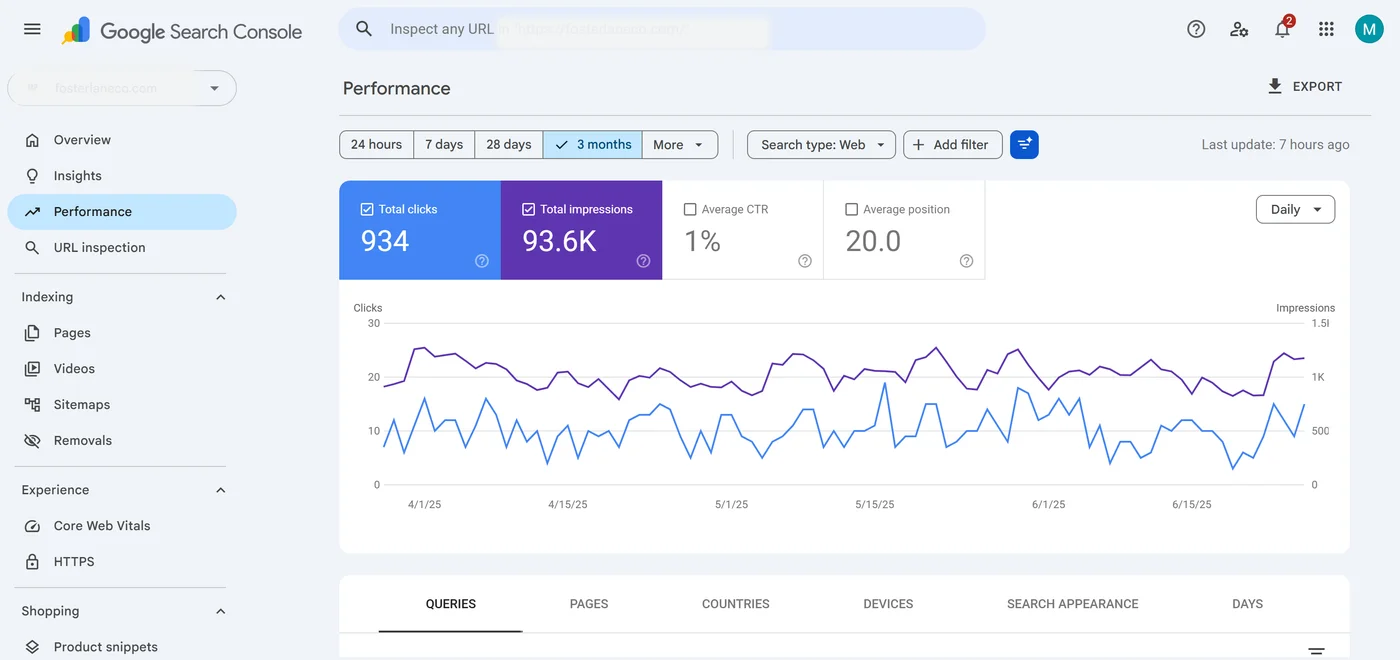
The month 1 view shows substantial impressions without a proportionate share of clicks, which is consistent with average visibility outside the strongest organic positions.
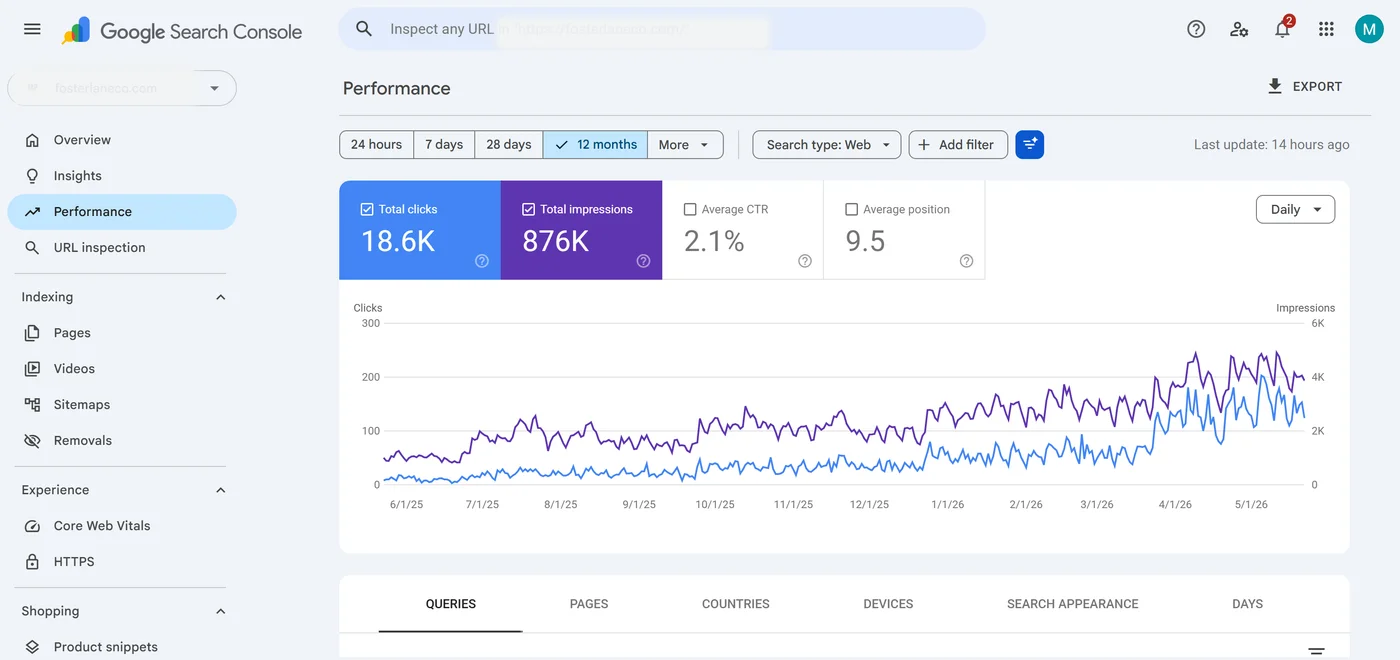
By month 12, average position is 4 and CTR moves from 1% to 3.5%. That relationship is directionally consistent with stronger search visibility, but it does not isolate the contribution of ranking position, query mix, titles, brand recognition, or changes in search-result presentation.
The click increase is close to 15 times the baseline, but traffic volume is not treated as a clinical or business outcome by itself. The conversion count moves from 10 to 170, which is useful as a lead-event measure while remaining separate from patient suitability, attendance, treatment choice, or health outcome.
Keyword Movement
The query set is more useful when grouped by intent than when treated as isolated wins. Local, cost, review, service, and consultation structures improve in the modeled period, while other terms remain flat or decline. Those differences should be read alongside page-role changes and competition rather than as proof that one tactic controlled every ranking.
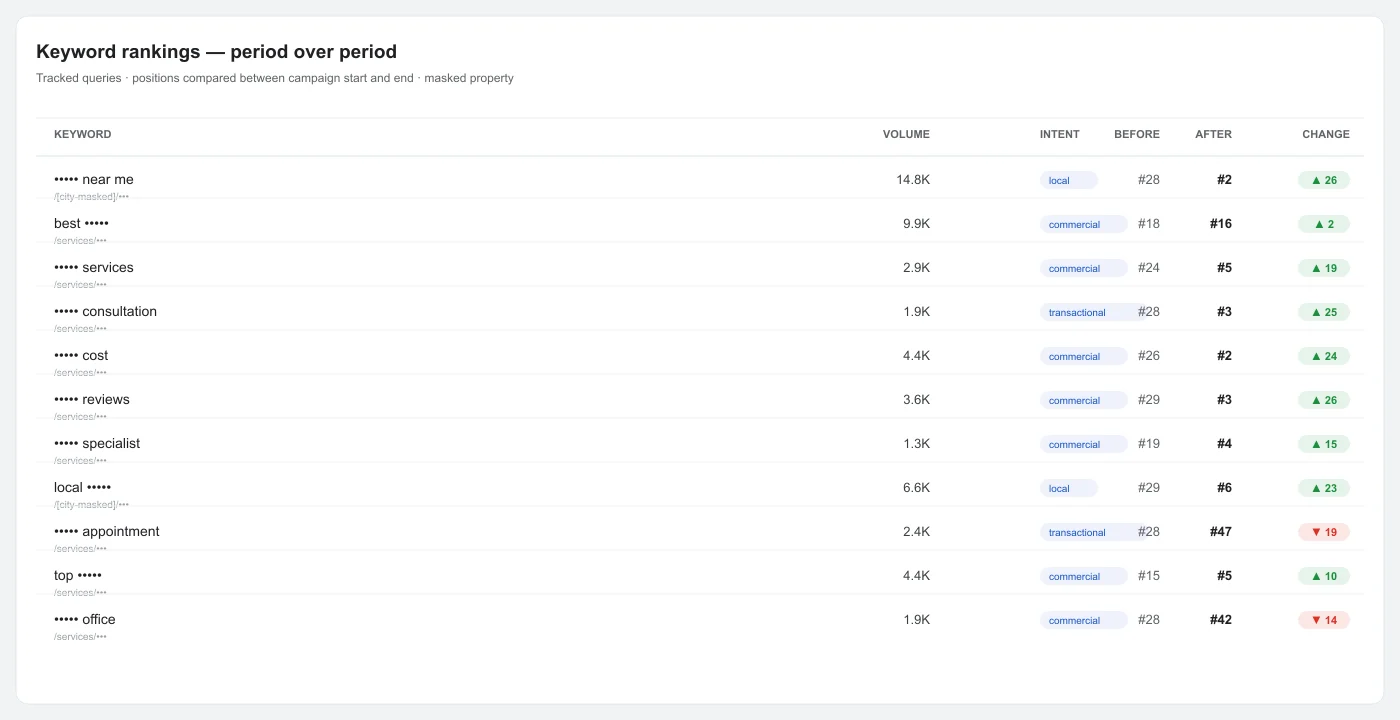
The mixed results are important. Two tracked intents decline and one large commercial head term barely changes. The masked table preserves the supplied volumes and positions so the trade-offs remain visible.
| Query structure | Intent | Volume | Before | After | Result |
|---|---|---|---|---|---|
| ••• near me | Local | 14,800 | 28 | 2 | Winner |
| ••• cost | Commercial | 4,400 | 26 | 2 | Winner |
| ••• reviews | Commercial | 3,600 | 29 | 3 | Winner |
| affordable ••• | Commercial | 3,600 | 23 | 4 | Winner |
| top ••• | Commercial | 4,400 | 15 | 5 | Winner |
| ••• services | Commercial | 2,900 | 24 | 5 | Winner |
| ••• consultation | Transactional | 1,900 | 28 | 3 | Winner |
| ••• near me open now | Local | 2,900 | 19 | 6 | Volatile |
| local ••• | Local | 6,600 | 29 | 6 | Volatile |
| ••• specialist | Commercial | 1,300 | 19 | 4 | Winner |
| ••• fees | Commercial | 1,300 | 31 | 5 | Winner |
| ••• experts | Commercial | 480 | 23 | 2 | Winner |
| ••• guide | Informational | 720 | 24 | 5 | Winner |
| best ••• | Commercial | 9,900 | 18 | 16 | Stable |
| ••• appointment | Transactional | 2,400 | 28 | 47 | Decliner |
| ••• office | Commercial | 1,900 | 28 | 42 | Decliner |
The 'best •••' head term (9,900 volume) changes only from 18 to 16. The case therefore treats it as essentially unresolved rather than inventing a success story. The operational choice was to prioritize other intents where the practice had clearer page relevance and could provide useful, evidence-aware information.
The two decliners ('••• appointment' and '••• office') fall after consolidation. Both were overlapping destinations that were merged or redirected. The correct interpretation is a portfolio trade-off: preserve the declining terms in the record, then judge whether the surviving destinations better match the intended user journey.
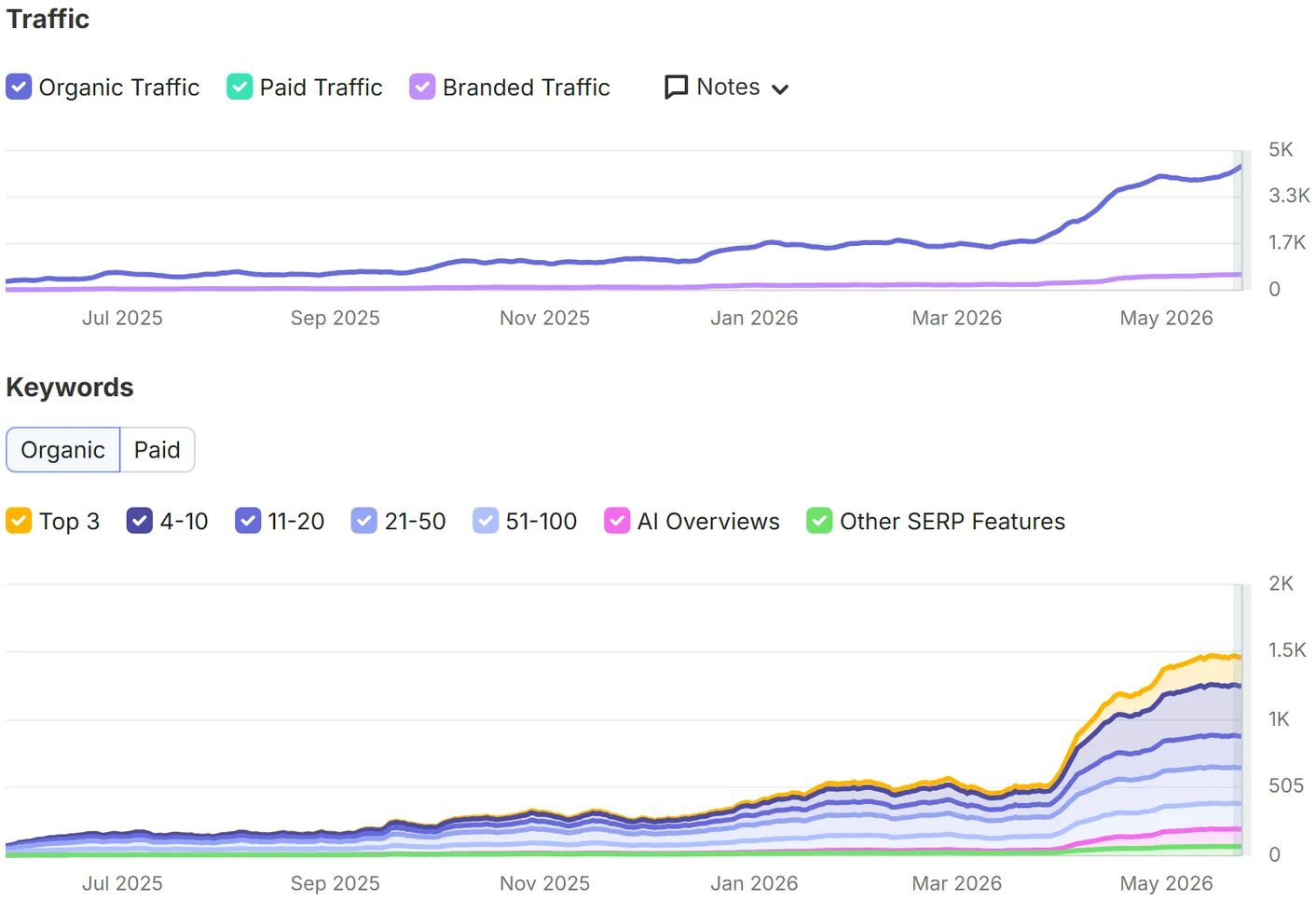
The third-party-style visibility view is directional context for the same period. It should not be presented as independent proof that content depth or internal linking caused the observed trajectory.
Business Interpretation
The scenario records 170 new-patient enquiries a month against 10 at the start, with modeled monthly value moving from roughly 3,800 to 64,600. Those figures are directional lead-value estimates rather than audited CRM revenue or patient outcomes.
Patient-education content matters because much dental search demand begins before someone is ready to book. People research cost, insurance, emergencies, treatment choices, and how to evaluate a provider. Reviewed informational pages can answer those questions and create clearer internal paths toward relevant service pages, but the case does not assume every reader becomes a patient.
The later stages, including months 11 and 12, show stronger search and enquiry observations after the resource library has matured. That timing supports a compounding interpretation, while still leaving room for competition, demand, seasonality, and other unmeasured factors.
AI visibility remains a secondary, unmeasured consideration. Structured content and clearer entity information may help AI systems and Google AI Overviews interpret a practice, but this case contains no verified AI citation or recommendation outcome, so none is claimed.
Evidence Limits
Months 9 and 10 are a useful warning against reading SEO as a straight line. Clicks sit around 1,755 and tracked conversions dip in month 10 from 64 to 56 before the stronger month 11 reading. That volatility may reflect competition, demand, local-search composition, or normal measurement noise; the scenario does not isolate a single cause.
Local and 'open now' queries remain volatile because their search results can change with proximity, business information, competition, and map-pack composition. The revenue layer is modeled; confirm it against your own CRM close rates before using it for budget decisions. The entire case is also an anonymized composite rather than actual Search Console or Google data.
What Likely Contributed
The most defensible reading is a contribution chain rather than a single-cause claim.
Technical and structural work came first. During months 1 to 3, crawl waste and overlapping page roles were reduced so later content entered a clearer architecture.
The informational layer expanded. The modeled program reaches 60 articles across 8 clusters, while the internal topical-authority measure moves from 18 to 77 and informational visibility reaches roughly 1,182 keywords. Those metrics describe the scenario; they are not official ranking scores.
Commercial pages received more relevant internal context. Several tracked service, cost, review, and local terms later appear near the top of the results. That correlation is consistent with the architecture and content work, but it is not a controlled causal test.
Search behavior improved alongside average visibility. CTR moves from 1% to 3.5%, while tracked conversions move from 10 to 170. The relationship is coherent, yet attribution remains shared across query mix, search-result presentation, page changes, demand, and user behavior.
Decision Takeaways
- Fix page ownership before scaling. A site with overlapping commercial intent and crawl waste can make new content less useful than it should be.
- Build patient education around real decisions. Cost, insurance, emergencies, treatment choices, aftercare, and provider selection deserve reviewed information that can be maintained over time.
- Keep declining terms visible. Consolidation can improve some destinations while weakening others, so evaluate the whole intent portfolio instead of protecting every legacy URL.
- Treat later acceleration cautiously. Months 11 and 12 are the strongest observed endpoint, not a guaranteed pattern for another practice.
- Separate search performance from clinical claims. Rankings, clicks, bookings, and AI visibility do not validate treatment efficacy, safety, suitability, or patient outcomes.