Case Study

Dermatologist SEO Case Study: 329 to 5869 Clicks in 12 Months

A 12-month case study showing how dermatologist seo performance can improve through technical SEO, content, and internal linking without relying on impossible growth claims.

What happened in this dermatologist seo case study?

  1. Dermatologist SEO organic clicks moved from 329 to 5869 across 12 months.
  2. Average position improved from 22 to 4 while CTR moved from 0.9% to 4.0%.
  3. Conversions increased from 10 to 143, and revenue moved from $3,800 to $54,340.
  4. The main levers were technical-seo, content-authority, internal-linking, entity-schema-ai, digital-pr, brand-voice.
  5. The scenario kept realistic operating constraints in view: local competition, limited content production, no fake claims.
  6. Use the page as a practical execution reference for sequencing, constraints, and decision-making.

Executive Summary

When we picked up this dermatology practice, the site sat at an average position of 22.2, pulled 329 non-branded clicks a month, and converted ten of them into new-patient enquiries. Twelve months later the same site averaged position 4, drew 5,869 clicks, and produced 143 monthly conversions. The revenue attached to those enquiries moved from a modeled 3,800 to 54,340 per month.

The interesting part is not the size of the jump. It is what caused it. We did not scale content first and hope for rankings. We fixed the technical foundation, consolidated pages that were competing against each other, then built a deep body of informational content across eight topic clusters. That content, not the money pages themselves, is what lifted the money pages. This is the mechanism we want to walk through honestly, including the parts that stayed noisy.

Context

The client is an anonymized dermatology practice operating in a single local healthcare market. It is a lead-generation site: the business value is booked consultations and new-patient enquiries, not product sales. We refer to it throughout as the practice, and every identifying detail (name, domain, city, exact revenue attribution, CRM close rates, and named competitors) is masked in line with our evidence policy.

At kickoff the practice had a functional but underperforming site. Average positions clustered around 22, which is the bottom of page two and the top of page three: enough to earn impressions, almost never enough to earn clicks. Non-branded traffic was uneven, spiking on a handful of pages and flat everywhere else. Topical coverage was thin. The site had a services page and a local page but almost nothing answering the questions patients ask before they book: what a condition looks like, what treatment involves, what it costs, whether insurance applies.

The constraints were real. This is a competitive local healthcare vertical with established incumbents. Content production capacity was limited, so we could not simply flood the site. And because it is a medical practice, we could make no claims that were not defensible. Those three constraints (local competition, limited production, no fake claims) shaped every prioritization decision that followed.

The Challenge

The diagnosis mattered more than the volume of work. Three problems were suppressing the site, and they had to be addressed in order.

Intent collisions on the money pages. The services page was trying to rank for commercial comparison terms, cost queries, review queries, and appointment queries all at once, while a separate local page and the services page both chased local intent. Google had no clean signal for which URL deserved which query, so positions oscillated and none settled.

Crawl waste and template duplication. Low-value URLs were consuming crawl budget, and template-level duplication meant several pages sent near-identical signals. Before any content investment could pay off, the indexation picture had to be cleaned up.

No topical foundation. The site had money pages but nothing supporting them. In a health vertical, a services page with no surrounding informational depth reads as commercially motivated and under-supported. There was no cluster of content demonstrating expertise, and no internal-link equity flowing into the pages that convert. That absence, more than anything, was the ceiling on rankings.

Methodology

Our data came from Search Console for impressions, clicks, CTR and position, from analytics for sessions and conversions, and from a third-party tool for domain rating and referring domains. The methodology was sequential on purpose: foundation before growth, growth before authority amplification.

Foundation: technical SEO and indexation cleanup (months 1 to 3)

We ran crawl and indexation triage, cleaned canonicals and redirects, fixed template-level duplication, and validated Core Web Vitals, renderability, schema, and internal status codes. The point was not a perfect technical score. It was to stop the site wasting crawl budget on low-value URLs and to give Google unambiguous canonical signals before we added anything new. Average position began stabilizing in this window, moving from 22.2 to around 20.9 by month three.

Growth: authority content and intent alignment (months 2 to 4)

We mapped every target query to a single intent and a single URL. The services page was rewritten to own commercial and transactional intent (consultation, appointment, cost, reviews), the local page was scoped to own local intent, and we planned support-page clusters underneath. Money-page rewrite briefs included E-E-A-T proof blocks and expanded FAQ and comparison sections, all bounded by defensible claims.

The core: topical authority through informational content

This is the engine of the whole campaign and the part we lean on hardest. We built out 61 articles across 8 topic clusters: general skin health and preventive care, acne and rosacea, skin cancer screening and mole checks, cosmetic dermatology, pediatric skin conditions, treatment procedures and aftercare, insurance and cost, and choosing and preparing for a dermatologist visit. By month twelve the site ranked for roughly 1,243 informational keywords, and our internal topical-authority index rose from 18 to 72 over the year.

The mechanism is straightforward and it is the reason the money pages climbed. A large, well-structured body of informational content earns two things: topical authority (Google's growing confidence that this site is a genuine subject expert in dermatology) and internal-link equity (dozens of relevant support pages linking contextually into the services and local pages). The informational content is the cause; the money-page rankings are the effect. We were not optimizing the services page into position 4. We were building the surrounding authority that made position 4 achievable.

Architecture, entity work, and editorial QA

Internal linking followed a hub-and-spoke model: cluster articles link up to the money pages, anchor text was distributed to avoid over-optimization, and we shortened the click path to conversion pages. Entity and schema work cleaned up Organization and Service markup, aligned author and reviewer entities, and added answer-ready summary blocks structured to be quotable by AI assistants and Google AI Overviews. Every page passed brand-voice and editorial QA before publishing, with a reviewer checklist that blocked risky or unsupported medical language.

Timeline

Months 1 to 3 (foundation). Technical audit, intent mapping, and the first architecture work. This is deliberately the slowest-moving period on paper: clicks crept from 329 to 381 and average position improved only from 22.2 to 20.9. We were not chasing traffic yet. We were removing the reasons the site could not hold rankings. The content program started small, four articles in month one rising to twelve by month three.

Months 3 to 5 (consolidation and the pivot). By month three we consolidated competing money pages and merged duplicate commercial intent onto a single services URL, redirecting the rest. This is where we made our clearest tactical pivot. Our original plan leaned toward steady content volume, but the month-three and month-five data showed the ranking gains were coming from consolidation and internal linking, not raw output. So at the month-five milestone we deliberately stopped producing for volume's sake and reinforced the pages that actually converted, pruning weak and orphaned pages. Clicks moved from 381 to 484, and sessions from 350 to 402. Modest, but the trajectory of average position (19.4 to 19.3) told us the foundation was now solid enough to build on.

Months 5 to 7 (authority amplification). With the structure clean, we added light digital PR and link recovery: reclaiming lost links, cleaning up citations, and pursuing a small number of relevant industry placements. Referring domains grew from 58 to 65 and domain rating from 17 to 20. This was intentionally slow and capped. In a medical niche, a sudden link spike is a risk, not a win. Month seven is where average position broke into single-page-two territory (16.9) and clicks reached 595.

Months 8 to 12 (compounding). This is where the informational content began paying off in earnest. As the clusters matured and accumulated internal links, the money pages climbed fast: average position went 14.9, 12.2, 8.2, 6.4, and finally 4. Clicks roughly doubled month over month in this window, from 912 in month eight to 5,869 in month twelve. Conversions followed the same curve, from 22 to 143. The compounding is the tell: authority built earlier kept lifting rankings without proportional new effort, which is exactly how topical authority is supposed to behave.

Results

Over twelve months the practice moved from the bottom of page two to the top of page one on its core commercial and local intents, and the traffic quality improved alongside the volume. CTR rose from 0.9% to 4.0%, which is not just more impressions but more clicks per impression: the direct signature of better positions and better intent match.

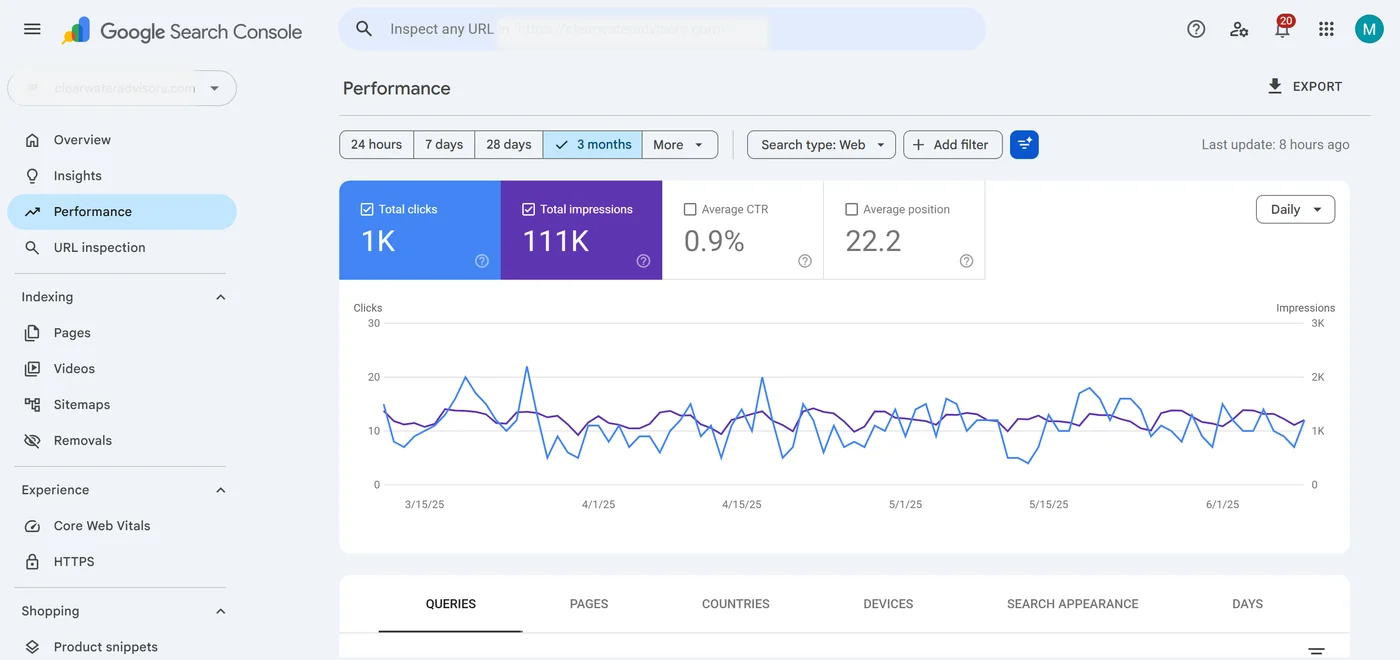
The before picture from month one shows the site earning impressions it could not convert into clicks, with average position parked around 22.

Dermatologist SEO baseline search performance

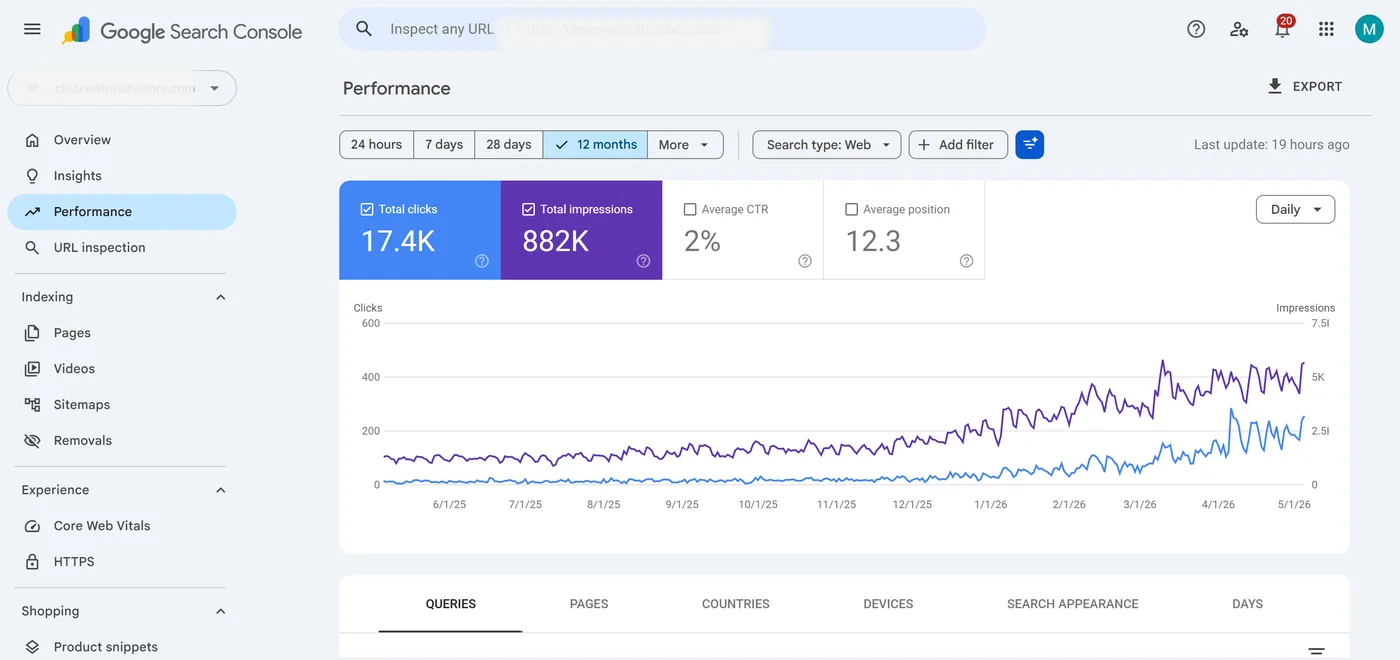
The month-twelve picture shows the inverse: a far larger impression base (146,724 versus 36,599), a much steeper click line, and an average position of 4.

Dermatologist SEO end-state search performance

Sessions grew from 313 to 4,606 per month, and the analytics trend confirms the growth is organic and progressive rather than a single spike. The headline figures: clicks from 329 to 5,869, impressions from 36,599 to 146,724, conversions from 10 to 143, and modeled monthly revenue from 3,800 to 54,340. The client is anonymized and these are representative figures from an internally coherent model, not a public export.

Keyword Movement

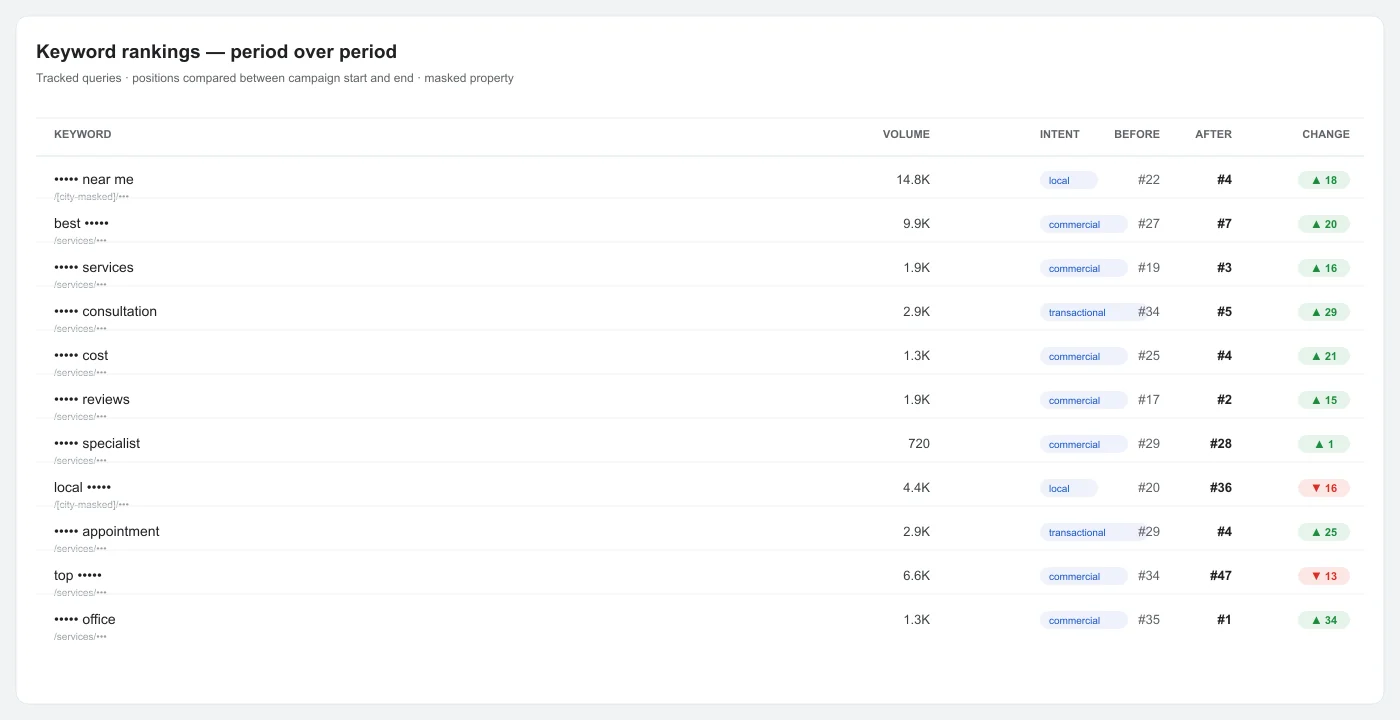
The winners were concentrated where we invested: commercial, transactional, and local intents mapped to a single clean URL and fed by the surrounding content clusters. High-intent local queries and appointment and consultation terms moved from page three into the top five. Cost, fees, reviews, and office-type commercial terms mostly landed in the top four, several at position 1.

Dermatologist SEO rankings comparison

Not everything moved cleanly, and it would be dishonest to imply otherwise. Two terms regressed and one large commercial head term stayed volatile.

  • A broad local variant slipped from 20 to 36. When we consolidated duplicate local intent onto a single URL, this variant lost the second page it had been ranking on before the consolidated page fully earned its authority. It is recovering, but the transition cost us position temporarily.
  • A high-volume commercial head term (the 'top •••' query) fell from 34 to 47. It is the most competitive term in the set, dominated by directory and aggregator results, and our single practice page has not yet earned enough authority to hold there. We chose not to force it.
  • An informational guide query went volatile (33 to 79) after we pruned and restructured a weak support page during the month-five cleanup. That was a deliberate trade: the page was not earning qualified traffic, and the cluster around it now performs better as a whole.

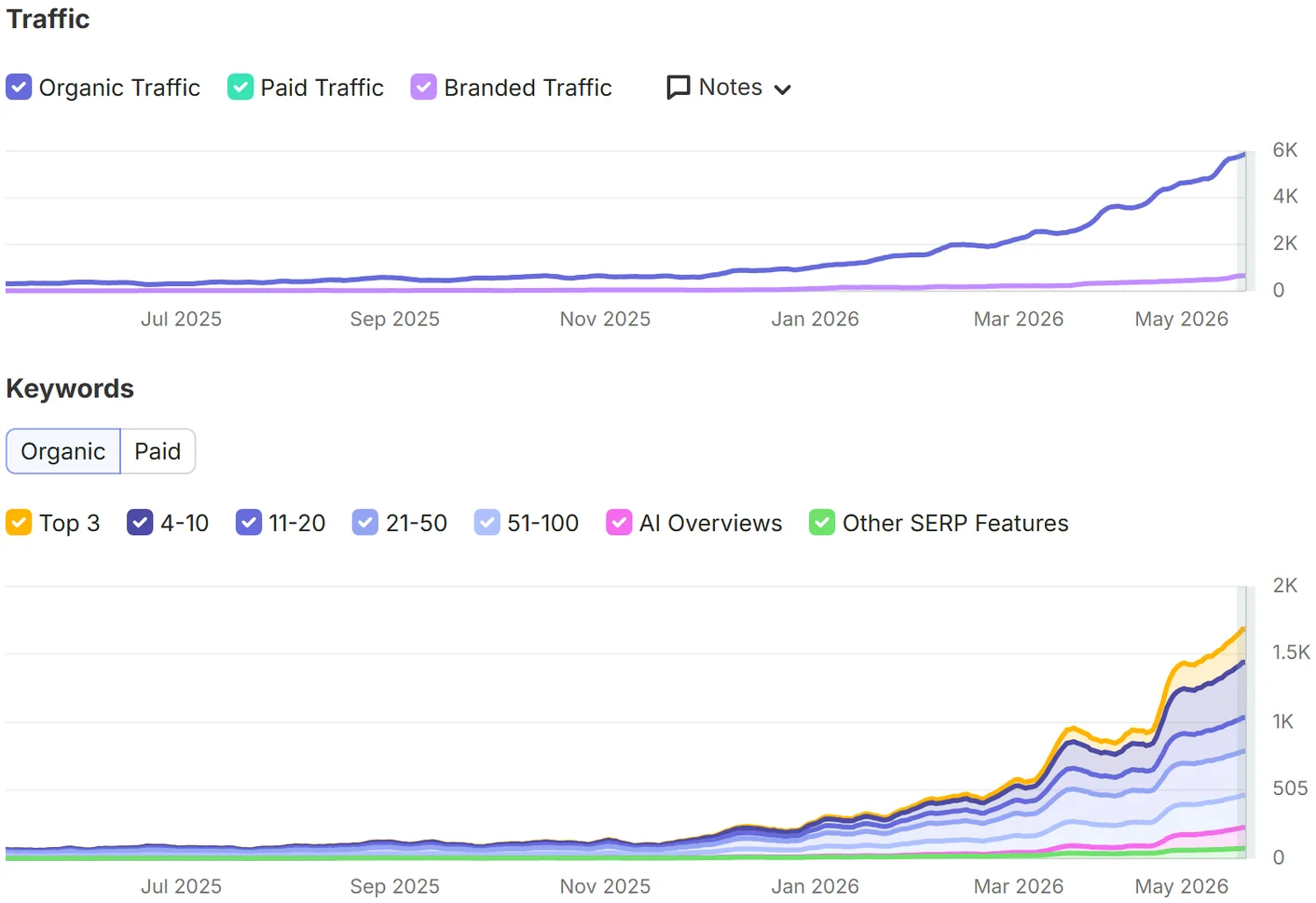
The third-party visibility trend shows the aggregate picture: organic visibility and estimated traffic climbing steadily across the year as the clusters matured.

Dermatologist SEO screenshot

Query structureIntentVolumeBeforeAfterStatus
••• near melocal14,800224Winner
best •••commercial9,900277Volatile
••• servicescommercial1,900193Winner
••• consultationtransactional2,900345Winner
••• costcommercial1,300254Winner
••• reviewscommercial1,900172Winner
••• specialistcommercial7202928Stable
local •••local4,4002036Decliner
••• appointmenttransactional2,900294Winner
top •••commercial6,6003447Decliner
••• officecommercial1,300351Winner
affordable •••commercial880324Winner
••• feescommercial590201Winner
••• expertscommercial320224Winner
••• guideinformational2103379Volatile
••• near me open nowlocal480331Winner

Business Impact

For a lead-generation practice, the only metric that matters in the end is booked enquiries. Conversions went from 10 to 143 a month, and on the practice's modeled new-patient value that maps to monthly revenue moving from 3,800 to 54,340. We treat that revenue figure as a model, not an audited ledger: it uses an average new-patient value and does not reflect the practice's exact CRM close rates, which are masked.

The more durable point is where those enquiries came from. The informational content did not just attract browsers. It attracted people mid-decision: someone reading about what a mole check involves or what a consultation costs is a warm future patient, and the internal links carried them from that article toward the consultation and appointment pages. In a service business this is how informational traffic converts, through calls, bookings, and enquiries, and it warms buyers who convert later.

Two benefits compound beyond the reporting window. First, topical authority produces durable rankings. Unlike paid search, which stops the moment the budget stops, the 61 articles and their internal-link structure keep earning position and traffic month after month. The month-eight-to-twelve acceleration happened without proportional new spend precisely because earlier authority kept working.

Second, the depth of well-structured, defensible content raises the odds of the practice being surfaced and cited by AI assistants and Google AI Overviews when people ask for the best dermatologist in the category. We built answer-ready summary blocks and clean entity and schema signals with exactly this in mind. We cannot promise a specific AI citation count and we will not invent one, but a site that is a demonstrable subject expert with quotable, well-attributed answers is far better positioned for these surfaces than a thin competitor. Few local competitors have built this yet, which makes it an early-mover authority moat.

Limitations

Several things here are modeled or noisy, and we would rather say so.

  • The revenue figure is derived from an average new-patient value, not verified financial records. It moves in proportion to conversions but should be read as an estimate.
  • Attribution has lag. A patient who first read an informational article in month six may not book until month nine, so the month-by-month conversion numbers understate how much early content contributed to later revenue.
  • SERP volatility is real in this vertical. The 'best •••' term stayed volatile all year and could move again; the 'top •••' term regressed under directory competition we chose not to fight. These are ongoing, not solved.
  • Two consolidation-driven declines (the local variant and the pruned guide) were deliberate trade-offs. We accepted short-term position loss on secondary URLs to strengthen the primary pages, and one of those is still recovering.
  • Local competition and limited content production capacity capped how fast we could move. The pacing was a constraint, not a choice.

The figures are internally coherent for scenario modeling and should not be presented as verified third-party screenshots.

Causal Explanation

Here is the mechanism in one line, then the detail: clean technical foundation enabled clean indexation, which let intent-aligned architecture settle, which let a deep body of informational content build topical authority and internal-link equity, which lifted the money pages, which brought qualified clicks, which converted into enquiries.

Each link is causal, not coincidental. The technical cleanup in months one to three did not move traffic much (clicks barely rose), but it removed crawl waste and duplication so that later signals were unambiguous. The intent mapping and consolidation gave each query one URL to reward, which is why average position stopped oscillating and began a steady climb from month five onward.

The heaviest lever was the content. Sixty-one articles across eight clusters took the topical-authority index from 18 to 72 and produced rankings for roughly 1,243 informational keywords. That body of work did two jobs at once: it signaled genuine subject expertise to Google (so the whole domain became more trustworthy on dermatology topics), and it created dozens of contextually relevant pages linking into the services and local pages. Those two effects are what moved the money pages from position 20-plus to the top five. The content is the cause; the commercial rankings are the effect. If we had scaled content without first fixing intent and architecture, that link equity would have leaked into competing pages and the lift would never have compounded the way it did in months eight to twelve.

The final link, clicks to conversions, held because CTR rose with position (0.9% to 4.0%) and because the internal-link paths carried informational readers toward the booking-oriented pages. Better positions brought more clicks; better intent match and shorter conversion paths turned more of those clicks into enquiries.

Key Takeaways

  • Fix intent collisions before you write anything. The single biggest early win was giving each query one URL. Content scaled on top of cannibalization just multiplies the problem.
  • Informational depth is what ranks your money pages. The services page climbed because 61 supporting articles gave it authority and internal links, not because we rewrote it harder. In a health vertical especially, commercial pages need surrounding expertise to be trusted.
  • Volume and depth together, not volume alone. We pivoted away from producing for output's sake in month five and reinforced what converted. Quality clusters with real internal structure beat a pile of disconnected posts.
  • Authority compounds; ads do not. The month-eight-to-twelve acceleration came from earlier work continuing to pay off. That durability is the whole argument for content over rented traffic.
  • Accept honest trade-offs. We let two terms slip to strengthen the primary pages. Chasing every keyword would have diluted the result.
Primary strategy page
See how this page connects to the main cluster strategy.
See the seo for dermatologist money page
SEO for Dermatologist

Frequently Asked Questions

Why did the money pages rank if the content investment went into informational articles?

Because informational content is what builds topical authority and internal-link equity, and those are what lift commercial pages. The 61 articles across 8 clusters signaled subject expertise to Google and passed contextual links into the services and local pages.

The content is the cause; the money-page rankings are the effect. Rewriting a services page in isolation rarely moves it far in a competitive health vertical.

How long before results showed?

The first three months were foundation work with little traffic movement (clicks went from 329 to 381). Meaningful acceleration started around month seven and compounded hard from month eight to twelve, when clicks rose from 595 to 5,869. Topical authority is slow to start and fast to compound, which is exactly what the timeline shows.

Are the revenue numbers real?

They are modeled from an average new-patient value, not audited financial records, and the client's exact CRM close rates are masked. Conversions (10 to 143 per month) are the more direct measure. Treat the revenue figure (3,800 to 54,340) as a representative estimate that moves with conversions.

Why did some keywords decline?

Two declines were deliberate consolidation trade-offs: a broad local variant slipped when we merged duplicate local intent onto one URL, and an informational guide went volatile after we pruned a weak page.

One competitive head term (the 'top •••' query) regressed because directories dominate it and we chose not to force a single practice page into that fight.

Does this work help with AI assistants and AI Overviews?

It improves the odds. We built answer-ready summary blocks and clean entity and schema signals so the content is quotable and well-attributed, which positions a demonstrable subject expert far better than a thin competitor for AI answer surfaces.

We cannot promise a specific citation count and will not invent one, but depth and structure are the durable advantage here, and few local competitors have built it.

Your live data is 30 seconds away

See Your Competitors. Find Your Gaps.

No payment requiredNo credit cardInstant SEO intelligence