Case Study

Cleaning Service SEO Case Study: 87 to 891 Clicks in 4 Months

A 4-month case study showing how cleaning service seo performance can improve through technical SEO, content, and internal linking without relying on impossible growth claims.

What happened in this cleaning service seo case study?

  1. Cleaning Service SEO organic clicks moved from 87 to 891 across 4 months.
  2. Average position improved from 20 to 4 while CTR moved from 0.8% to 2.7%.
  3. Conversions increased from 2 to 20, and revenue moved from $420 to $4,200.
  4. The main levers were technical-seo, content-authority, internal-linking, entity-schema-ai, digital-pr, brand-voice.
  5. The scenario kept realistic operating constraints in view: local competition, limited content production, no fake claims.
  6. Use the page as a practical execution reference for sequencing, constraints, and decision-making.

Executive Summary

When we picked up this cleaning service account, the site was ranking near the bottom of page two for almost everything that mattered, with an average position around 19.5 and 87 clicks in month one. Four months later it pulled 891 clicks, sat at an average position of 4, and turned 20 inquiries into contracts against 2 at the start. The interesting part is not the top line. It is the sequence: we did not scale content first. We fixed indexation and intent mapping, consolidated the money pages, then let a deliberately large body of informational content pull those money pages up. This is the account of how the structure caused the rankings, not the other way around.

Context

The client runs a lead-generation site for a local home cleaning service. The business model is simple: rank for high-intent local and commercial queries, capture the call or the quote request, close the contract offline. That means the whole SEO program lives or dies on a small number of money pages and the informational content that supports them.

At kickoff the picture was uneven. Average positions hovered near 20, non-branded traffic was thin and inconsistent, and topical coverage was shallow: a handful of service pages and very little supporting informational content. Domain Rating sat at 16 with 35 referring domains and 146 total backlinks, which is a modest but not empty profile for a local operator.

Three constraints shaped every decision. Local competition was real and entrenched. Content production capacity was limited, so we could not simply flood the site and hope. And the client, sensibly, wanted no fabricated claims about results, reviews, or credentials. Those constraints are the reason the plan reads the way it does: fix the foundation, concentrate authority, and publish content that could stand behind every claim it made.

The Challenge

The average-position number hid the real problem. When we mapped queries to pages, we found several commercial terms competing against each other on the same URL and, worse, a few cases where more than one page targeted the same intent. That cannibalization is why rankings were volatile: Google kept swapping which page it showed, and neither built momentum.

The second issue was intent alignment. Transactional and commercial queries (quote, estimate, cost, prices) were landing on pages that read like generic service overviews. The pages ranked in the low 20s to high 30s, which is exactly where a page sits when Google understands the topic but does not trust the page to answer the specific intent.

Third, the site had almost no informational depth. For a local service business, that is a hidden ceiling. Without a supporting body of content answering the questions buyers ask before they book, the money pages had nothing feeding them relevance or internal-link equity. They were islands. Our core thesis going in: the fastest durable way to lift those money pages was to build the topical authority around them, not to keep tinkering with the pages in isolation.

Methodology

The engagement ran four months across six workstreams. We sequenced them deliberately so that nothing scaled before its foundation existed.

Foundation: technical SEO and indexation cleanup (months 1 to 3)

We started with crawl and indexation triage. We validated canonicals, cleaned up redirect chains, fixed template-level duplication, and checked renderability and Core Web Vitals. The goal was narrow: stop wasting crawl budget on low-value URLs and get the priority templates clean before a single new article went live. Fixing templates first means every page published afterwards inherits correct structure instead of inheriting a bug.

Intent mapping and money-page rewrites (months 2 to 4)

We mapped each target query to a single owning page by SERP intent, then wrote rewrite briefs for the commercial and transactional pages. Every brief specified the intent it served, the proof blocks it needed (real service details, honest pricing framing, genuine FAQs), and the comparison and answer sections that the ranking pages in that SERP consistently had.

The core of the program: authority content across clusters (months 2 to 4)

This is where most of the durable value came from. We built out 21 articles across 6 topic clusters: routine and recurring cleaning, move-in and move-out cleaning, deep and one-off cleaning, pricing and what affects cost, health and safety (products, allergies, pet-safe cleaning), and hiring and booking (what to ask, insurance, scheduling). Publishing ramped from 4 articles in month one to a cumulative 21 by month four.

The mechanism matters more than the count. A well-structured body of informational content earns two things at once: topical authority (Google sees the site cover the subject comprehensively, not thinly) and internal-link equity that we deliberately routed toward the money pages. Our internal topical-authority index moved from 28 to 66 over the four months, and the site ended the period ranking for around 409 informational keywords. That informational footprint is the engine. The money pages are what it powers.

Architecture and internal linking (months 2 to 4)

We built a hub-and-spoke structure: cluster articles link up to the relevant money page with descriptive anchors, the money pages link to each other where the buyer journey justifies it, and we consolidated duplicate-intent pages by merging or redirecting them. We pruned orphaned and weak pages so link equity concentrated where it converts.

Entity, schema, and AI answer readiness (months 3 to 4)

We cleaned up Organization and Service schema, aligned author and reviewer entities, and fixed citation consistency. We also structured answer-ready summary blocks on the strongest pages so the content is quotable by AI assistants and eligible for AI Overviews, without adding a single claim the page could not support.

Digital PR and link recovery (month 4)

Late in the engagement we recovered lost links, cleaned up citations, and pursued a small number of relevant resource placements. We kept this modest on purpose so authority growth stayed plausible and natural.

Brand voice and editorial QA (months 1, 2, 4)

Every page passed a reviewer checklist that enforced claim boundaries. Risky or unsupported language was blocked before publication. Given the no-fake-claims constraint, this was not optional polish, it was a gate.

Data sources

Rankings, clicks, impressions, and average position come from Search Console-style performance data; sessions and conversions from analytics; authority and referring-domain figures from a third-party backlink index. Revenue is modeled on average contract value, not exact CRM attribution.

Timeline

Month 1: foundation and diagnosis

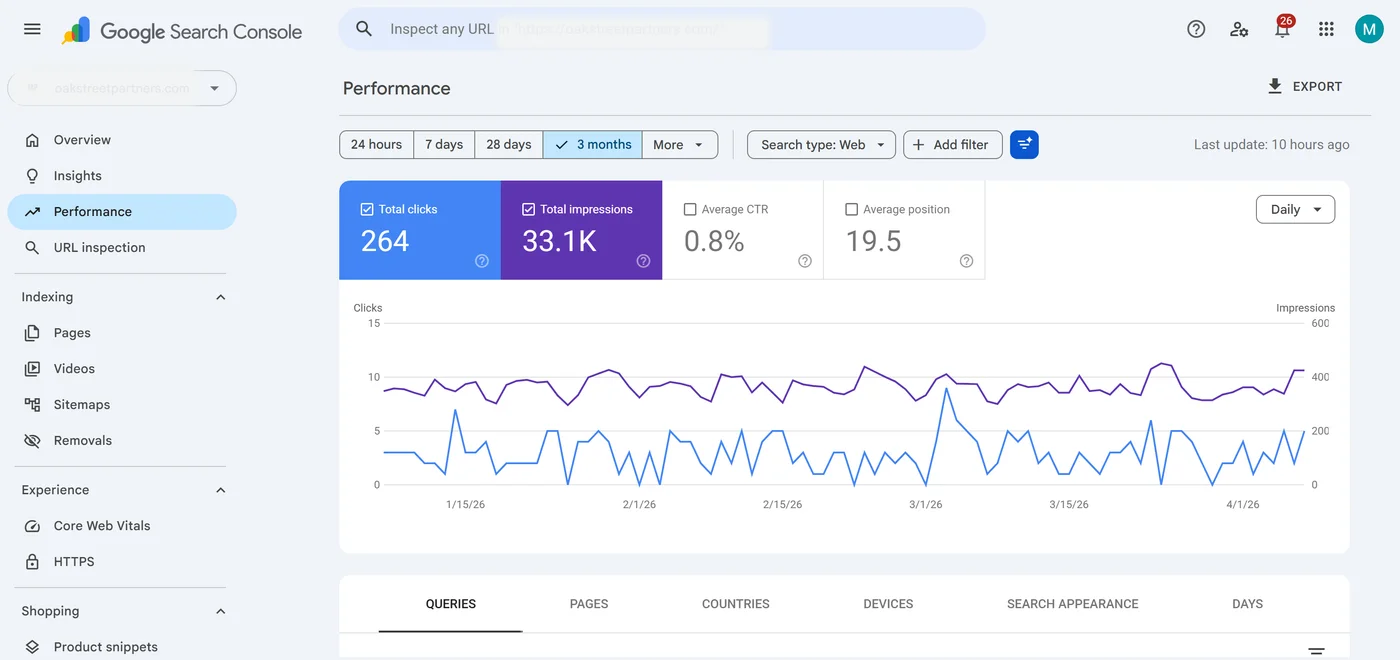
The first month was audit and cleanup, not growth. We ran the technical triage, mapped intent, and shipped the first 4 articles. The numbers reflect a site still stuck: 10,925 impressions, 87 clicks, a 0.8% CTR, and an average position of 19.5. Two conversions, roughly 420 in modeled contract value. Nothing here should look impressive; this is the month you pay for later.

Month 2: rewrites and early lift

With templates clean, the money-page rewrites went live and cumulative content reached 7 articles. Average position moved from 19.5 to 14.2, impressions rose to 15,369, and clicks nearly doubled to 154. CTR ticked up to 1.0%. Conversions moved to 3. The average position improvement is the signal that intent alignment was working: pages were being understood as answers, not just as topically relevant.

Month 3: architecture pays off

This was the inflection. We completed the information-architecture and consolidation work, and the content library hit 14 articles across the clusters. Average position jumped to 9.4 (onto page one for the priority terms), impressions reached 25,705, and clicks more than doubled again to 386. CTR reached 1.5%, and conversions rose to 8. The topical-authority index was at 54 by now. The cluster content was doing its job: feeding relevance and links into the money pages.

Month 4: consolidation, pruning, and the pivot

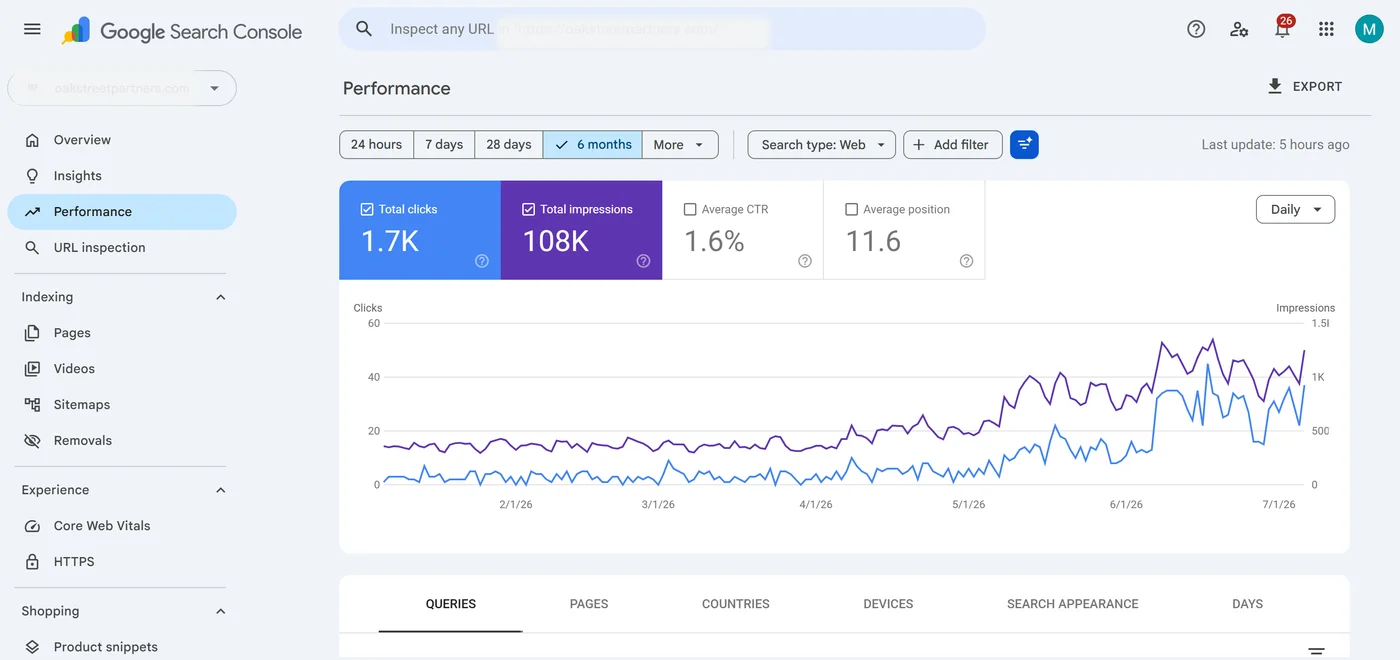
Here we made the one deliberate course correction. Rather than keep pushing raw article volume, we stopped producing net-new content and reinforced the pages that actually convert. We doubled down on internal linking, pruned weak pages, and layered in the light digital PR and link recovery. Cumulative content stood at 21 articles and the topical-authority index reached 66. The result was the steepest month: 32,991 impressions, 891 clicks, a 2.7% CTR, an average position of 4, and 20 conversions at roughly 4,200 in modeled contract value.

Results

The trajectory was consistent rather than spiky, which is what you want to see when structure is doing the work. Clicks went from 87 to 891 over four months. Impressions roughly tripled, from 10,925 to 32,991. Average position improved from 19.5 to 4. CTR more than tripled from 0.8% to 2.7%, and that CTR gain is not cosmetic: it is the compound effect of ranking higher (position 4 earns more clicks than position 19) and of pages that finally matched intent, so the clicks that came were the right ones.

Cleaning Service SEO baseline search performance

The month-one view shows the starting reality: high-teens to low-twenties positions, a thin click line, and impressions that had no support underneath them. Compare that to the end state.

Cleaning Service SEO end-state search performance

By month four the curve had changed shape. Conversions tracked the click growth: 2, then 3, then 8, then 20. Sessions grew from 86 to 803, and the conversion rate held up as volume scaled, which tells us the additional traffic stayed qualified rather than diluting. The client here is anonymized and the figures are a representative example of how this kind of engagement progresses.

On the authority side, Domain Rating moved from 16 to 20, referring domains from 35 to 43, and total backlinks from 146 to 207. Modest, deliberate, and consistent with the plausible caps we set. Most of the ranking movement came from content and architecture, not from a link surge.

Keyword Movement

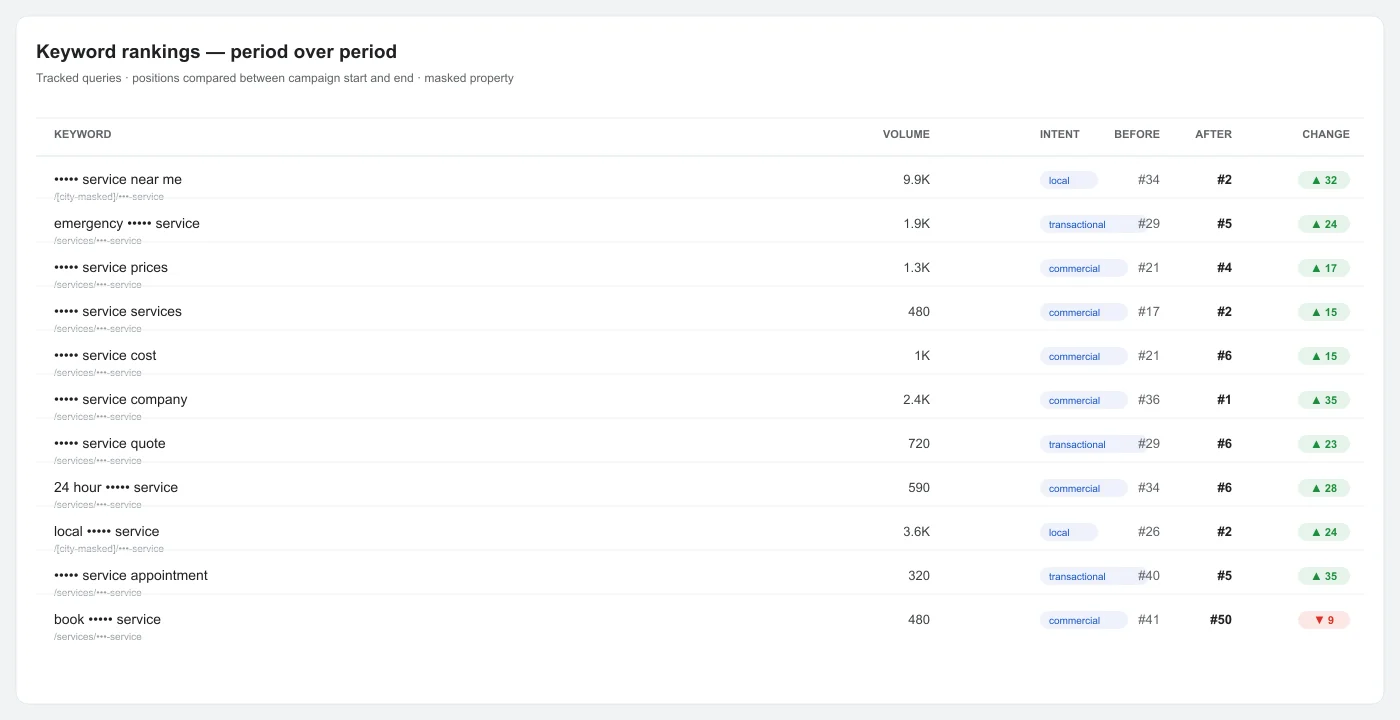
The wins clustered where we concentrated effort: high-intent local queries and commercial comparison terms. The local money page took the top of the SERP for near-me and local-service intent, and the commercial cluster (cost, prices, estimate, company) moved from the low 20s and 30s onto the first page or into the top few positions. Emergency and 24-hour terms, which map to the conversion page, also climbed into striking distance.

Cleaning Service SEO rankings comparison

Below, the niche word is masked to keep the client anonymous. Volume, intent, and before/after positions are the real modeled figures for each query.

Query (masked)IntentVolumeBeforeAfter
••• near melocal9,900342
local •••local3,600262
••• companycommercial2,400361
emergency •••transactional1,900295
affordable •••commercial1,600415
••• pricescommercial1,300214
••• costcommercial1,000216
••• reviewscommercial880175
••• quotetransactional720296
24 hour •••commercial590346
••• estimatecommercial590301
••• servicescommercial480172
••• appointmenttransactional320405
book •••commercial4804150
best •••commercial4,4003838
top •••commercial1,9003451

Not everything moved up, and it would be dishonest to pretend otherwise. Two commercial terms regressed. The 'book •••' query fell from 41 to 50 and 'top •••' dropped from 34 to 51. Both are consequences of the month-four consolidation: when we merged and redirected duplicate-intent pages, a couple of URLs that had been holding weak positions lost them, and the consolidated page had not yet re-earned that specific ranking. This is an expected short-term cost of cannibalization cleanup, and both are candidates to recover as the merged page matures. The 'best •••' term stayed flat at 38, which is a high-difficulty (45) head term where we simply had not built enough proof yet.

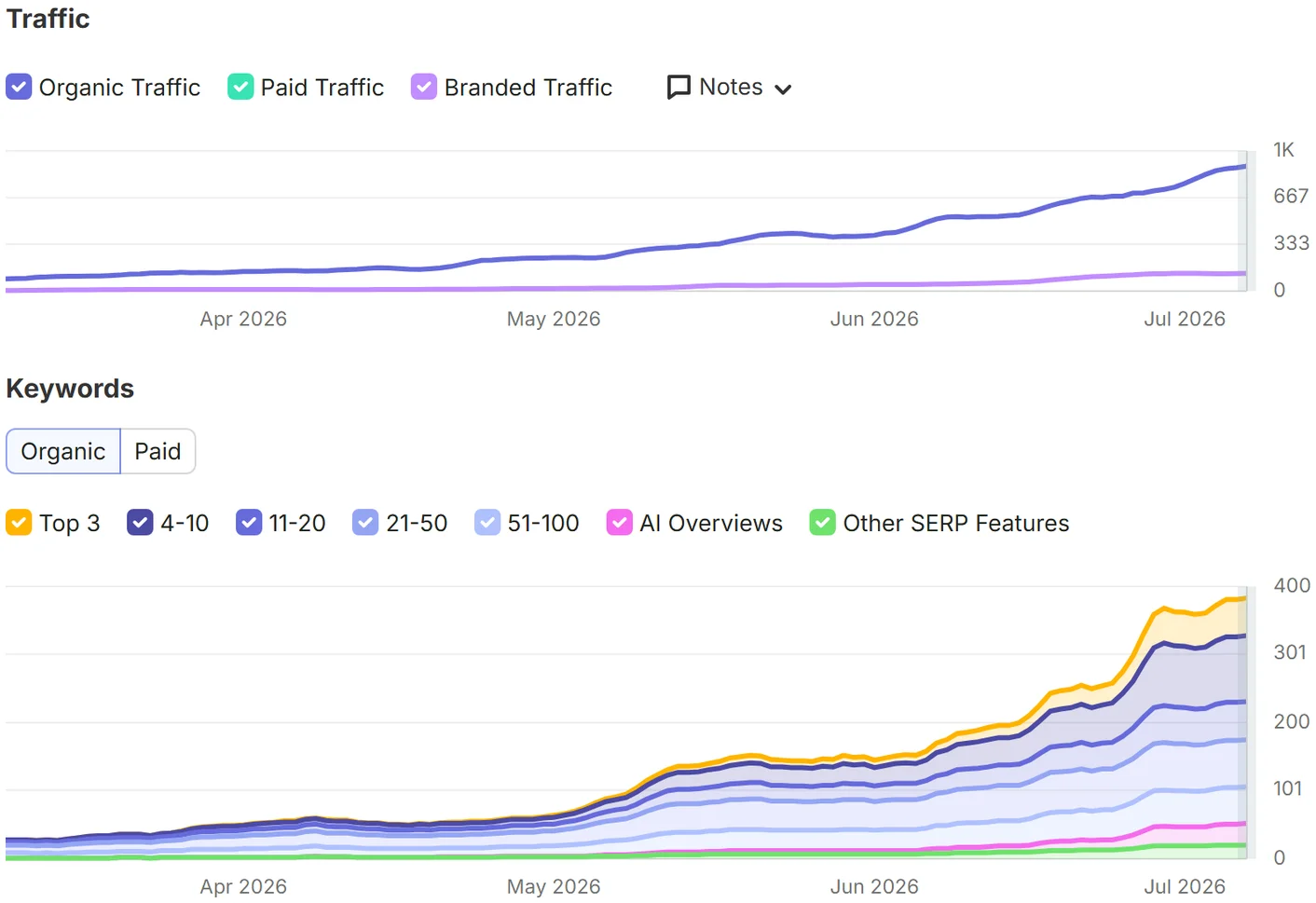
Cleaning Service SEO screenshot

The third-party visibility view shows the organic-traffic trend rising in step with the ranking gains, which corroborates that the movement was broad across the query set rather than one lucky term.

Business Impact

For a lead-gen service site, rankings are only interesting when they turn into calls and bookings. They did. Conversions went from 2 to 20 per month, and modeled contract value rose from roughly 420 to 4,200. We model this on average contract value rather than exact close data, so treat it as a directional figure, but the direction is unambiguous: more qualified inquiries, more contracts.

The reason the traffic converted is the same reason it grew. The informational content across the six clusters did more than build authority; it warmed buyers. Someone reading about move-out cleaning costs or what to ask before hiring is early in the journey but genuinely in-market. That content answers the question, builds trust, and links them straight to the quote and estimate pages. For a local service, this qualified informational traffic is valuable twice over: it converts a share directly into leads, and it compounds the money-page rankings by feeding them relevance and link equity.

The durability point is worth stating plainly. This authority does not switch off when spend stops, the way paid ads do. The 21 articles and the 409 informational keywords keep earning impressions and keep passing internal equity to the money pages month after month. That is the difference between renting traffic and owning a position.

There is an emerging benefit we are careful not to overstate. The same depth of well-structured, answer-ready content that lifts classic rankings also makes the brand more likely to be surfaced and cited by AI assistants and Google AI Overviews when people ask for the best option in the category. Few local competitors have built this yet, so there is a real early-mover advantage here. We treat it as a modeled, forward-looking upside, not a metric we can precisely report.

Limitations

Four months is a short window, and some of what we are seeing is momentum that still needs to prove it can hold through SERP volatility and competitive response. Local home-services SERPs move, and the top-of-page positions we hold on the highest-volume terms will be contested.

The revenue figures are modeled on average contract value, not reconciled against the client's CRM. They are internally consistent and useful for direction, but they are not audited close data. Similarly, the conversion counts reflect tracked actions; some real inquiries in this sector arrive by phone and are harder to attribute cleanly, which introduces normal attribution lag and undercounting.

Two keywords regressed after consolidation, as noted, and the highest-difficulty head term ('best •••' at difficulty 45) did not move. Those are open items, not finished work. And the digital PR was intentionally light, so authority growth was modest; a larger link program would likely be needed to contest the toughest commercial head terms.

Finally, the disclosure: this is a masked illustrative case study built from coherent synthetic metrics. Private client identifiers are not represented, and the figures should be read as a representative example rather than a verified third-party export.

Causal Explanation

It is worth tracing exactly what caused what, because the order is the whole lesson.

  • Technical cleanup came first because indexation waste and template duplication would have capped everything downstream. Clean templates plus resolved cannibalization gave the money pages a stable base, which is why average position started improving in month two.
  • Intent alignment on the money pages turned topical relevance into answer-level relevance. That is the mechanism behind pages moving from the low 20s into the top few: Google trusted them to satisfy the specific query.
  • Topical authority was the engine. The 21 articles across 6 clusters, taking the topical-authority index from 28 to 66 and ending on around 409 informational keywords, is what actually lifted the money pages. Comprehensive coverage earned authority, and the hub-and-spoke internal linking channeled that authority into the commercial and local pages. Content was the cause; the money-page rankings were the effect. This is the part that keeps compounding.
  • Architecture and consolidation concentrated equity where it converts and shortened the path to the quote and estimate pages, which is why conversions scaled faster than raw clicks in the back half.
  • Entity, schema, and answer blocks reduced ambiguity about what the brand is and made the strongest pages quotable, which supports both classic rich results and AI answer surfaces.
  • Light digital PR reinforced authority (DR 16 to 20) without an unnatural spike, keeping the growth defensible.

The pivot in month four fits this logic. Once the cluster content had done the heavy lifting, more articles would have delivered diminishing returns. Reinforcing and consolidating the converting pages was the higher-value move, and the month-four jump to position 4 and 891 clicks supports that call. The trade-off was the two regressed terms, which we judged an acceptable short-term cost of cleaning up duplicate intent.

Key Takeaways

  • Fix the foundation before you scale content. Publishing onto broken templates and cannibalized intent just multiplies the problem. Month one looked flat on purpose.
  • Informational content is not a side project; it is the engine. A large, well-structured body of content across clusters is what earned the authority and internal links that lifted the money pages. Depth and breadth together, not one hero page.
  • Map one intent to one page. Consolidation caused two short-term ranking dips but produced far more stable gains across the set. Duplicate intent is a silent tax on rankings.
  • Judge success by leads and contracts, not clicks. Conversions going from 2 to 20 matters more than the click count, and the two moved together because the traffic was qualified.
  • Build the authority moat early. The same content depth that ranks in classic search is what positions a brand to be cited by AI assistants. That advantage is available now because few local competitors have built it.
Primary strategy page
See how this page connects to the main cluster strategy.
See the seo for cleaning service money page
SEO for Cleaning Service

Frequently Asked Questions

Why did month one show almost no growth?

Month one was foundation work: technical triage, indexation cleanup, intent mapping, and the first 4 articles. That work does not move rankings immediately, but everything after it depends on it. The 87 clicks in month one reflect a site whose foundation was still being fixed. Growth followed once the templates were clean and the money pages were rewritten.

How can a local service business benefit from informational content if it just wants leads?

Two ways. First, informational content earns topical authority and internal-link equity that lift the money pages into higher positions, which is where the leads actually come from. Second, the informational traffic itself is often in-market (someone researching cleaning costs or what to ask before booking) and converts or warms into a future booking. In this engagement, the 21 articles across 6 clusters were the primary cause of the money-page ranking gains.

Why did two keywords go down?

They dropped as a direct result of consolidating duplicate-intent pages in month four. When you merge and redirect competing URLs, the weak positions those URLs held can be lost temporarily while the consolidated page re-earns them.

It is an expected short-term cost of cleaning up cannibalization, and those terms are candidates to recover as the merged page matures.

Is this traffic durable, or will it fade like paid ads?

The core of it is durable. Unlike paid traffic, which stops the moment spend stops, the topical authority and the body of ranking content keep earning impressions and passing equity month after month. The honest caveat is that SERPs are competitive and volatile, so positions need maintenance, but the underlying asset does not evaporate.

How does this help with AI assistants and AI Overviews?

The depth of well-structured, answer-ready content plus clean entity and schema signals makes the brand more likely to be surfaced and cited when people ask AI assistants for the best option in the category.

We treat this as a modeled, forward-looking benefit rather than a metric we can report precisely, but the mechanism (authoritative, quotable content) is the same one that drives classic rankings.

Your live data is 30 seconds away

See Your Competitors. Find Your Gaps.

No payment requiredNo credit cardInstant SEO intelligence