
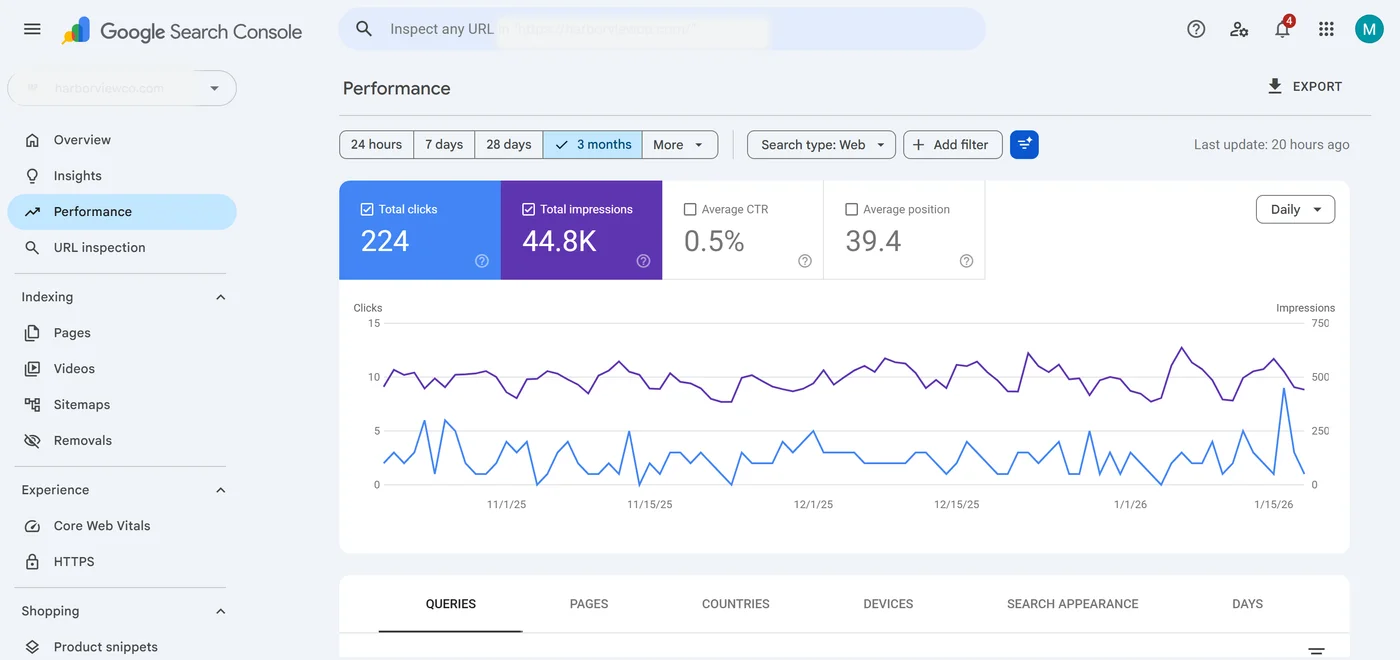
The starting point was not a traffic shortage in isolation. The site recorded 74 clicks and 2 conversions from roughly 14,770 impressions, while average position sat near 39. By the end of the case-study window, the same modeled dataset showed 1,792 clicks, 72 conversions, and an average position of 4. The practical lesson is the order of operations: technical cleanup and query-to-page ownership came before large-scale supporting content, and the content was then used to reinforce the pages most capable of generating contractor leads. The case also keeps the uneven parts visible, including terms that did not improve and decisions that traded breadth for a cleaner commercial architecture.
Executive Summary
Context
This case concerns an anonymized general contractor lead-generation site competing in a local home-services market. At the beginning, the commercial pages had weak non-branded visibility and little informational support. An average position around 39 meant the site could technically appear for relevant searches while still sitting far from the places where most users choose a result.
The commercial objective was straightforward: turn qualified local search demand into calls, quote requests, and booked work. That made traffic volume a secondary measure. Page ownership, intent fit, and the distance between a search landing page and a lead action mattered more than publishing for its own sake.
The constraints were equally important. Competition was established, production capacity was finite, and the reporting policy prohibited invented claims, credentials, or certainty. The figures on this page are masked, representative scenario metrics modeled to stay internally coherent, so use them to follow the logic and sequencing of the campaign rather than as a client's audited performance report.
The Challenge
The visible problem was a shortage of qualified leads, but the underlying issues were structural. Some commercial pages overlapped in purpose, several important intents were not matched by the right page type, and informational coverage was too thin to support the money pages consistently.
- Intent ownership was unclear. Cost, comparison, and high-intent service searches were not always routed to the page best equipped to answer them, which weakened both relevance and conversion clarity.
- Overlapping pages split signals. Multiple URLs competed around similar commercial themes instead of giving one strong destination a clear job.
- Supporting coverage was shallow. There was little content for homeowners researching before they request a quote, so the site had fewer contextual internal links and less subject coverage behind the commercial pages.
- Authority was limited. The starting backlink profile recorded Domain Rating 17 and 28 referring domains, so the plan could not rely on brute-force link acquisition.
The decision was therefore to fix ownership and crawl clarity first. Publishing more pages into an already ambiguous architecture would have created more places for signals to fragment.
Methodology
The engagement used six connected workstreams, but they were not treated as six independent tactics. Each phase was intended to make the next one easier to interpret.
1. Technical cleanup first (months 1 to 3)
The first pass covered crawl and indexation triage, canonical and redirect review, template duplication, renderability, Core Web Vitals checks, and internal status-code validation. The operating goal was to reduce avoidable crawl noise and make the priority commercial templates consistent before adding more content.
2. Match each commercial intent to one useful destination (months 2 to 4)
Commercial SERPs were reviewed by intent, then the money pages were revised around the questions and proof a homeowner would need before contacting a contractor. Supporting content was planned around those same decision areas rather than around disconnected keyword lists. Across the campaign, 30 articles were organized into 6 topic clusters: repair and maintenance basics, remodeling planning, budgeting, emergency and 24-hour situations, permit and licensing questions, and contractor selection. By the end of the period, the dataset recorded roughly 594 informational keywords.
The reason for that structure was practical. Supporting articles could answer earlier-stage questions and then link readers toward the most relevant commercial page. The internal topical authority index moved from 25 to 58, which is an internal observation rather than a Google metric. The value of the index here is comparative: it shows broader subject coverage developing alongside the commercial ranking movement.
3. Consolidate duplicate intent and rebuild internal paths (months 2, 3, 5)
Where two pages competed for the same purpose, the stronger destination was kept and weaker variants were merged or redirected. Contextual links were then rebuilt so supporting articles pointed toward the appropriate conversion page instead of distributing relevance arbitrarily.
4. Clarify entities and answer surfaces (months 3 to 5)
Organization and Service schema were cleaned up, author and reviewer references were aligned, and citations were checked for consistency. Summary blocks were also tightened so Google AI features and other assistants could extract a complete statement without inventing missing context. This was presentation and entity-clarity work, not a claim of special AI ranking treatment.
5. Add authority carefully (months 4 to 6)
Lost-link recovery, citation cleanup, relevant resource outreach, and unlinked-mention work were used selectively. Referring domains moved from 28 to 52; the important point is that this was gradual reinforcement rather than the explanation offered for every ranking gain.
6. Keep editorial claims within what the evidence supports (months 1, 2, 4)
Editorial review checked wording before publication against a clear boundary: what the approved evidence supports. That protected the public pages from invented outcomes or unsupported superiority language, and this case study's own claims follow the same rule.
Timeline
Months 1 to 2: establish a clean baseline. Clicks were 74 in the first month and 74 again in the next, with 2 conversions each. Average position shifted from 39.4 to 37.7. The team used this period for technical cleanup, intent mapping, and the first 4 and then 8 articles. The lack of a dramatic traffic jump is useful context: these were setup changes intended to make later ranking movement easier to attribute.
Month 3: consolidation starts to show. Clicks reached 125, conversions 5, and average position improved to 28.9. Impressions reached 20,810. The content library stood at 12 pieces and the internal topical authority index read 41. This was the first stage where clearer page ownership and supporting coverage were visible at the same time.
Month 4: commercial visibility broadens. Clicks rose to 219, conversions to 8, and average position to 20.6. At this stage the question was no longer whether the site had enough pages, but whether the pages already live were reinforcing the commercial destinations cleanly.
Month 5: reinforce what is working. Clicks reached 514, conversions 20, and average position 11.8. Instead of chasing article count, the work shifted toward pruning weaker material, folding overlapping pages into stronger hubs, and tightening internal links around the pages producing qualified demand. The decision reduced the risk of adding new cannibalization just as the money pages were becoming more competitive.
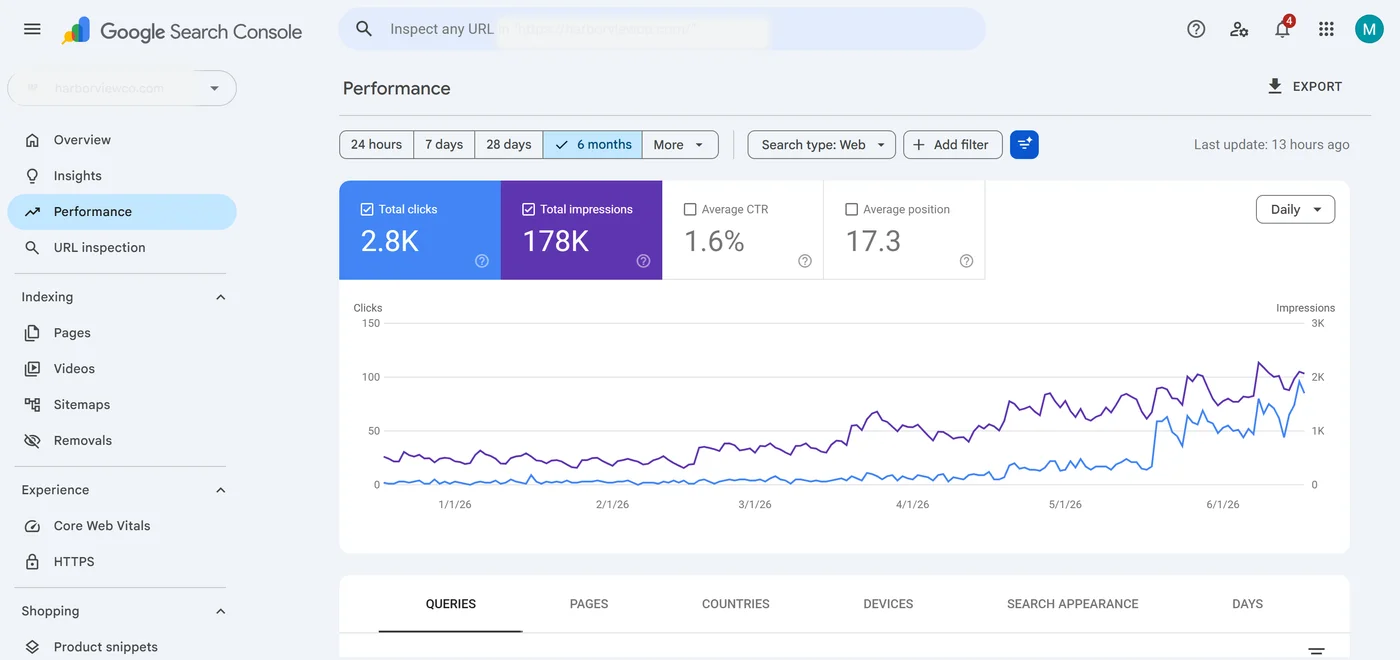
Month 6: read the combined outcome. The dataset then recorded 1,792 clicks, 72 conversions, average position 4, and 54,306 impressions. CTR moved from about 0.5% to 3.3%. Link recovery and digital PR work also ran across months 4 to 6, but the case does not treat that timing alone as proof that links caused the final jump.
Results
The before view represents a site with relevant visibility but weak placement for the searches that mattered most commercially.
The end-state view shows a broader impression base, stronger click-through, and a much better average position across the tracked set.
Across the full period, the recorded movement was:
- Clicks: 74 to 1,792 per month.
- Impressions: 14,770 to 54,306 per month.
- Average position: about 39 to 4.
- CTR: about 0.5% to 3.3%.
- Conversions: 2 to 72 per month.
- Domain Rating: 17 to 23; referring domains 28 to 52.
The difference between impression growth and click growth is why position and intent fit matter. The same search demand can produce very different traffic depending on where the result appears and whether the landing page matches what the searcher wants. The dataset implies about 24x growth in clicks against about 4x growth in impressions across the same tracked period.
Keyword Movement
The tracked query set shows the strongest gains around commercial comparisons, costs, estimates, emergency needs, and contractor-selection intent. Those are the areas where the retained money pages received the clearest supporting content and internal-link reinforcement.
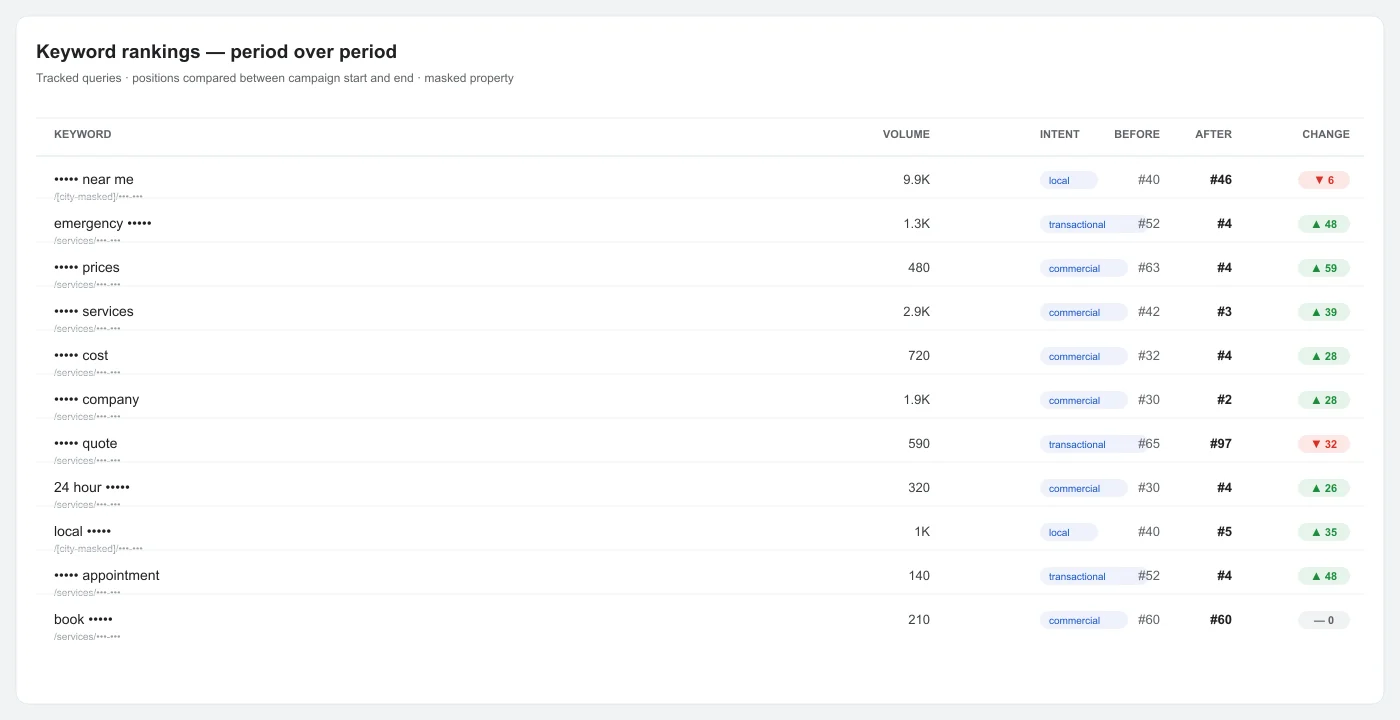
A separate third-party visibility view, built from the same anonymized, representative figures, shows the broader trajectory alongside the tracked query set.
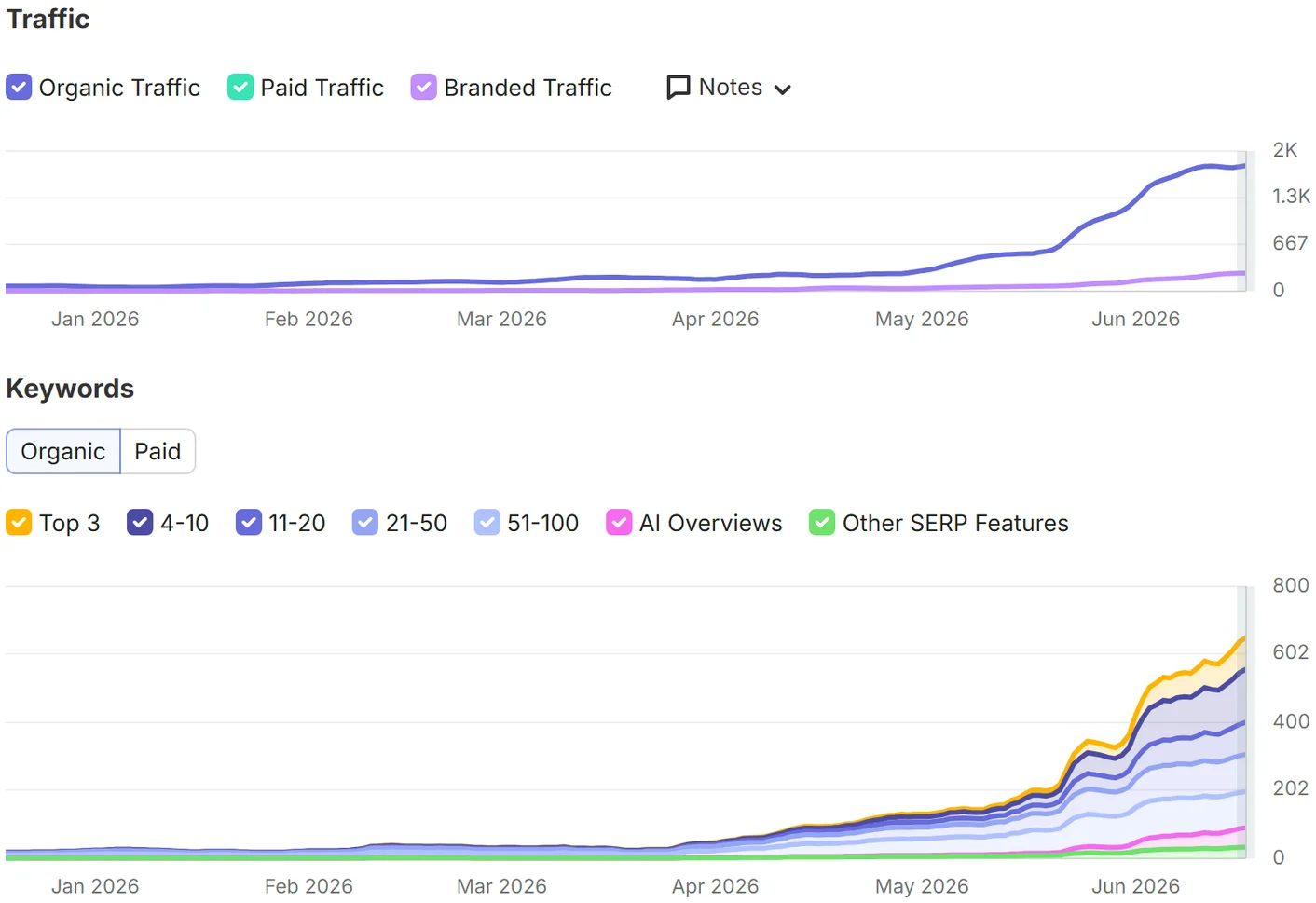
The masked table keeps the client unidentifiable while preserving the demand and position figures for each query structure.
| Query structure | Intent | Volume | Before | After |
|---|---|---|---|---|
| best * | commercial | 4,400 | 26 | 2 |
| * services | commercial | 2,900 | 42 | 3 |
| top * | commercial | 2,400 | 63 | 5 |
| * company | commercial | 1,900 | 30 | 2 |
| emergency * | transactional | 1,300 | 52 | 4 |
| local * | local | 1,000 | 40 | 5 |
| * reviews | commercial | 880 | 64 | 70 |
| * cost | commercial | 720 | 32 | 4 |
| * estimate | commercial | 590 | 55 | 1 |
| * quote | transactional | 590 | 65 | 97 |
| * prices | commercial | 480 | 63 | 4 |
| affordable * | commercial | 480 | 57 | 2 |
| 24 hour * | commercial | 320 | 30 | 4 |
| book * | commercial | 210 | 60 | 60 |
| * appointment | transactional | 140 | 52 | 4 |
| * near me | local | 9,900 | 40 | 46 |
The decision-useful point is not that every term improved. Several did not. The table makes clear which intents responded to the consolidated commercial architecture and which remain unresolved, so a next phase would prioritize the misses instead of treating total traffic growth as proof that every query strategy worked.
Business Impact
For a contractor lead-generation site, the commercial question is whether qualified search visits become inquiries and booked work. Tracked conversions moved from 2 to 72, while modeled monthly revenue moved from 680 to 24,480 using an average-job-value assumption. The revenue line is modeled rather than reconciled CRM revenue: use it to estimate what each additional lead could be worth, then compare it with your own job values and close rates.
The informational library supported that business path in two ways. It gave earlier-stage homeowners useful material around costs, permits, repair situations, and contractor selection, and it created contextual internal links toward commercial pages. That does not mean every article directly produced a job; it means the content had a defined role in the site's decision journey rather than existing as isolated traffic inventory.
The broader asset is the subject coverage itself. The campaign produced 30 articles across 6 clusters, with the internal authority index moving from 25 to 58 and roughly 594 informational keywords. Those observations suggest a larger organic footprint at the end of the period. For Google AI Overviews or other AI features, the appropriate conclusion is narrower: clear, well-sourced pages can be easier for systems to interpret and quote, but this case includes no verified AI citation metric and makes no guarantee of inclusion.
Limitations
The campaign should be read with its unresolved areas intact.
- The highest-volume local term moved the wrong way. The masked near-me query at 9,900 volume changed from 40 to 46. That is a meaningful miss. A separate local target and strong local-result competition are plausible context, though neither is proven as a single cause.
- Two commercial intents also weakened. The quote term moved from 65 to 97 and the reviews term from 64 to 70. Those should remain open optimization targets rather than being explained away by the overall traffic trend.
- One booking term did not improve. It remained at 60, a reminder that consolidation and supporting content do not make every SERP respond on the same schedule.
- The final-stage acceleration may include lag and seasonality. Home-services demand can vary over time, and work published earlier can influence later observations. The case does not contain enough evidence to separate those effects cleanly.
- Authority movement was modest. Domain Rating moved from 17 to 23. That is compatible with gradual link work, but third-party authority metrics are not Google ranking inputs, so read them as context for the link work.
Use the figures to understand sequencing and trade-offs: which work came first, which pages were consolidated, and which losses were accepted. They are not a promise of identical contractor SEO outcomes.
Causal Explanation
The case is most useful when the observed sequence is separated from claims of certainty.
Technical cleanup reduced noise. Canonical, duplication, and crawl issues were handled before content expansion so later page changes had a cleaner base. The early average-position movement from about 38 to 29 occurred in the same broad period as consolidation, which is consistent with clearer page ownership but is not proof of a single-variable cause.
Supporting content broadened the site's topical footprint. The library reached 30 articles across 6 clusters, with the internal authority index changing from 25 to 58. That library created more relevant pages from which contextual internal links could point toward commercial destinations.
Better placement and better intent fit coincided with stronger click-through. CTR changed from about 0.5% to 3.3%. Because position improved sharply at the same time, the sensible interpretation is that both ranking position and page-to-query fit contributed. The dataset also records click growth of about 24x against impression growth of about 4x, ending with 72 conversions.
Link growth was reinforcement, not a complete explanation. Authority work was gradual and ran across months 4 to 6, but timing alone does not prove that links caused every ranking gain.
The decision framework is therefore straightforward: establish one clear page per intent, support those pages with genuinely useful topic coverage, make internal links deliberate, and keep unresolved SERPs visible in reporting instead of hiding them behind aggregate growth.
Key Takeaways
- Fix ambiguity before adding inventory. More content is not automatically useful if templates, canonicals, or intent ownership are still unclear.
- Give one page one job. Consolidating overlapping commercial pages makes ranking movement easier to interpret and gives internal links a clear destination.
- Use supporting content to answer real homeowner decisions. This program organized material into topical clusters instead of scattering posts across unrelated keywords.
- Pause production when reinforcement is the higher-value task. A cleaner set of commercial pages can be more useful than another batch of thin articles.
- Report losses alongside wins. Some local and conversion-adjacent terms weakened even while aggregate traffic increased, so the next plan should address those gaps directly.
- Treat third-party authority metrics as context. Slow, relevant link growth can support a stronger site, but a metric jump by itself is not the goal.