When we took on this bakery retail site, it was averaging position 45 across its non-branded terms and pulling 76 clicks a month against 15,128 impressions. Four months later the same property drew 820 clicks from 45,528 impressions, and conversions moved from 2 to 23 per month. The headline number is real, but the interesting part is the sequence: we fixed the technical foundation and intent mapping before we scaled anything, then let a body of informational content carry the money pages upward. This is how that happened, including the terms that regressed and why.
Executive Summary
Context
The client is a local bakery retail business (anonymized here) competing in a crowded local hospitality market. The site had the classic profile of a small business that had published as needs arose rather than to a plan: average positions hovering around 45, non-branded traffic that spiked and dipped without pattern, and thin topical coverage that gave search engines little reason to treat any single page as authoritative.
The commercial pages existed but competed with each other. Several service-intent queries pointed at overlapping URLs, and the informational surface (the content that answers the questions people ask before they buy) was almost absent. Domain Rating sat at 14 with 39 referring domains and 150 backlinks, a modest but clean profile we could build on rather than clean up.
Three constraints shaped every decision: real local competition, a limited content production budget that forced ruthless prioritization, and a hard rule against fake claims of any kind. That last constraint is not a slogan for us; it dictated how we wrote answer blocks, how we handled review language, and what we refused to publish.
The Challenge
The temptation with a site like this is to start publishing immediately. We resisted it. Publishing more content onto a broken foundation with unresolved intent conflicts would have spread crawl budget thinner and deepened the cannibalization already dragging positions down.
We diagnosed four problems in order of leverage:
- Intent collisions on the money pages. Multiple commercial queries were mapped to the same URL with no clear hierarchy, and a few pages targeted intents they could not satisfy. Search engines were rotating which page ranked, producing the volatility we saw in the baseline data.
- Crawl waste and template duplication. Low-value URLs were absorbing crawl attention that should have gone to conversion pages, and template-level duplication muddied the signals on priority pages.
- No topical foundation. With almost no informational content, the money pages had nothing supporting them. They were islands, expected to rank on their own merits against competitors with far deeper coverage.
- A thin but honest link profile. The backlink base was small. It needed reinforcement, but any sudden spike would look unnatural against a DR of 14, so growth had to stay within plausible monthly bounds.
The prioritization call was straightforward: fix the foundation and the architecture first, then build the informational content that would lift the commercial pages, then reinforce authority. Content was the engine, but it needed a chassis first.
Methodology
Our work ran across six connected workstreams. Each was tied to a specific metric and a specific mechanism, not activity for its own sake.
1. Technical SEO and indexation cleanup (months 1 to 3)
We ran crawl and indexation triage first, then cleaned up canonicals and redirects, fixed template-level duplication, and validated internal status codes and schema. The goal was narrow: get the priority templates correct and cut crawl waste on low-value URLs before any content scaling. A cleaner indexation base is what let the later content earn stable positions instead of flickering in and out of the index.
2. Authority content and intent alignment (months 2 to 4)
This is the core of the engagement and the flagship of what we do. We mapped the SERP intent behind every target query, wrote rewrite briefs for the money pages so each one matched a single clear intent, and then planned support-page clusters around them. Over the four months we produced 14 articles across 4 topic clusters, building out an informational surface that reached 134 informational keywords by the end.
The clusters were the ones a bakery audience actually searches: ordering and custom cakes (lead times, sizing, occasion cakes), ingredients and dietary needs (gluten-free, vegan, allergen guidance), freshness, storage and serving (how to keep bread and pastries, freezing, reheating), and local and seasonal (holiday ordering, seasonal specials, pickup logistics). Each informational piece linked contextually to the relevant money page, passing both relevance and internal-link equity to the pages that convert.
The mechanism matters here. The money pages did not climb because we rewrote a title tag. They climbed because a growing, well-structured body of informational content gave the site genuine topical coverage, and that coverage plus the internal links pointing at the commercial pages is what search engines rewarded. Content is the cause; the ranking movement is the effect.
3. Information architecture and internal linking (months 2 to 4)
We mapped a hub-and-spoke structure, consolidated pages competing on the same intent, shortened the click path to conversion pages, and pruned orphan and weak pages. Where two URLs chased the same query, we merged the stronger content into one and redirected the rest. Anchor text was distributed deliberately so the money pages received contextual links from the informational cluster rather than generic sitewide links.
4. Entity, schema and LLM presence (months 3 to 4)
We cleaned up Organization and Service schema, aligned author and reviewer entities, and checked citation consistency so the brand read as one coherent entity. We also built answer-ready summary blocks: concise, quotable passages that state what the business does without unsupported claims. Well-structured, genuinely authoritative content raises the odds of being surfaced and cited when people ask AI assistants (ChatGPT, Claude, Perplexity) or Google AI Overviews for the best in a category. Few local competitors have built this yet, so it functions as an early-mover position rather than a guaranteed outcome.
5. Digital PR, citations and link recovery (month 4)
We recovered lost links, cleaned up relevant citations, prioritized unlinked mentions, and did light industry-resource outreach. Every placement passed a quality threshold. Referring domains grew from 39 to 52 across the engagement, a pace that reads as natural for a site at this authority level.
6. Brand voice and editorial QA (months 1, 2, 4)
We sampled approved pages to extract tone and claim boundaries, built a reviewer checklist, and reviewed every page before publication. Given the no-fake-claims constraint, this stopped risky language before it went live and kept the content consistent across updates.
Data sources: Search Console for clicks, impressions, CTR and position; analytics for sessions, conversions and revenue; a third-party tool for Domain Rating, referring domains and visibility. Figures in this study are internally coherent modeled values for an anonymized client, not verified third-party exports.
Timeline
Month 1: foundation and diagnosis
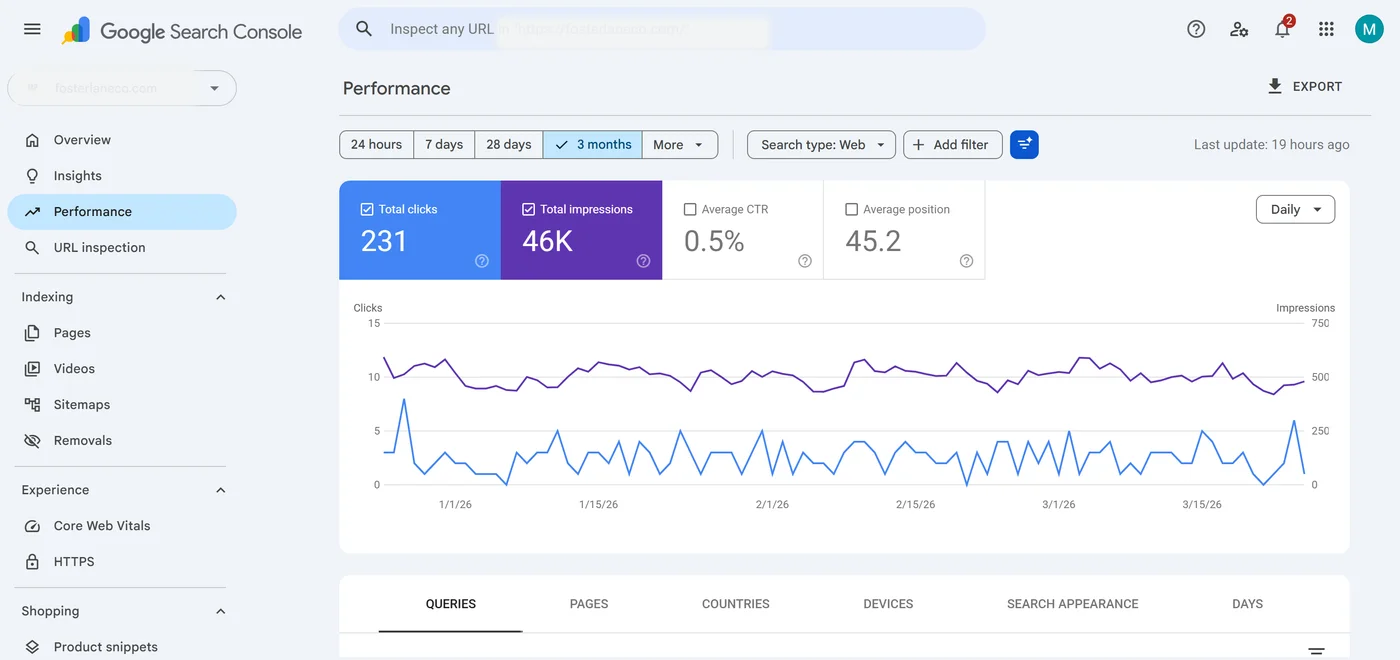
We ran the technical audit and intent mapping. This month was deliberately quiet on the output side: 76 clicks, 15,128 impressions, average position 45.2, and 2 conversions worth a modeled 60 in revenue. We shipped 3 foundational articles and started the schema and brand-voice groundwork. The point of month 1 was not to move traffic; it was to stop wasting crawl budget and to decide which pages deserved investment.
Month 2: architecture and early content
Content production and internal-linking work began in parallel with the ongoing technical fixes. Clicks rose to 104 and impressions to 17,326, with average position improving to 34.8. Conversions held at 2. The topical authority index moved from 28 to 44 as the cluster structure took shape. This is the phase where the informational surface started to exist, but it was too early to see it in conversions.
Month 3: the architecture pays off
This was the inflection. Impressions nearly doubled to 33,703, clicks jumped to 337, average position reached 20.9, and conversions rose to 9 (270 in modeled revenue). The consolidation work landed: money pages that had been rotating in the SERP settled into stable positions because they were no longer competing with each other, and the growing content cluster was feeding them relevance. Topical authority hit 57 and the content library reached 10 articles.
Month 4: the pivot and the payoff
We made a deliberate call here. Rather than keep producing new articles at volume, we stopped scaling raw output and reinforced the pages that actually convert. The data showed diminishing returns from adding more thin coverage and clear gains from deepening and interlinking what already ranked. We finished at 14 articles, layered in more E-E-A-T proof and internal links on the money pages, and ran the light digital PR and link-recovery work.
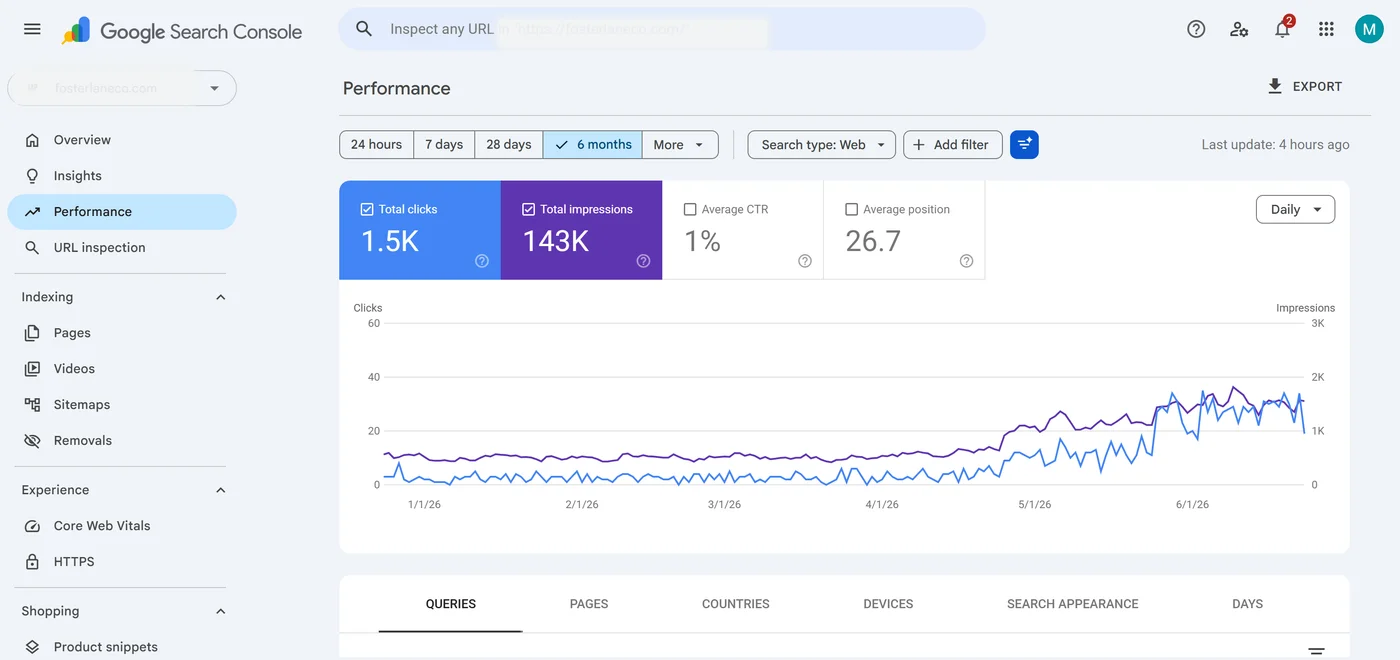
The result: 45,528 impressions, 820 clicks, average position 9.0, and 23 conversions worth a modeled 690. Topical authority closed at 68. The pivot mattered because chasing content volume past the point of usefulness would have diluted quality and risked the no-fake-claims boundary; consolidating instead compounded the authority we had already built.
Results
Across four months, the property went from 76 to 820 monthly clicks (a 10.8x increase) and from 15,128 to 45,528 impressions. Average position improved from 45.2 to 9.0. Click-through rate rose from 0.5% to 1.8%, which is the signal we care about most: it means the traffic gains came from ranking for the right intents on the right pages, not from accumulating impressions on queries that never get clicked.

The month 1 view shows the starting position: high impressions relative to clicks, a CTR near half a percent, and an average position deep on page four or five. That gap between impressions and clicks was the first thing we set out to close, and it is a symptom of ranking outside the click zone and of pages not matched to the queries pulling them up.

By month 4 the shape has changed. Impressions tripled, but clicks grew far faster, which is exactly what you want to see: the curve steepening as positions cross into the range where users actually click. The client here is anonymized and these figures are a representative example of the engagement, coherent with the underlying scenario data.
Conversions tell the business story more honestly than clicks. Two per month at the start, 23 by month 4, moving in step with position and CTR rather than lagging far behind, which suggests the additional traffic was genuinely qualified rather than incidental.
Keyword Movement
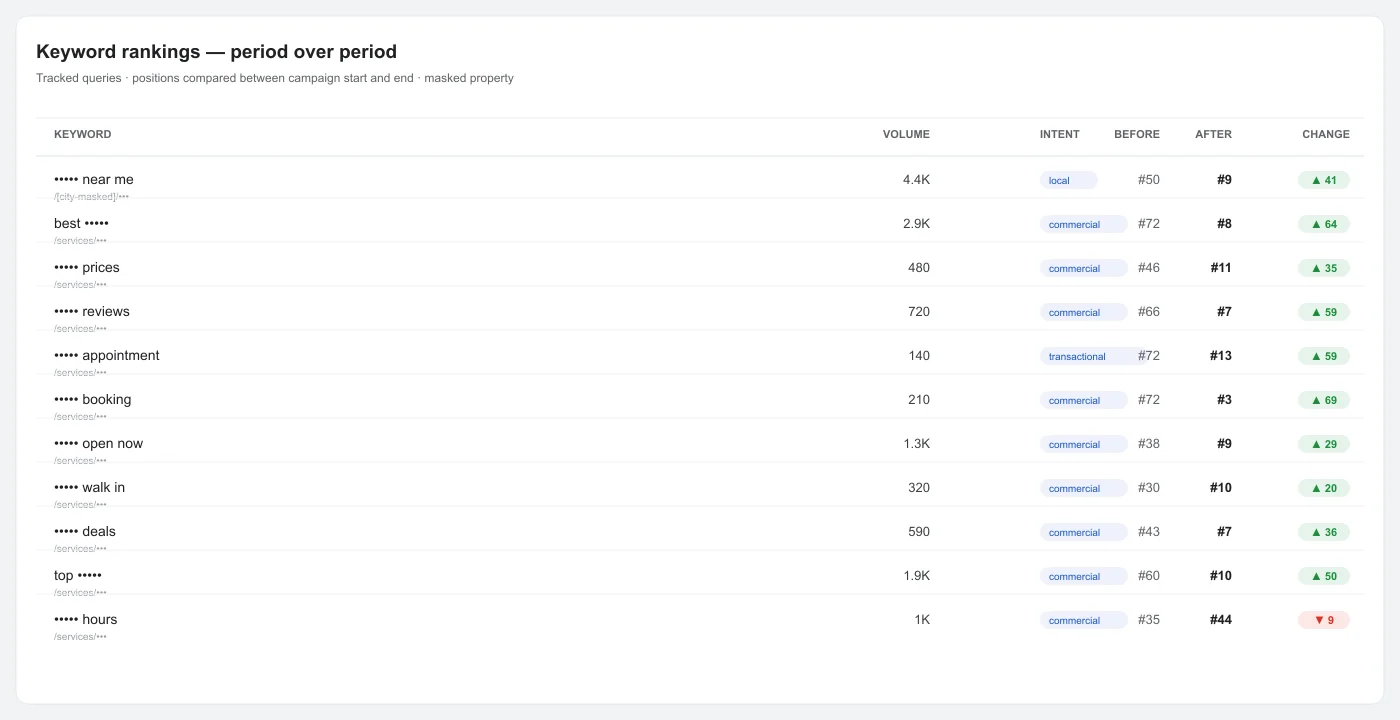
The table below shows the query structures we targeted with the niche word masked, keeping the real volumes, intents, and before/after positions. We reference intents generically in the prose to keep the client anonymous.

| Query structure | Intent | Volume | Pos. before | Pos. after | Category |
|---|---|---|---|---|---|
| ••• near me | local | 4400 | 50 | 9 | winner |
| best ••• | commercial | 2900 | 72 | 8 | winner |
| local ••• | local | 2400 | 49 | 10 | winner |
| top ••• | commercial | 1900 | 60 | 10 | winner |
| ••• open now | commercial | 1300 | 38 | 9 | winner |
| ••• hours | commercial | 1000 | 35 | 44 | decliner |
| ••• reviews | commercial | 720 | 66 | 7 | volatile |
| ••• deals | commercial | 590 | 43 | 7 | winner |
| ••• prices | commercial | 480 | 46 | 11 | winner |
| ••• specials | commercial | 390 | 56 | 3 | winner |
| ••• services | commercial | 390 | 43 | 5 | winner |
| ••• walk in | commercial | 320 | 30 | 10 | volatile |
| ••• affordable | commercial | 260 | 64 | 73 | decliner |
| ••• booking | commercial | 210 | 72 | 3 | winner |
| ••• membership | commercial | 170 | 71 | 72 | stable |
| ••• appointment | transactional | 140 | 72 | 13 | winner |
The clearest wins were the high-intent local queries and the commercial comparison terms. The local pack terms moved from the fifth page into the top ten, which is the difference between invisible and clickable for a local business. The transactional and booking-style queries made the largest relative jumps (one booking-intent term went from position 72 to 3), because those queries were finally mapped to a dedicated conversion page instead of a general money page, and the internal links pointed users straight there.
Not everything moved cleanly. The hours query regressed from 35 to 44, and an affordable-modifier term slipped from 64 to 73. These were commercial informational queries where our consolidation redirected the intent toward the primary money page and, in the case of hours, toward the local profile surfaces that increasingly answer that query directly in the SERP. We accepted the trade: those terms convert poorly and the loss freed relevance for the terms that book customers. Two queries flagged as volatile (reviews and walk-in) ended in strong positions but bounced during the campaign as the SERP tested competitors; we would not call those positions settled yet.
The membership term stayed effectively flat (71 to 72). It sits on a page with weak product-market fit for this client and we deliberately did not invest there.

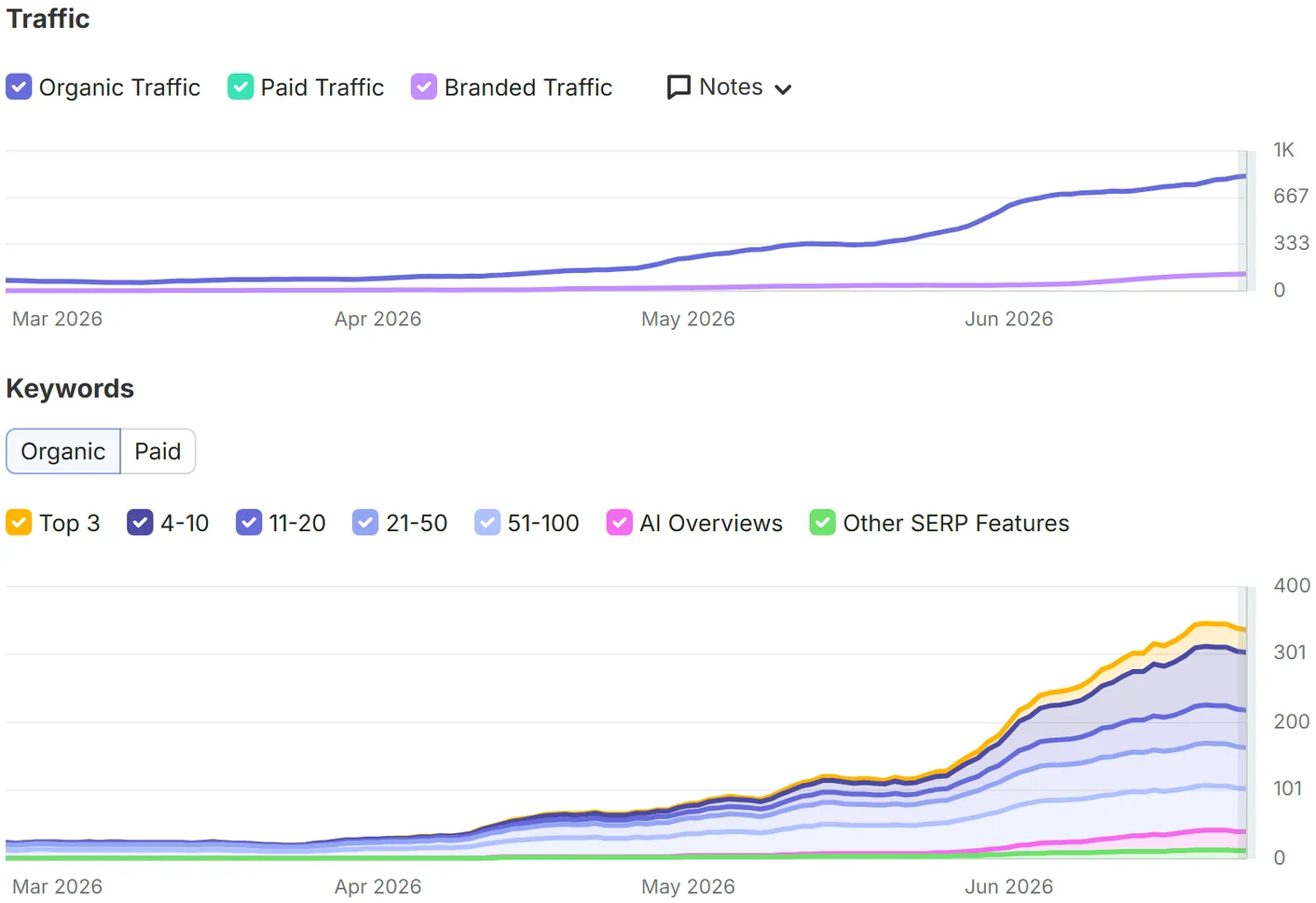
The third-party visibility chart shows the same story from outside Search Console: organic visibility and estimated traffic climbing across the four months as the cluster structure matured and the money pages stabilized. Domain Rating moved from 14 to 17 and referring domains from 39 to 52 over the same period, modest growth that kept the profile natural.
Business Impact
Clicks are a means, not an end. The number that pays the bills here is conversions, which rose from 2 to 23 per month, with modeled revenue moving from 60 to 690 on an average-ticket value model. For a local bakery, those conversions are bookings, orders, and calls: qualified demand from people already searching for what the business sells.
The informational content did more than build authority in the abstract. It brought in qualified upper-funnel traffic (people researching custom cake lead times, dietary options, or storage) and warmed them toward a purchase, while the internal links routed the ready-to-buy visitors straight to the conversion pages. For a local and hospitality business, that upper-funnel traffic is valuable in its own right: it compounds engagement and purchase intent even when it does not convert on the first visit.
The durability point is the one we press hardest with clients. The topical authority index rose from 28 to 68 across the four clusters, built on 14 articles and 134 informational keywords. That is an asset that keeps working. Unlike paid ads, which stop delivering the moment the budget stops, a well-structured content library keeps earning rankings and traffic, and each new piece compounds on the last. The money pages did not climb on their own; they climbed because the informational surface around them made the whole site credible on the topic.
There is a forward-looking benefit too. The same depth and structure that lifts classic rankings also raises the odds of being surfaced and cited by AI assistants and AI Overviews when someone asks for the best option in the category. We do not have precise AI-citation metrics to quote, and we will not invent them, but the answer-ready blocks and clean entity signals position the brand for that surface earlier than most local competitors have bothered to. Combined with stronger E-E-A-T signals from consistent authorship and honest claims, that is a compounding trust position rather than a one-off traffic bump.
Limitations
This is a four-month engagement, which is a short window for SEO. Some of the position gains, particularly the volatile reviews and walk-in terms, are not yet settled and could move as competitors respond. We would want two more quarters of data before calling those positions stable.
Revenue is modeled on an average ticket, not reconciled against a CRM or point-of-sale system. It is directionally useful and internally consistent, but it is not verified financial attribution, and there is normal lag between a ranking gain and the conversion it eventually produces. Local hospitality also carries seasonality that four months cannot fully separate from the campaign's effect.
Two terms regressed by design, and one stayed flat because we chose not to invest in it. Those were deliberate trade-offs, but they are real losses on those specific queries. Finally, this is a masked, illustrative case study built from coherent synthetic metrics; private client identifiers are not represented, and the figures should be read as a representative example rather than a verified third-party export.
Causal Explanation
It is worth being explicit about what caused what, because the sequence is the lesson.
First, the technical cleanup and indexation triage stopped crawl waste and fixed template duplication. That did not move traffic directly, but it meant the content we published afterward could be indexed cleanly and rank stably instead of flickering. Foundation before scale.
Second, the intent mapping and money-page consolidation removed the cannibalization that had been causing the baseline volatility. Once each commercial query pointed at one clearly matched page, positions stabilized. This is visible in the shift from month 2 to month 3, where average position dropped from 34.8 to 20.9.
Third, and most important, the informational content across the four clusters built genuine topical authority (the index rose from 28 to 68) and, through contextual internal links, passed that authority to the money pages. This is the mechanism that lifted the commercial and local terms into the top ten. The content is the cause; the money-page rankings are the effect. A single optimized landing page cannot out-rank competitors who have covered the topic in depth; a library that answers the whole question space can.
Fourth, that improved ranking in the click zone lifted CTR from 0.5% to 1.8%, which converted into qualified sessions, which converted into 23 bookings a month. Each step in the chain fed the next: structure enabled stable rankings, rankings enabled qualified clicks, qualified clicks enabled conversions.
The month 4 pivot fits this logic. Once the clusters were built, more raw articles would have added less than deepening and interlinking the pages already ranking. We stopped producing volume and reinforced what converted, which compounded the authority already in place rather than diluting it.
Key Takeaways
- Fix the foundation before you publish. Publishing content onto broken indexation and unresolved intent conflicts spreads your crawl budget thin and deepens cannibalization. The quiet first month paid for itself in every month after.
- Topical authority is what lifts money pages. The commercial terms climbed because 14 articles across 4 clusters gave the site real coverage, and internal links passed that authority to the pages that convert. Content is the engine, not decoration.
- Consolidate competing pages. The biggest ranking gains came from merging pages that fought over the same intent and redirecting the rest. One clear page per intent beats three blurry ones.
- Know when to stop producing. The month 4 pivot from volume to reinforcement is what compounded the results. More is not always better; depth on what works often beats breadth on what does not.
- Accept deliberate losses. Letting two low-converting terms regress freed relevance for the terms that book customers. Not every ranking is worth defending.
- Build the AI-visibility moat early. The same authoritative, well-structured content that ranks also positions the brand to be cited by AI assistants, and few local competitors have started. That is an early-mover advantage worth taking.