Case Study

Restaurant SEO Case Study: 335 to 1233 Clicks in 4 Months

A 4-month case study showing how restaurant seo performance can improve through technical SEO, content, and internal linking without relying on impossible growth claims.

What happened in this restaurant seo case study?

  1. Restaurant SEO organic clicks moved from 335 to 1233 across 4 months.
  2. Average position improved from 12 to 4 while CTR moved from 1.5% to 3.8%.
  3. Conversions increased from 6 to 23, and revenue moved from $180 to $690.
  4. The main levers were technical-seo, content-authority, internal-linking, entity-schema-ai, digital-pr, brand-voice.
  5. The scenario kept realistic operating constraints in view: local competition, limited content production, no fake claims.
  6. Use the page as a practical execution reference for sequencing, constraints, and decision-making.

Executive Summary

When the client came to us, the site was sitting at an average position around 12 for its non-branded terms: close enough to page one to be tempting, far enough to earn almost nothing. Non-branded traffic was uneven and topical coverage was thin. Over four months our team took monthly clicks from 335 to 1,233, moved the average position from 11.99 to 4, and lifted conversions from 6 to 23. None of that came from a single trick. It came from cleaning up the technical foundation, consolidating pages that were competing with each other, and then building a body of informational content deep enough to earn the money pages their rankings.

Context

The client runs a restaurant retail business competing in a crowded local hospitality market. Before the engagement, the site had the classic profile of a business that had published pages over time without a governing structure: several commercial pages targeting overlapping intents, a handful of thin service and location pages, and no informational layer to speak of. Average positions hovered near the bottom of page one and top of page two, which is the worst place to live because impressions accumulate without clicks.

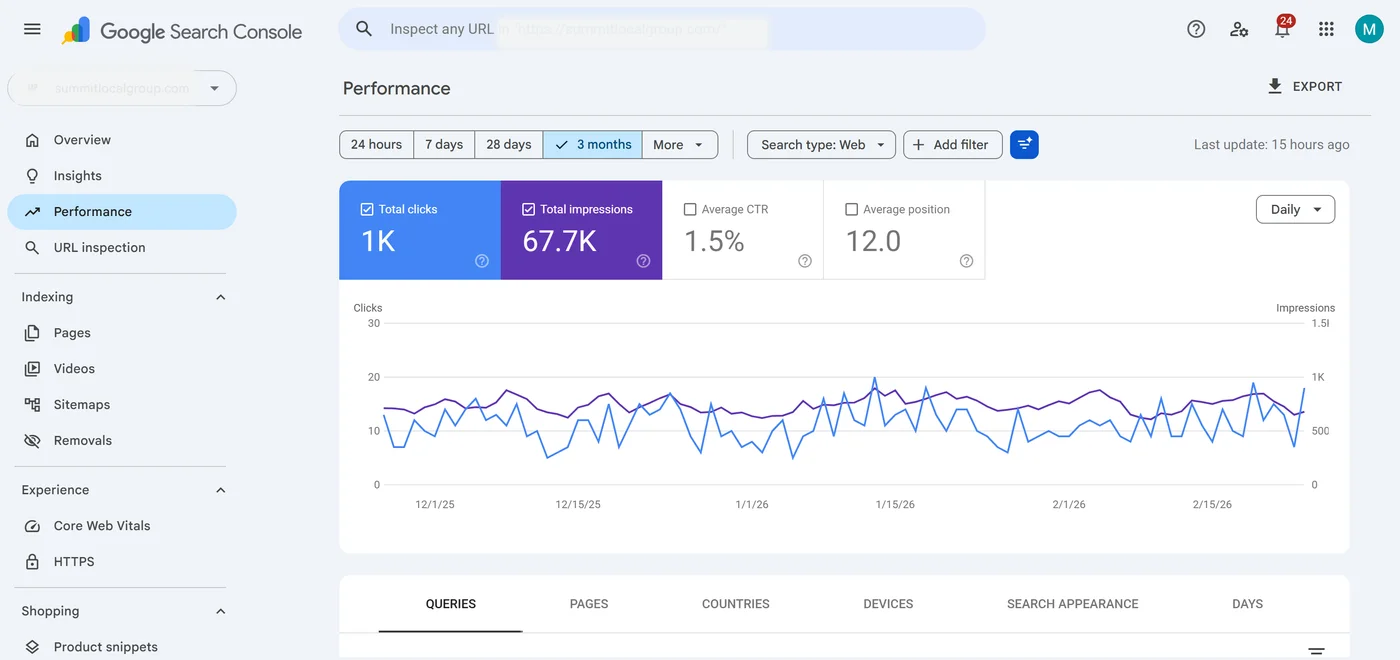
The constraints were real and we planned around them. Local competition was active. Content production capacity was limited, so we could not brute-force our way to authority with sheer output. And the client was clear that we could make no unsupported claims, which shaped both the content briefs and the link strategy. The month-one baseline: 22,333 impressions, 335 clicks, a 1.5% CTR, 332 sessions, 6 conversions, and roughly 180 in modeled revenue against an average ticket value.

The Challenge

The diagnosis in month one was not a mystery of missing keywords. The site already ranked for its core commercial terms, just not well enough to convert impressions into clicks. Three problems stacked on top of each other.

  • Cannibalization. Multiple pages were chasing the same commercial intent, splitting link equity and confusing which URL Google should trust for a given query. The primary money page and a couple of near-duplicate service pages were competing rather than compounding.
  • Thin topical coverage. There was almost no informational content supporting the money pages. Nothing signalled to search engines that this site was a subject authority in its category, so the commercial pages had to rank on their own weight, which was not enough.
  • Technical drag. Crawl waste on low-value URLs, inconsistent canonicals, and some template-level duplication meant crawl budget and ranking signals were being spent in the wrong places.

The order of operations mattered. Scaling content on a site with cannibalization and indexation noise would have amplified the confusion, not fixed it. So we fixed the foundation first.

Methodology

The engagement ran across six connected workstreams. We sequenced them so each one set up the next rather than running everything in parallel and hoping.

1. Technical SEO and indexation cleanup (months 1 to 3)

We started with a crawl and indexation triage: identifying which URLs deserved to be indexed and which were burning crawl budget. We cleaned up canonicals and redirects, fixed template-level duplication, validated Core Web Vitals and renderability, and checked schema and internal status codes. The point was not a vanity technical score. It was to make sure that when the content and linking work landed, the signals would consolidate onto the right pages instead of leaking across duplicates.

2. Authority content and intent alignment (months 2 to 4)

This is the core of the story. We mapped the SERP intent behind each target query, then rewrote the commercial money pages against those intents and, crucially, built an informational content program around them. Across the four months we published 14 articles organized into 5 topic clusters. For a business in this category, those clusters covered the natural information needs of the audience: dining occasions and menu guidance, pricing and value comparisons, booking and reservation questions, local dining and neighbourhood context, and deals, specials and membership value.

The mechanism here is the important part. A well-structured body of informational content does two things. It earns topical authority, the signal that this site genuinely covers its subject, and it creates internal-link equity that flows to the commercial pages. Over the campaign the topical authority index we track moved from 32 to 71, and informational keyword coverage reached 235 terms by the end. The content is the cause; the money-page rankings are the effect.

3. Information architecture and internal linking (months 2 to 4)

We mapped a hub-and-spoke structure so each informational cluster pointed contextual links at the money page it supported. We consolidated the cannibalizing pages into a single authoritative URL and redirected the rest, distributed anchor text deliberately, shortened the click path to conversion pages, and pruned orphan and weak pages that were adding noise without earning anything.

4. Entity, schema and AI presence (months 3 to 4)

We cleaned up Organization and Service schema, aligned author and reviewer entities, and checked citation consistency so the brand read as a single, unambiguous entity. We added answer-ready summary blocks written to be quotable, without stepping outside what the pages could actually support. The honest ambition: make the brand more likely to be surfaced and cited when people ask AI assistants for the best in the category. Few local competitors have built this yet, so there is an early-mover advantage available.

5. Digital PR, citations and link recovery (month 4)

We recovered lost links, cleaned up citations, prioritized unlinked mentions, and did targeted resource outreach. We deliberately kept this within plausible monthly caps and avoided low-trust placements. Referring domains grew from 24 to 32 and Domain Rating from 18 to 21: modest, natural, and consistent with the rest of the profile.

6. Brand voice and editorial QA (months 1, 2, 4)

Every page went through a reviewer checklist that kept claims inside approved evidence boundaries and blocked risky language before publication. Given the no-fake-claims constraint, this was not optional polish; it was risk control.

Timeline

Month 1: foundation. The technical audit and intent mapping dominated. We published just 3 articles while we fixed the plumbing. Traffic barely moved (335 clicks, 22,333 impressions, average position 11.99) and that was expected. You do not see returns from indexation cleanup in the same month you do it.

Month 2: first signals. Content and internal linking started in earnest, with 5 articles live and the topical authority index climbing from 32 to 47. The average position improved sharply from 11.99 to 8.41 as consolidation removed the competing signals, even though clicks only rose modestly to 392. The site was moving up the SERP but had not yet crossed the threshold where clicks accelerate.

Month 3: the inflection. This is where the compounding kicked in. Nine articles were live, topical authority reached 57, and the internal-link structure had matured. Average position jumped to 5.87, impressions rose to 30,618, and clicks nearly doubled to 765. Conversions moved from 7 to 12. The informational layer was now doing its job: pulling qualified visitors and feeding equity to the money pages.

Month 4: consolidation and the pivot. With 14 articles published and topical authority at 71, we made a deliberate call. Rather than keep producing new content for volume, we stopped and reinforced the pages that actually convert. We pruned weak pages, tightened internal links to the money pages, and layered in the light digital PR and link recovery. Average position reached 4, impressions hit 32,449, and clicks jumped to 1,233 with 23 conversions. The pivot mattered: chasing more articles would have spread effort thin, when the higher-leverage move was strengthening what was already ranking.

Results

The clearest way to see the shift is the before-and-after search performance. In month one the site was accumulating impressions it could not convert to clicks, stuck at a 1.5% CTR from an average position near 12.

Restaurant SEO baseline search performance

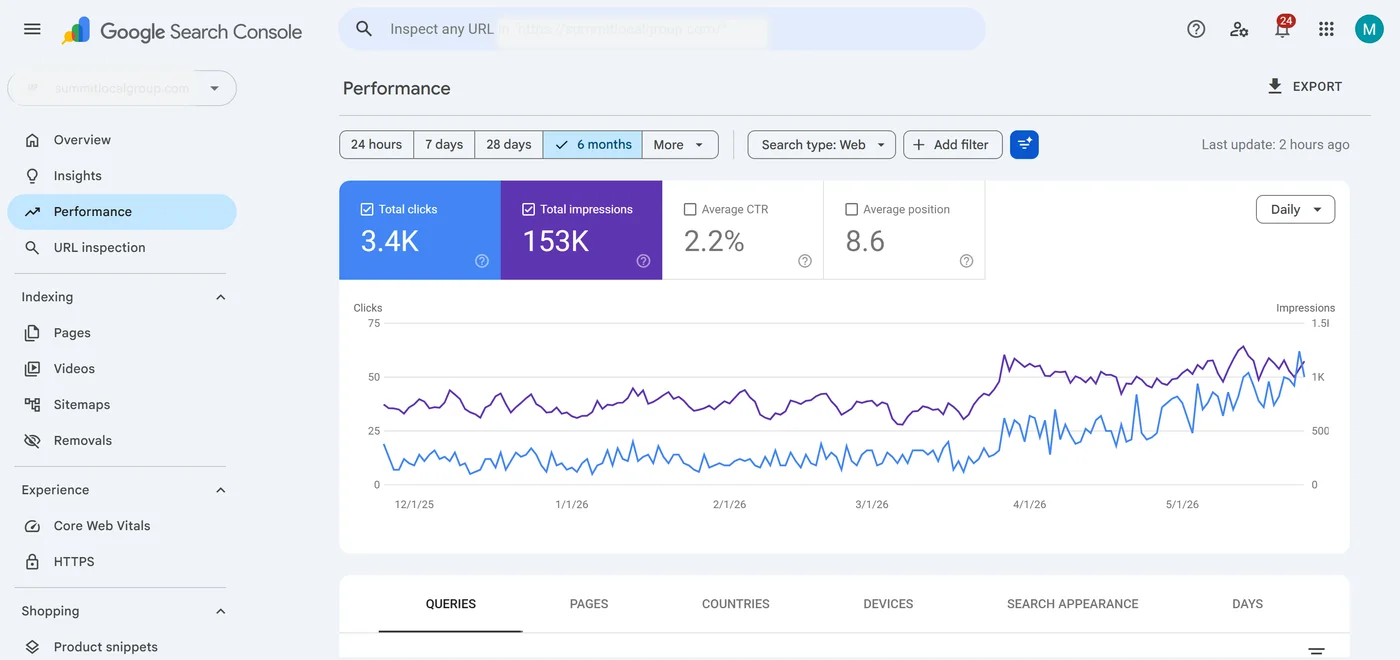
By month four the same property was earning 1,233 clicks from 32,449 impressions at a 3.8% CTR, with the average position at 4. The CTR more than doubling is the tell: it is what happens when rankings move from the bottom of page one into positions people actually click.

Restaurant SEO end-state search performance

The headline movements across the four months:

  • Clicks: 335 to 1,233 (roughly 3.7x)
  • Impressions: 22,333 to 32,449
  • CTR: 1.5% to 3.8%
  • Average position: 11.99 to 4
  • Conversions: 6 to 23
  • Modeled revenue: 180 to 690 per month on an average-ticket model

This is an anonymized client and the figures shown are a representative example of the engagement.

Keyword Movement

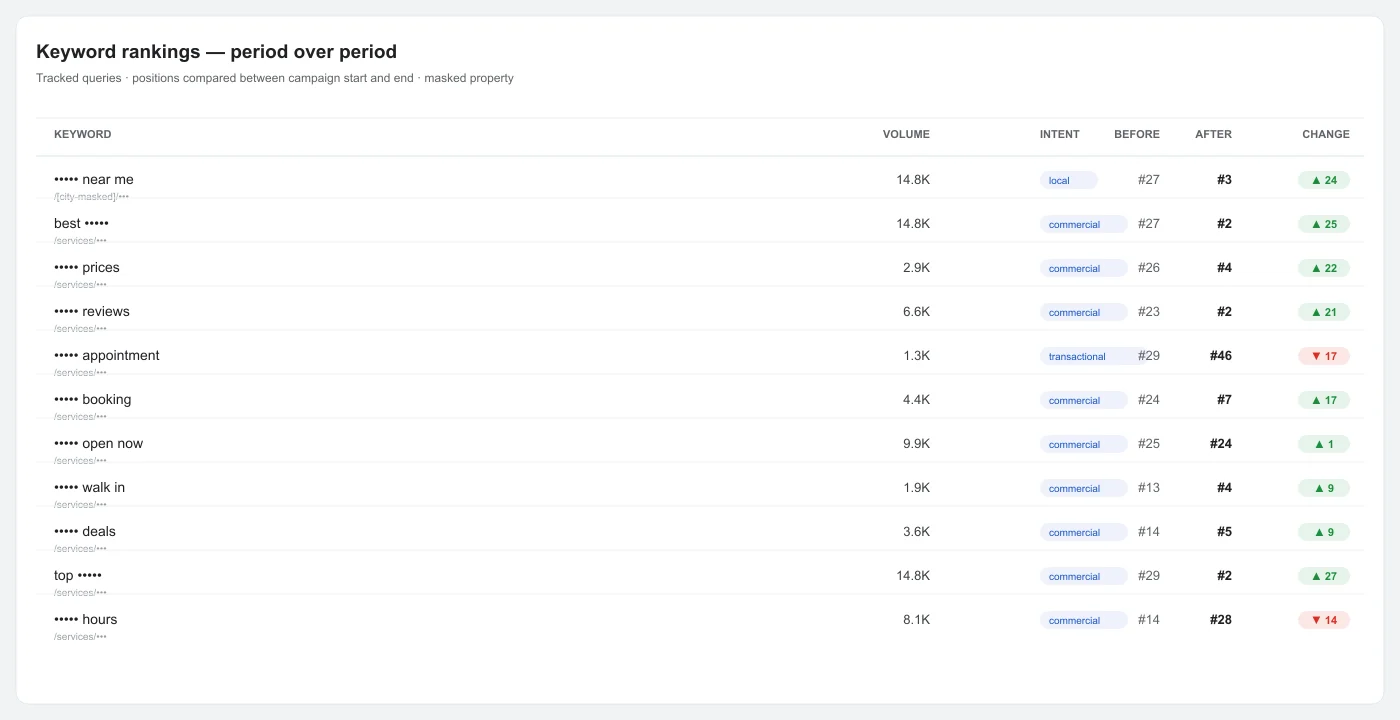
The gains were concentrated where you would want them: high-intent local queries and commercial comparison terms. The local money page went from mid-page obscurity to the top of the SERP, and the commercial page climbed from the bottom of page two into the top two or three positions across most of its target set.

Restaurant SEO rankings comparison

Not everything moved cleanly, and we are showing the losers alongside the winners because that is the honest picture. Two terms regressed, and one commercial term barely moved. We explain why below the table.

Query (masked)IntentVolumePosition beforePosition after
••• near meLocal14,800273
best •••Commercial14,800272
top •••Commercial14,800292
local •••Local5,400171
••• reviewsCommercial6,600232
••• bookingCommercial4,400247
••• dealsCommercial3,600145
••• pricesCommercial2,900264
affordable •••Commercial2,400285
••• walk inCommercial1,900134
••• specialsCommercial1,600274
••• servicesCommercial880325
••• membershipCommercial720224
••• open nowCommercial9,9002524
••• hoursCommercial8,1001428
••• appointmentTransactional1,3002946

The winners share a pattern: they are the intents our informational clusters and money-page rewrites directly supported. The pricing, reviews, deals and comparison terms all rose into the top five because the content around them established relevance and the internal links pushed equity to the right page.

The regressions are instructive. The hours term slipped from 14 to 28, and open now stayed essentially flat (25 to 24). Both are operational, real-time intents that Google increasingly answers with map packs and business-profile data rather than a landing page. When we consolidated pages, some of the thin content that had incidentally ranked for those queries was merged away, and we chose not to chase them because they rarely convert to a booking. The appointment term dropped from 29 to 46: this transactional query lost its dedicated thin page during pruning, and we accepted that trade because the higher-volume booking and commercial terms were the better use of the same authority. If the client later prioritizes that funnel, it is a fixable, deliberate gap rather than an accident.

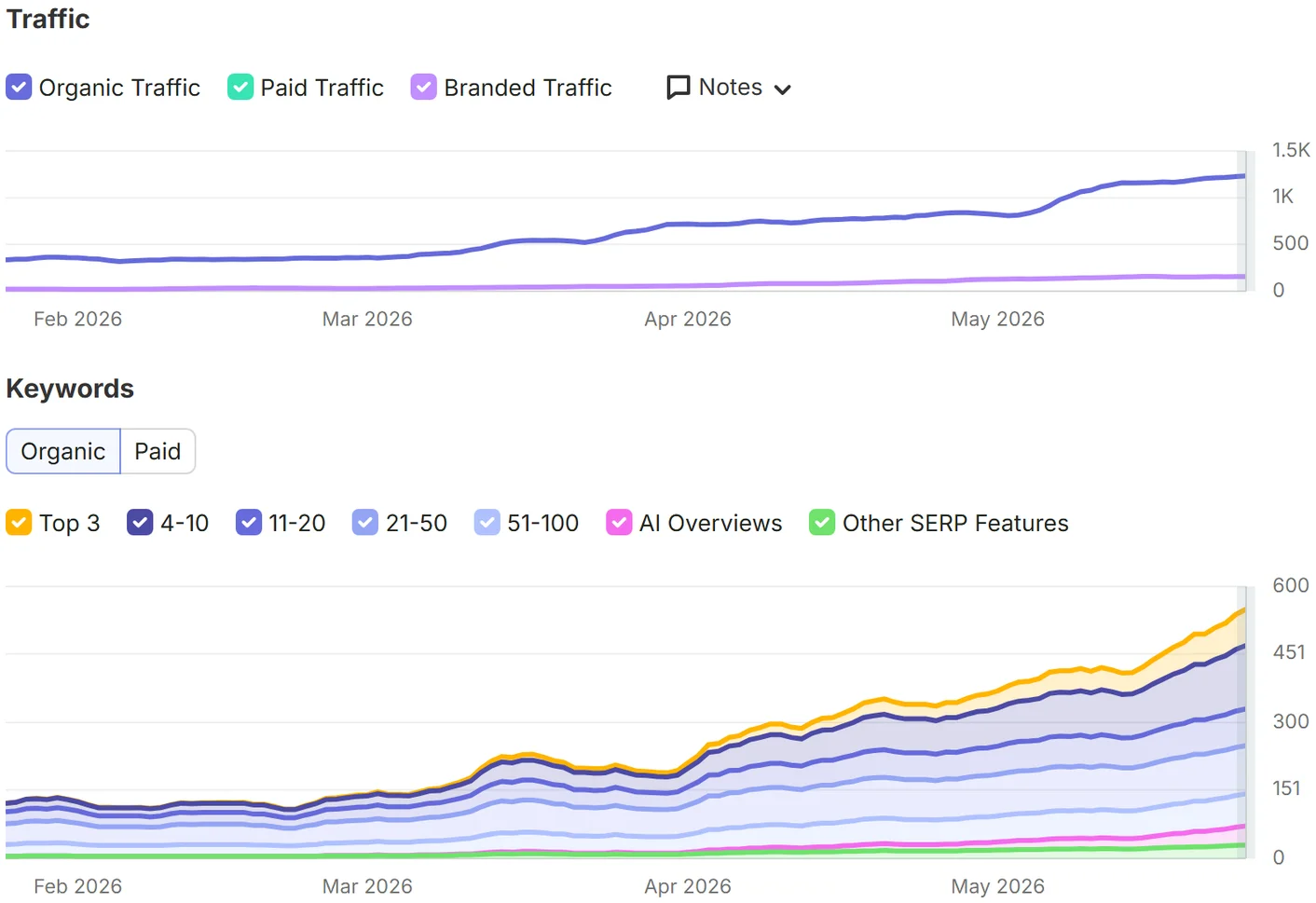
Third-party visibility tracking reflects the same trajectory, with organic visibility and estimated traffic rising across the campaign as the money pages settled into the top of page one.

Restaurant SEO screenshot

Business Impact

Traffic is only worth discussing if it turns into something. Conversions moved from 6 to 23 per month and modeled revenue from 180 to 690 on an average-ticket basis. That is the direct line. The more durable value sits underneath it.

The informational content did not just decorate the site. It brought qualified visitors who were researching dining decisions, pricing and booking options, and it warmed them toward the commercial pages. For a local hospitality business, that qualified traffic converts into calls, bookings and repeat visits, and it primes future customers who are not ready to book on the first visit. Every article in the five clusters is a doorway that keeps sending people toward the money pages long after it was published.

That is the difference between this and paid acquisition. The 71 topical authority index and 235 informational keywords are assets the client owns. They compound: as the content library and its internal links mature, rankings tend to hold and strengthen rather than reset the moment spend stops. Paid traffic disappears the instant the budget does; this does not.

There is also an emerging surface worth naming honestly. The depth and structure of the authoritative content, combined with the entity and schema cleanup, make the brand more likely to be surfaced and cited by AI assistants and AI Overviews when people ask for the best option in the category. We cannot put a precise number on AI citations and we will not pretend to. What we can say is that few local competitors have built this kind of structured authority yet, so being early is an advantage while it lasts.

Limitations

A few things deserve a straight answer.

  • Four months is short. The month-four numbers reflect momentum that was still building. Some of the top-two positions were not yet fully stable given ongoing SERP volatility in a competitive local market, and a couple of the volatile terms (booking at position 7, for instance) could still move either way.
  • Revenue is modeled. We use an average-ticket value, not CRM close-rate data or exact revenue attribution. The direction is reliable; the absolute figures are an estimate, not audited accounting.
  • We conceded terms on purpose. The hours, open now and appointment terms did not benefit from this strategy, and two of them regressed. That was a prioritization decision, not a failure to notice them.
  • Attribution lag is real. Content published late in the campaign had not fully matured by month four, so some of its ranking contribution is still ahead of the reporting window.

Causal Explanation

It helps to state plainly what caused what, because the sequence is the whole argument.

Step 1: structure enabled everything else. The technical cleanup and cannibalization consolidation meant ranking signals stopped splitting across duplicate pages. That alone drove the average position from 11.99 to 8.41 between months one and two, before most content had even landed.

Step 2: informational content built topical authority. Fourteen articles across five clusters, taking the authority index from 32 to 71, told search engines this site genuinely covered its subject. That authority is not abstract: it flows through internal links to the commercial pages.

Step 3: internal linking channelled that authority to money pages. The hub-and-spoke structure pointed the equity from the informational cluster at the exact URLs that convert. This is why the commercial terms climbed into the top five in month three, when the linking matured, rather than earlier.

Step 4: better positions produced qualified clicks. The CTR moving from 1.5% to 3.8% is the mechanical result of ranking where people click. Clicks nearly doubled in month three and doubled again in month four.

Step 5: qualified clicks converted. Conversions tracked the click growth, 6 to 23, because the visitors arriving were matched to commercial and local intent, not generic informational curiosity that never buys.

The reason the content volume matters so much is that authority is cumulative. A handful of pages does not move the needle; a deep, well-structured library across every cluster the audience cares about is what makes the rankings durable. That is why the flagship of this engagement was informational content, not link-buying or technical tweaks in isolation.

Key Takeaways

  • Fix structure before you scale content. Publishing more onto a cannibalized, noisy site amplifies the problem. The biggest early position gain here came from consolidation, not new pages.
  • Informational depth is what lifts commercial pages. The money pages did not climb on their own weight. They climbed because 14 articles across 5 clusters built the authority and internal links that carried them.
  • Know which terms to concede. Real-time operational queries like hours and open now are often answered by map packs, not landing pages. Spending authority there would have cost the terms that actually book customers.
  • Volume without effort is not the goal. The month-four pivot away from producing more content and toward reinforcing what converts is what pushed the average position to 4.
  • Authority compounds; ads do not. The content library and its rankings keep working after the campaign. That is the case for investing in owned assets over rented traffic.
Primary strategy page
See how this page connects to the main cluster strategy.
See the seo for restaurant money page
SEO for Restaurant

Frequently Asked Questions

Why did clicks jump so much more than impressions?

Impressions rose modestly (22,333 to 32,449) but clicks went from 335 to 1,233 because the average position moved from near 12 to 4. Clicks are far more sensitive to position than impressions: moving from the bottom of page one into the top few results is exactly where CTR accelerates, which is why it climbed from 1.5% to 3.8%.

Why did some keywords lose positions?

Two operational terms (hours, appointment) regressed and one (open now) stayed flat. These are real-time intents Google often answers with map packs and business-profile data rather than a landing page, and they rarely convert to a booking.

During page consolidation we let their thin pages be merged or pruned so authority could concentrate on the higher-volume commercial and local terms that drive revenue. It was a deliberate trade, not an oversight.

How does informational content help a local business that just wants bookings?

Informational content earns topical authority and internal-link equity that lift the commercial and local money pages into positions where people actually click and book. It also brings qualified researchers (people comparing prices, reading reviews, checking deals) who warm toward booking. So the content is not a detour from bookings; it is the mechanism that makes the booking pages rank.

Are the revenue figures verified?

No. Revenue is modeled on an average-ticket value, not CRM close-rate data or exact attribution. The trend is reliable and consistent with the conversion growth (6 to 23 per month), but the absolute numbers are an estimate.

Will these rankings hold after the campaign?

Topical authority and the internal-link structure are owned assets that tend to compound rather than decay, so rankings generally hold better than paid traffic, which stops the moment you stop paying.

That said, four months is a short window, the local SERP is competitive, and a few volatile terms could still move either way without ongoing maintenance.

Your live data is 30 seconds away

See Your Competitors. Find Your Gaps.

No payment requiredNo credit cardInstant SEO intelligence