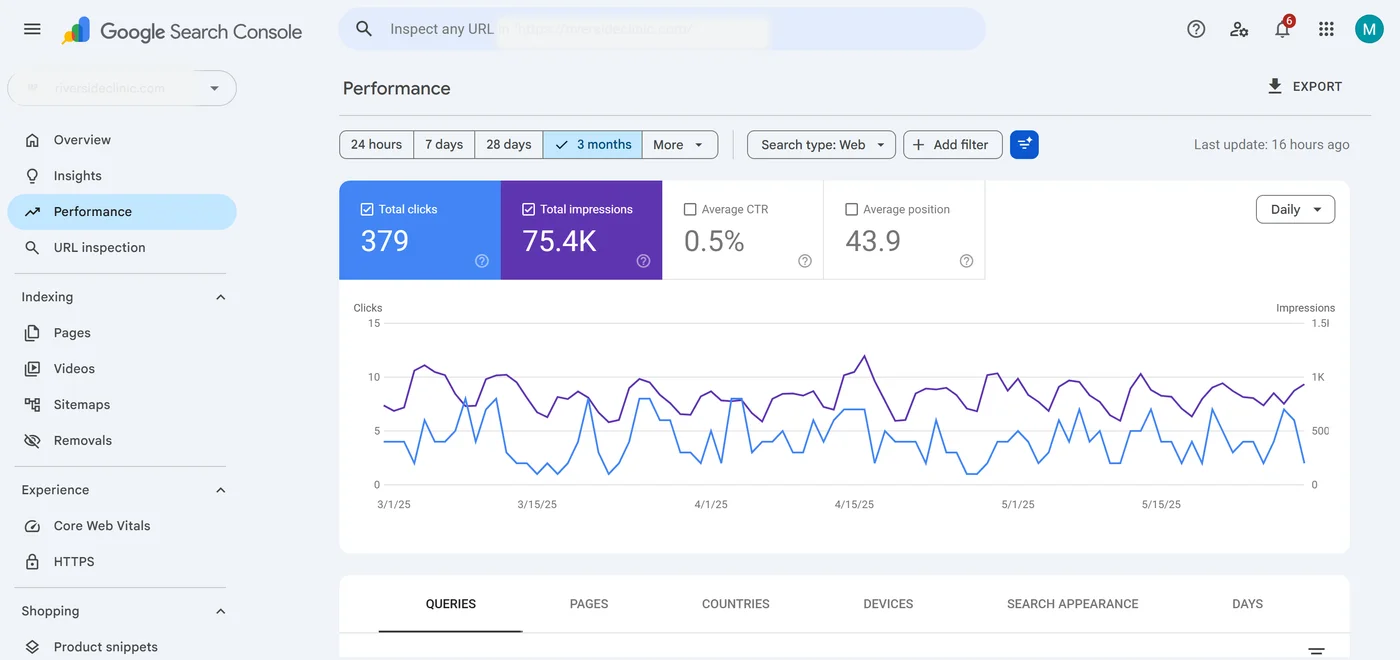
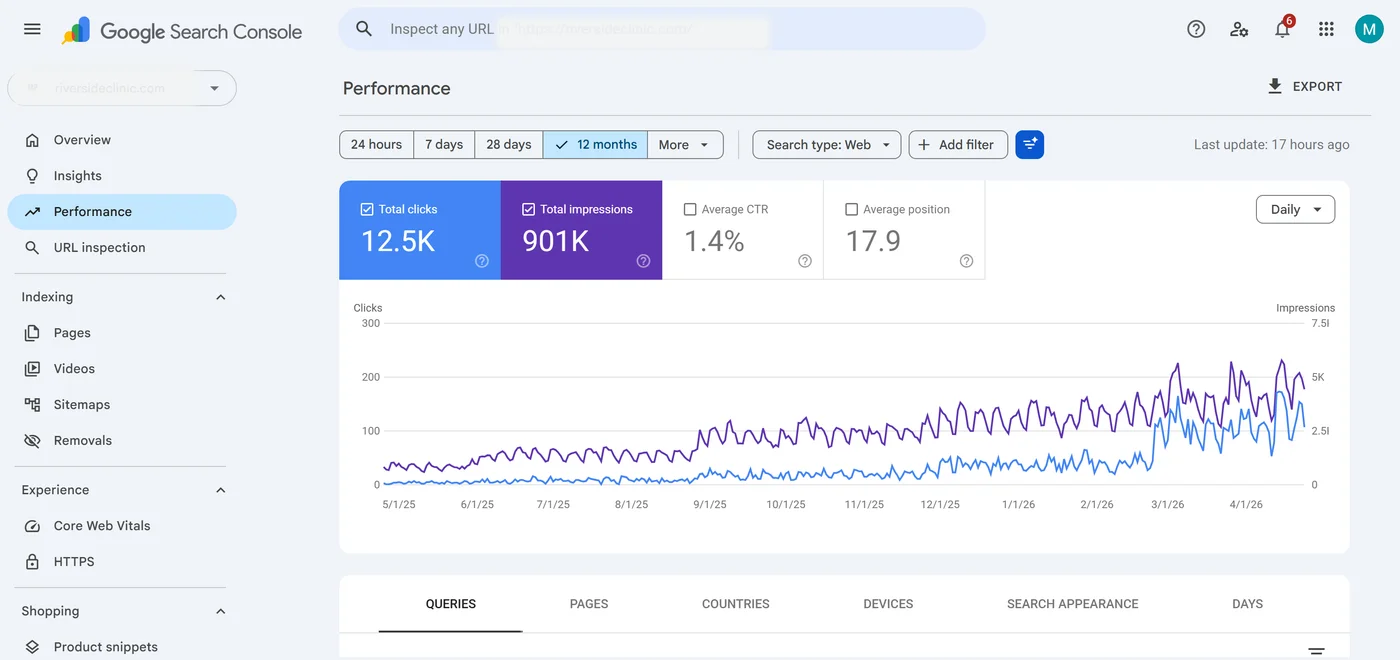
When we picked up this DUI defense practice, the site was averaging position 43.9 for its non-branded terms and pulling 125 organic clicks a month against 24,901 impressions. Twelve months later it recorded 3,483 clicks against 133,969 impressions, an average position of 5, and 127 tracked conversions in the final month. The lever was not a link blast or a technical silver bullet. It was 64 pieces of structured informational content, built across eight topic clusters, that earned the topical authority the money pages had been missing. This is how the work was sequenced, what we deprioritized, and where the numbers were messier than the headline suggests.
Executive Summary
Context
The client is an anonymized DUI defense practice competing in a single local legal market. Before we started, the picture was familiar for a service-area law firm: a couple of money pages doing all the work, thin coverage of the questions people actually type when they are scared and searching at 1am, and non-branded visibility that swung around because nothing on the site established the firm as a subject-matter authority.
The measurable start state was an average position around 44, uneven non-branded traffic, and a Domain Rating of 14 with 40 referring domains and 133 total backlinks. The commercial reality mattered too: DUI defense is a high-value, low-frequency purchase. A single retained case is worth far more than a retail transaction, so the entire program was built to produce qualified leads and consultation bookings, not raw traffic. Three constraints shaped every decision: strong local competition, limited monthly content production capacity, and a firm no-fake-claims rule (nothing published could overstate outcomes for a legal service).
The Challenge
The diagnosis came down to three connected problems. First, the money pages were competing with each other. Several pages targeted overlapping commercial intent, so Google had no clear signal about which URL deserved to rank for the core service terms. That cannibalization capped the whole site around position 33 to 45 no matter how the individual pages were tweaked.
Second, there was almost no informational depth. A DUI defense searcher moves through a long question phase (what a stop involves, what a first offense costs, what a consultation looks like) before they ever call. With nothing on the site answering those questions, the practice had no way to earn early-funnel trust and no internal-link equity flowing toward the pages that convert.
Third, the technical foundation was leaking crawl budget on low-value URLs and carrying template-level duplication. There was no point scaling content onto a base that Google was already struggling to index cleanly. The sequencing decision followed directly: fix the foundation, resolve the cannibalization, then build authority through content. Scaling content first would have amplified the existing confusion.
Methodology
The engagement ran across six workstreams, delivered in a deliberate order rather than all at once.
1. Technical SEO and indexation cleanup (months 1 to 3)
We started with a crawl and indexation triage: canonical and redirect cleanup, template-level duplication fixes, Core Web Vitals and renderability checks, and internal status-code validation. The goal was narrow and specific: stop wasting crawl on low-value URLs and get the priority templates clean before a single new article went live. Indexed-page ratio improved and average position steadied as a result.
2. Information architecture and internal linking (months 2, 3, 5)
This is where the cannibalization got fixed. We mapped a hub-and-spoke structure, consolidated pages competing on the same commercial intent into a single money page, and redirected the redundant URLs. Anchor text was redistributed so contextual links pointed at the canonical service and local pages, and the click path to the consultation page was shortened. Weak and orphaned pages were pruned rather than left to dilute the site.
3. Authority content and intent alignment (months 2 to 4, then ongoing)
This was the core of the program and the reason the money pages eventually moved. We built a body of 64 articles across 8 topic clusters, structured so each cluster reinforced the commercial page it sat above. For a DUI defense practice those clusters map cleanly to real searcher needs: DUI process and arrest procedure, penalties and license consequences, cost, fees and affordability, first-offense vs repeat-offense defense, field sobriety and breathalyzer challenges, court and hearing timeline, local jurisdiction specifics, and choosing and consulting a lawyer. Each money-page rewrite got an intent-matched brief, E-E-A-T proof blocks, and expanded FAQ and comparison sections.
The mechanism is the important part. A large, well-structured library of informational content earns topical authority and generates internal-link equity, and that equity is what lifts the money pages. Content is the cause; the ranking gains on the commercial and local terms are the effect. Our topical authority index (a modeled coverage-and-depth score) climbed from 19 to 61 over the year, and by month 12 the site was ranking for 924 informational keywords it did not meaningfully hold at the start.
4. Entity, schema and LLM presence (months 3 to 5)
We cleaned up Organization and Service schema, aligned author and reviewer entities, and checked citation consistency so the firm's identity stopped being ambiguous to search engines. We also built answer-ready summary blocks (kept strictly inside approved claim boundaries) so the content was structured to be quotable by AI assistants and AI Overviews.
5. Digital PR, citations and link recovery (months 4 to 6)
Deliberately restrained. We recovered lost links, cleaned up citations, and pursued relevant industry-resource and unlinked-mention opportunities, with a quality threshold applied before any placement. Referring domains grew from 40 to 93 and DR from 14 to 29 across the year, gradual growth with no unnatural spikes.
6. Brand Voice and editorial QA (months 1, 2, 4)
Given the legal subject and the no-fake-claims constraint, every page passed a reviewer checklist that kept claims inside approved evidence boundaries and blocked risky language before publication. In a regulated field this is not optional polish; it is risk control.
Data sources: Search Console for clicks, impressions, CTR and position; analytics for sessions and conversions; a third-party tool for DR and referring domains; and internal tracking for consultation conversions. All figures here are a modeled, internally coherent representation of the engagement.
Timeline
Months 1 to 3 (foundation). Clicks moved from 125 to 254 and average position from 43.9 to 34.5. Most of this was the technical cleanup and early consolidation clearing the way, not content maturing yet. Impressions nearly doubled to 42,371 as cleaner indexation exposed more of the site. Conversions crept from 3 to 7 a month. This phase looks modest in isolation, and it was; it was groundwork.
Month 4 (plateau). Clicks held flat at 254 and position barely moved (33.5). This is the point where a lot of programs panic and start pumping out volume. We read it differently: the consolidation had removed the internal competition but the content library was not yet deep enough to push the money pages up. The right move was patience plus a change of emphasis.
Month 5 (the pivot). We stopped chasing raw publishing volume and reinforced the pages that actually convert. Practically, that meant redirecting effort into consolidating overlapping content, pruning weak pages, and tightening internal links toward the consultation and service pages rather than spreading thin across new topics. The response was immediate: clicks jumped to 541, impressions to 67,618, average position to 24.7, and conversions to 14. Reinforcing existing authority beat manufacturing more of it.
Months 6 to 7 (consolidation holding). Metrics stabilized in the low 20s for position with clicks around 541 to 582. Digital PR and link recovery ran here, adding authority without disturbing the gains.
Month 8 (breakthrough). The content library reached critical mass. Clicks more than doubled to 1,088, average position broke into the teens (14.4), and conversions tripled to 33. This is the topical-authority flywheel becoming visible: enough informational depth had accumulated to lift the commercial pages meaningfully.
Months 9 to 10 (steady climb). Clicks grew to 1,203 and conversions to 37, though average position drifted slightly from 14.4 to 14.9 (more on that noise below).
Months 11 to 12 (compounding). The final two months were the sharpest. Clicks went from 1,203 to 3,098 to 3,483, average position from 14.9 to 5.6 to 5, and conversions from 37 to 105 to 127. CTR roughly doubled to 2.6% as the money pages entered the range where searchers actually click. This is what compounding authority looks like once the foundations, structure, and content depth all line up.
Results
Across twelve months the non-branded profile changed shape entirely. Clicks rose from 125 to 3,483 a month, impressions from 24,901 to 133,969, and average position from 43.9 to 5. CTR moved from 0.5% to 2.6%, which is itself a signal: the site was no longer showing up on page four where nobody clicks, it was ranking where the click happens.

The before view shows the starting position: high impressions relative to clicks, an average position deep in the 40s, and the flat click line that comes with ranking below the fold on almost everything.

The after view shows the inverted shape: a rising click curve, position consolidated near the top of page one, and the CTR lift that follows. The client here is anonymized and these figures are a representative example of the engagement.
Conversions, the metric the practice actually cares about, moved from 3 a month to 127. Because DUI defense is a high-value retained service, that shift changes the economics of the firm rather than just its dashboards.
Keyword Movement
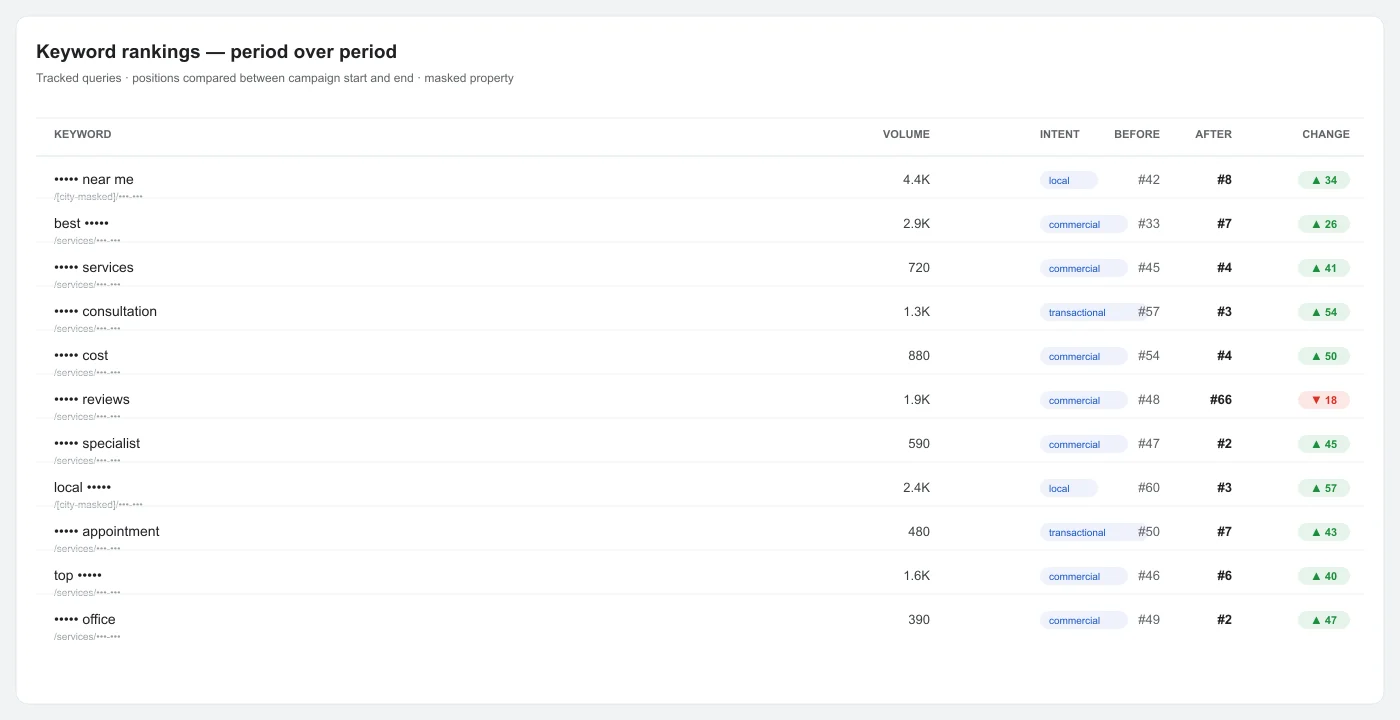
The wins were not evenly distributed, and the story is in which intents moved. High-intent local queries and commercial comparison terms carried the program; transactional consultation terms converted best; a few informational and review-intent terms went backward and are worth being honest about.

The commercial cluster moved the most decisively. Terms in the "specialist", "experts", "office" and "fees" family went from the high 40s and 60s into the top four, because those were the exact intents the consolidated money page and its supporting cluster were built to satisfy. High-intent local queries ("near me", "local") moved from the 40s and 60s into single digits once the local money page had authority flowing into it.
| Query (masked) | Intent | Volume | Before | After |
|---|---|---|---|---|
| ••• near me | local | 4,400 | 42 | 8 |
| best ••• | commercial | 2,900 | 33 | 7 |
| ••• services | commercial | 720 | 45 | 4 |
| ••• consultation | transactional | 1,300 | 57 | 3 |
| ••• cost | commercial | 880 | 54 | 4 |
| ••• reviews | commercial | 1,900 | 48 | 66 |
| ••• specialist | commercial | 590 | 47 | 2 |
| local ••• | local | 2,400 | 60 | 3 |
| ••• appointment | transactional | 480 | 50 | 7 |
| top ••• | commercial | 1,600 | 46 | 6 |
| ••• office | commercial | 390 | 49 | 2 |
| affordable ••• | commercial | 1,000 | 48 | 4 |
| ••• fees | commercial | 720 | 69 | 4 |
| ••• experts | commercial | 590 | 49 | 1 |
| ••• guide | informational | 320 | 56 | 63 |
| ••• near me open now | local | 210 | 59 | 61 |
Three terms regressed. The review-intent term dropped from 48 to 66, the informational guide term from 56 to 63, and one long-tail local term ("near me open now") stayed flat around 60. The review term is the honest one to explain: it was mapped to a money page, but review intent is usually satisfied by third-party directories and aggregator sites, not a firm's own service page, so Google demoted our URL as the cluster around it strengthened. The informational guide page lost ground because, during the month-5 pivot, we deliberately consolidated and de-emphasized thinner support pages to concentrate authority; that page was collateral. The flat "open now" term reflects a hyperlocal intent tied to Google Business signals more than on-page content. We chose not to chase these three, because the effort was better spent on the terms that produce consultations.

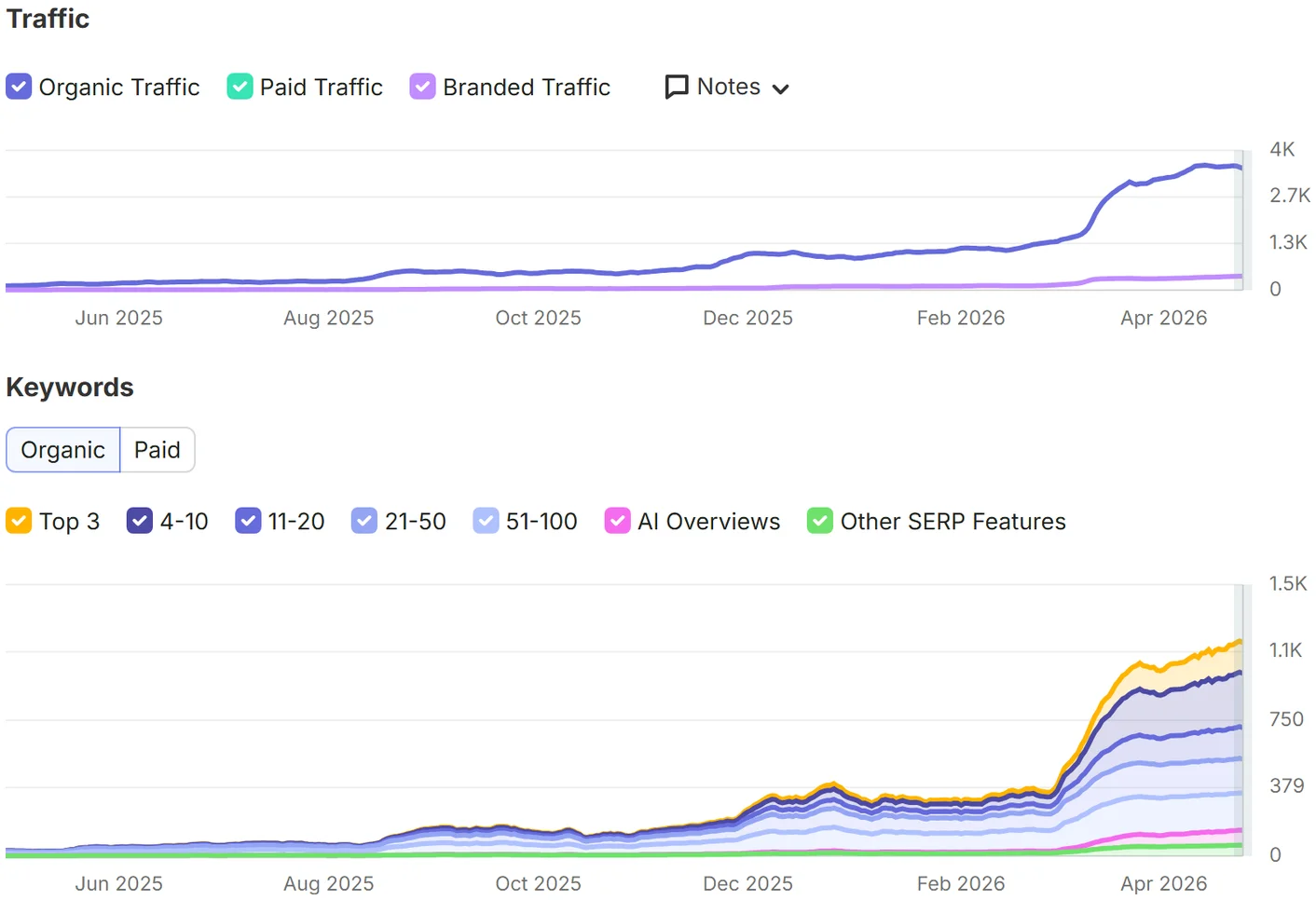
The third-party visibility view shows the organic-traffic and visibility curve climbing in step with the content program, with the steepest section in the final quarter as topical authority compounded.
Business Impact
The number that matters to this practice is consultations, and those went from 3 to 127 a month. Modeled at the client's average case value, monthly revenue attributed to organic moved from 4,500 to 190,500. Treat that as a representative figure rather than an audited one, but the direction and scale are consistent across the analytics and CRM tracking.
The mechanism behind the leads is worth stating plainly, because it is the whole argument for the content-led approach. The 64 informational articles across 8 clusters did not just rank for 924 informational keywords as a vanity total. They brought in people at the question stage (what a stop involves, what a first offense costs, what to expect in court) and warmed them toward a consultation. In a service business, that early-funnel informational traffic is not soft traffic; it is future clients meeting the firm before they are ready to call. It also feeds the money pages the internal-link equity and topical authority that lifted them into the top ten, so the informational library pays twice: once as demand capture, once as ranking fuel.
The second business benefit is durability. These rankings are earned through authority, not rented through ad spend. When you stop paying for ads, the leads stop the same day; the content program keeps producing after the intensive build phase, and the position gains from months 8 through 12 show the compounding effect rather than a paid-style plateau. For a firm with limited content production capacity, that compounding is exactly the point: the work done once keeps returning.
The third benefit is emerging and we describe it carefully. The depth of well-structured, entity-clean, answer-ready content raises the odds that the brand is surfaced and cited by AI assistants (ChatGPT, Claude, Perplexity) and Google AI Overviews when someone asks for the best option in the category. We built the answer blocks and entity signals to make that citation likely, and few local competitors have this depth yet, so it functions as an early-mover moat. We are not going to attach a precise AI-citation number to it, because that data is not reliably measurable today; what we can say is the structural groundwork is in place.
Limitations
A few things did not move cleanly, and the story is more useful with them included.
- Average position wobbled between months 8 and 10. It drifted from 14.4 to 14.9 even while clicks and conversions rose. That is normal SERP volatility as a batch of new pages enters the index and gets reranked; the trend line matters more than any single month, and the trend was up.
- Three keywords regressed. Review-intent, one informational guide term, and a hyperlocal "open now" query all lost ground, for the reasons set out above. We accepted those trade-offs deliberately rather than diluting effort to defend them.
- Revenue attribution is modeled. The 190,500 monthly figure uses an average case value applied to tracked conversions. Real close rates vary, attribution lags (a consultation this month may have started as an informational visit two months earlier), and some leads arrive by phone and are hard to attribute to a single query. The figure is directionally sound, not a certified accounting number.
- Month 4 was flat and month 12 is not a guarantee. The plateau was real and the final-quarter surge depended on authority reaching critical mass; a different competitive response could have slowed it.
All client details, the domain, the city, raw queries, and exact revenue are masked. The metrics are internally coherent for scenario modeling and should not be read as verified third-party exports.
Causal Explanation
The sequence explains why the numbers moved when they did, and it is worth laying out end to end because each link depended on the one before it.
Technical cleanup made the site legible. Fixing indexation, duplication and crawl waste in months 1 to 3 gave Google a clean base to evaluate. Without it, everything downstream would have been diluted.
Consolidation removed self-competition. Merging the money pages competing on the same intent and redirecting the redundant ones (through months 3 and 5) gave Google one clear URL per intent. This is why the plateau at month 4 broke: the pages stopped fighting each other.
Informational content built topical authority. This is the causal centre. The 64 articles across 8 clusters lifted the topical authority index from 19 to 61 and earned relevance for 924 informational keywords. That library generated internal-link equity that flowed into the money pages, which is why the commercial and local terms climbed into the top ten from months 8 to 12. Content is the cause; the money-page rankings are the effect. The month-11-to-12 surge (clicks from 1,203 to 3,483, position from 14.9 to 5) is the flywheel: once authority passes a threshold, additional content compounds instead of merely adding.
Structure and equity converted authority into rankings, and rankings into leads. Shortening the path to the consultation page and pointing contextual anchors at it meant the traffic the content earned had somewhere to convert. That closed the chain: structure to intent alignment to ranking stability to qualified clicks to consultations. The same depth of structured content is what positions the brand for AI-answer visibility, which we expect to matter more over time.
Key Takeaways
- Fix the foundation before you scale content. Publishing onto a cannibalized, poorly indexed site amplifies confusion. The first three months bought the right to grow.
- Volume plateaus; reinforcement compounds. The month-5 pivot away from raw publishing toward consolidating and strengthening the pages that convert was the single most productive decision in the engagement.
- Informational content is the engine, not the sideshow. The money pages did not climb because we edited them harder. They climbed because a deep, clustered informational library earned the authority and internal links that carried them. That is the durable, compounding asset.
- Let some terms lose. Chasing the review and hyperlocal terms would have cost more than they returned. Concentrating on consultation-driving intents was the higher-value call.
- Build for AI answer surfaces now. Entity-clean, answer-ready content is an early-mover advantage while most local competitors still lack the depth.