
The starting point was a gym site averaging about position 20 for the non-branded searches that mattered, with 129 to 1,335 monthly clicks recorded across the study window. Average position moved from 19.5 to 4, while tracked conversions moved from 3 to 38. Because this is a masked synthetic case study, those movements should be read as a coherent scenario rather than proof that any single tactic produced the change. The decision-useful part is the order of operations: repair technical and intent conflicts first, expand useful informational coverage next, and only then reinforce the pages closest to membership and visit decisions.
Case Study at a Glance
Starting Conditions
The gym operated in one local market where searchers could compare independent facilities and larger chains before visiting, calling, or starting a membership enquiry. The site had commercial pages, but its supporting content was too thin to explain the full set of questions a prospective member might have before taking action.
The baseline showed 12,925 impressions, 129 clicks, and CTR near 1%. Average position was 19.53, so much of the existing visibility sat below the area that usually attracts meaningful organic clicks. The backlink profile was not empty: the scenario records 40 referring domains across 114 backlinks and a Domain Rating of 15. That made the starting question less about creating a site from nothing and more about whether structure, intent coverage, and internal pathways were limiting the value of the authority already present.
Publishing capacity was also constrained. That made prioritization important: each new or revised page needed a clear job, a clear audience question, and a clear relationship to the pages where a visitor could evaluate the gym, understand membership options, or take the next step.
What Was Holding the Site Back
The commercial page at /services/gym was carrying too many different jobs. Pricing, reviews, membership, booking, promotions, and access-related searches were being funneled toward a narrow set of URLs, so the site did not present a clean one-intent, one-best-page pattern.
The keyword spread supported that diagnosis. Some commercial terms were already around positions 15 to 18, while others sat in the 20 to 30 range. That unevenness suggested the problem could not be reduced to authority alone: relevance, page purpose, internal competition, and destination clarity all needed review.
The informational layer was also sparse. Prospective members often research what a first visit is like, how memberships work, what facilities or programs are available, and when they can attend before they ever submit an enquiry. Without useful support pages for those questions, the commercial layer had fewer relevant internal links and less context around the broader gym decision journey.
The resulting plan was to resolve technical and mapping issues first, then expand genuinely useful topic coverage, and finally use internal linking and consolidation to make priority destinations easier for both people and crawlers to understand.
How the Work Was Sequenced
The program was divided into workstreams so that later publishing did not sit on top of unresolved technical or structural issues.
Technical cleanup and indexation review (months 1 to 3)
Crawl and indexation checks came first, followed by canonical and redirect review, template duplication cleanup, Core Web Vitals and renderability checks, and validation of internal status codes and existing schema. The operating goal was not to claim that any one technical change would increase rankings, but to reduce ambiguity and make priority pages easier to crawl, render, and interpret.
Information architecture and internal linking (months 2, 3, 5)
The next stage mapped each important intent to its strongest destination. Overlapping pages were reviewed for consolidation, contextual links were planned around reader needs, and shorter paths were created toward the pages where someone could compare options or take action. This turned internal linking into a navigation and relevance tool rather than a mechanical link-count exercise.
Authority content and intent alignment (months 2 to 4)
The editorial plan centered on five topic clusters covering the practical questions that can precede a gym decision. The study records 20 articles across the period, with cumulative output tracked as 3, 6, 8, 12, 16, 20. Instead of treating that volume as a ranking formula, the content was designed to give each question a useful answer and to connect relevant readers with the appropriate commercial destination.
The scenario's internal topical-authority index moved from 31 to 69, and the site was associated with 266 informational keywords by the end of the measured period. Those figures are observational within the model. They are useful because they show that broader informational visibility and commercial-page movement occurred together, not because they prove a direct causal equation.
Entity, schema and AI presence review (months 3 to 5)
Existing Organization and Service schema was cleaned up, author and reviewer references were aligned, and citation consistency was checked. Summary blocks were written to answer questions clearly and stay within supportable claims. Clear, well-structured content can also be easier for Google AI Overviews and other AI systems to interpret, but there is no special markup or guaranteed citation mechanism implied here.
Digital PR and link recovery (months 4 to 6)
External authority work was kept selective: recover relevant lost links, review unlinked mentions, and evaluate placements for relevance and quality before pursuing them. The scenario records referring domains moving from 40 to 65 and DR from 15 to 20, which should be read as part of the overall evidence set rather than as proof that link growth caused the ranking movement.
Brand voice and editorial QA (months 1, 2, 4)
Editorial review ran throughout the program so that claims, tone, and calls to action stayed consistent with the gym's actual offer. The checklist was used to reject unsupported wording before publication and keep the public pages useful rather than promotional for its own sake.
Stage-by-Stage Progress
Months 1 to 2: foundation. Early work concentrated on the audit, intent mapping, and initial cleanup. Impressions moved from 12,925 to 17,209 and clicks from 129 to 189, while average position moved from 19.53 to 16.78. These are early observations, not proof that the first technical changes alone produced the movement. The important decision was to keep the publishing pace controlled until the site structure was clearer.
Month 3: consolidation. Overlapping commercial destinations were reviewed and duplicates were redirected where appropriate. Average position moved from 16.78 to 11.69, clicks reached 287, and tracked conversions moved from 4 to 8. The timing is consistent with the consolidation stage, but the case study cannot isolate a single cause because technical, content, and internal-link changes overlapped.
Month 4: deeper support coverage. The informational layer continued to expand, average position reached 8.88, and clicks reached 465. At this stage, the value of the content program was judged by whether each page answered a distinct prospective-member question and supported a relevant next step, not simply by article count.
Month 5: reinforcement pivot. The team shifted emphasis away from raw publishing volume and toward improving pages already contributing to qualified actions. Average position moved to 7.0, clicks to 721, and tracked conversions to 19. The practical lesson is to let page-level evidence change the plan when additional publishing appears less useful than consolidation or stronger internal paths.
Month 6: authority reinforcement. Selective digital PR and link recovery were layered onto the existing technical, content, and internal-link work. Average position reached 4, impressions 35,139, clicks 1,335, and tracked conversions 38. The modeled topical-authority index ended at 69 with 20 articles supporting the commercial layer. These end-state figures summarize the scenario; they are not a performance guarantee for another gym.
What the Data Shows
The most useful reading of the result is the relationship between visibility, position, and click capture. Monthly clicks moved from 129 to 1,335, CTR from roughly 1% to 3.8%, and average position from 19.53 to 4. Impressions moved from 12,925 to 35,139. In this modeled dataset, clicks grew faster than impressions while average position improved, so the pattern is consistent with more of the existing visibility occurring in positions where searchers were more likely to click.
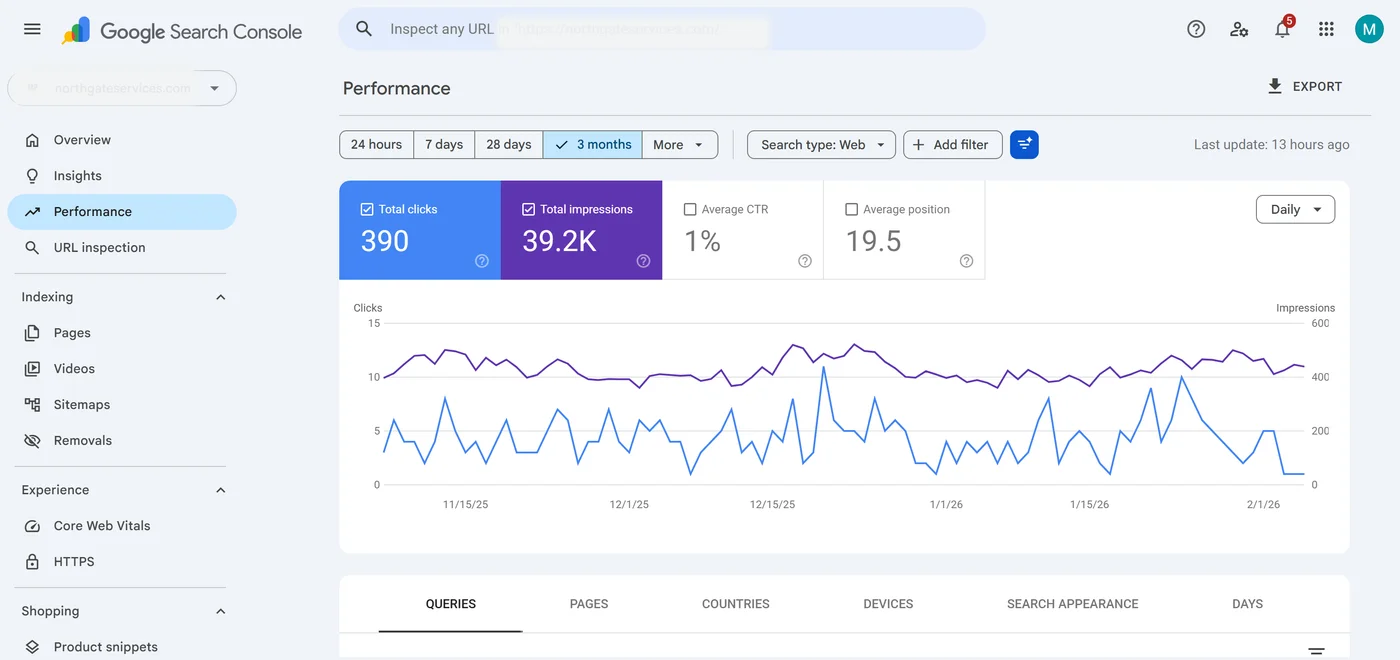
The baseline screenshot represents the low-click starting state: thousands of impressions at weak average positions, with only a small share turning into clicks.
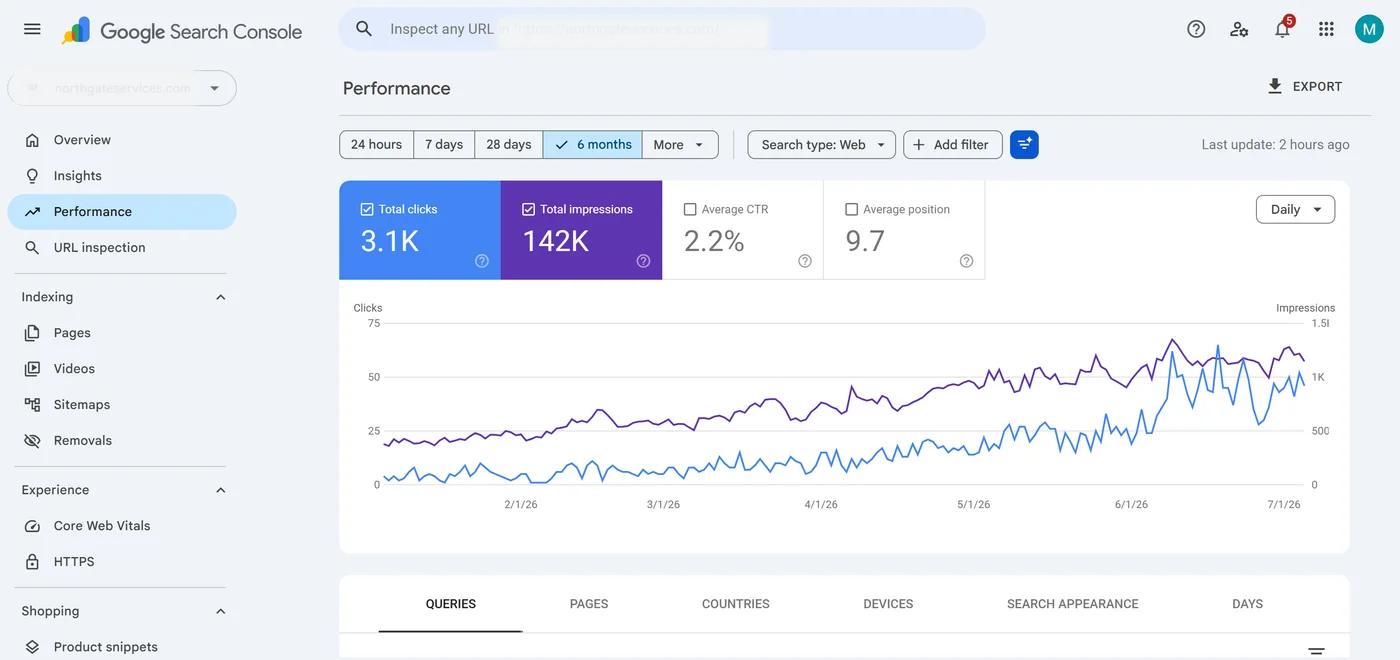
The end-state view provides a visual comparison for the same modeled property. It shows how the click curve changed once positions improved; another gym's curve will depend on its own starting positions, market, and capacity.
Tracked conversions moved from 3 to 38, while modeled value moved from 135 to 1,710. Domain Rating moved from 15 to 20 during the same window. Because multiple workstreams changed together, the case study treats these as concurrent observations and avoids assigning a guaranteed share of the movement to content, links, technical cleanup, or any other single factor.
How Search Visibility Shifted
The clearest improvements were concentrated around local, booking, membership, and comparison intents after page targeting and internal paths were clarified. The useful operating question is not whether every tracked query improved, but whether the site increasingly connected each important search need with a page that could satisfy it.
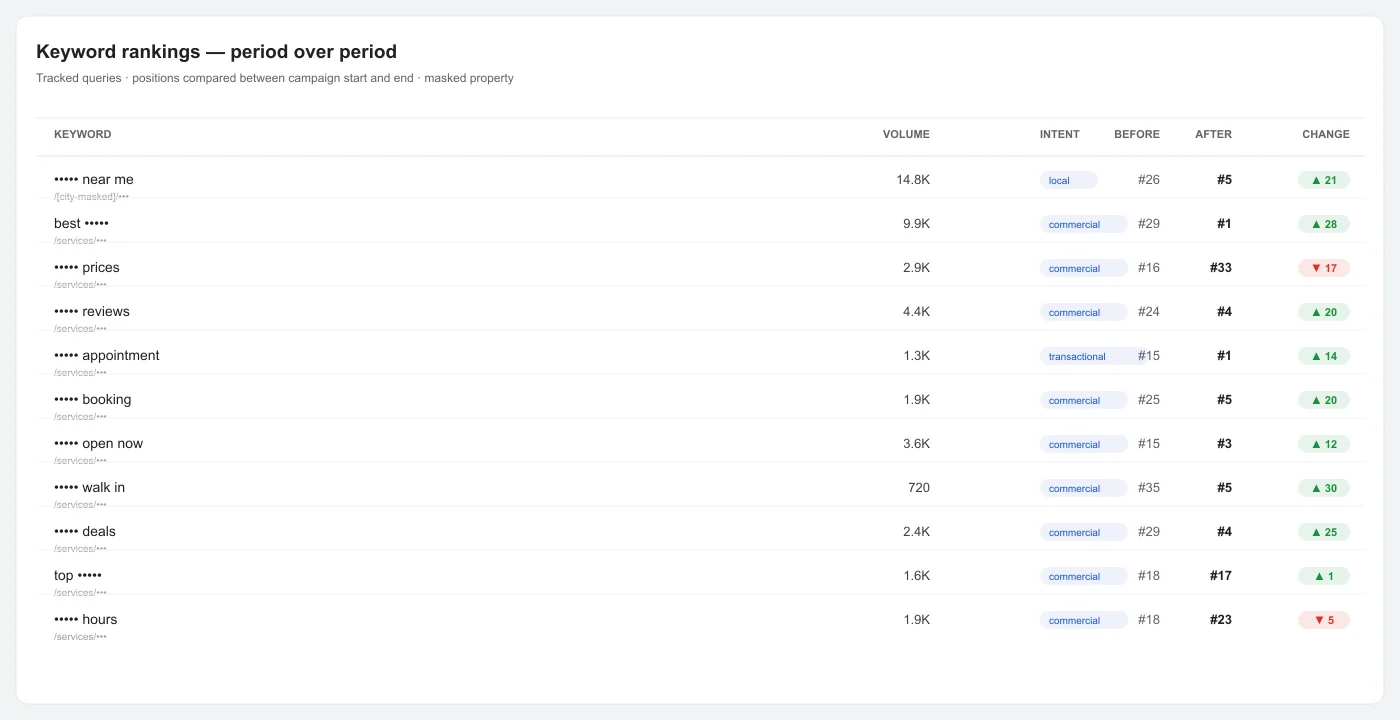
The movement was mixed. A pricing-style query moved from 16 to 33, an hours-style query from 18 to 23, and a broad comparison term from 18 to 17. Those regressions and near-flat results matter because they show why a case study should be read as a portfolio of query movements rather than a single headline average.
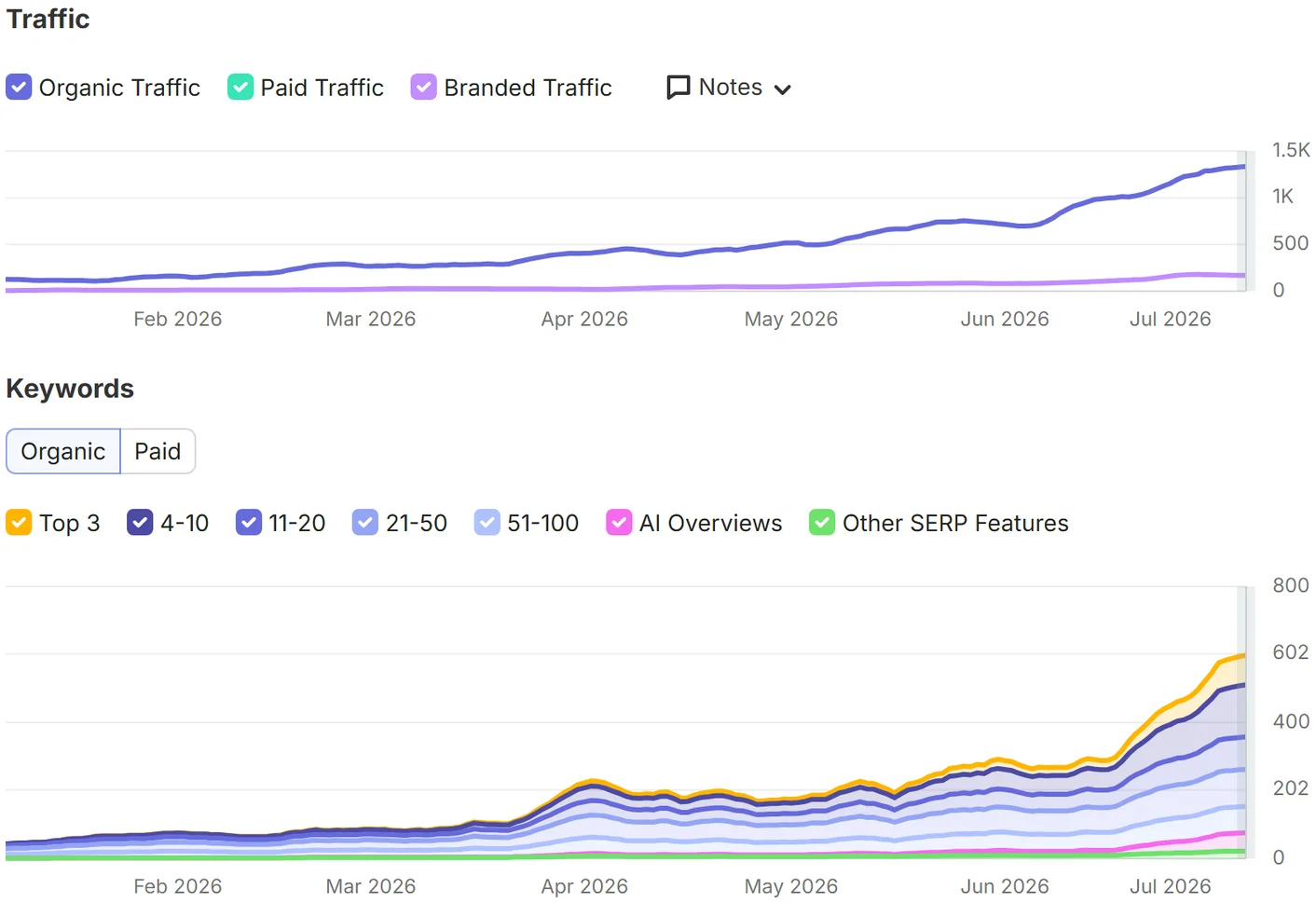
The third-party visibility view above shows the informational side of the same scenario: the expanded informational footprint reached 266 tracked informational keywords by the end of the period. Read that footprint as a coverage measure, and judge it by whether it supports the commercial queries in the table below rather than by its size alone.
| Query structure | Intent | Volume | Pos. before | Pos. after | Category |
|---|---|---|---|---|---|
| ••• near me | local | 14,800 | 26 | 5 | winner |
| best ••• | commercial | 9,900 | 29 | 1 | winner |
| ••• prices | commercial | 2,900 | 16 | 33 | decliner |
| ••• reviews | commercial | 4,400 | 24 | 4 | volatile |
| ••• appointment | transactional | 1,300 | 15 | 1 | winner |
| ••• booking | commercial | 1,900 | 25 | 5 | winner |
| ••• open now | commercial | 3,600 | 15 | 3 | winner |
| ••• walk in | commercial | 720 | 35 | 5 | winner |
| ••• deals | commercial | 2,400 | 29 | 4 | winner |
| top ••• | commercial | 1,600 | 18 | 17 | stable |
| ••• hours | commercial | 1,900 | 18 | 23 | decliner |
| local ••• | local | 3,600 | 24 | 2 | winner |
| affordable ••• | commercial | 1,300 | 26 | 5 | winner |
| ••• specials | commercial | 880 | 34 | 3 | volatile |
| ••• membership | commercial | 6,600 | 22 | 6 | winner |
| ••• services | commercial | 1,000 | 29 | 4 | winner |
Terms marked volatile should not be treated as settled wins. Their final recorded positions are useful for the scenario, but a decision-maker should review stability, page intent, SERP composition, and conversion relevance before deciding what to reinforce next.
What the Movement Meant for the Business
The business question is whether search visibility connected the gym with more people who were considering a visit, membership, booking, or enquiry. Tracked conversions moved from 3 to 38 during the period. That is more decision-useful than the click headline by itself because it keeps attention on actions rather than traffic volume.
The broader informational footprint, recorded at 266 keywords, also gave prospective members more entry points before they were ready to act. In the scenario, the topical-authority index moved from 31 to 69. Those internal measures are best used as planning signals: they can help a team see whether topic coverage and commercial-page visibility are expanding together, but they should not be treated as universal benchmarks or guarantees.
Informational pages can support a local gym when they answer genuine questions about membership, facilities, programs, access, and first visits, then provide a natural next step. Their value is not that content automatically ranks or converts, but that useful coverage can reduce uncertainty for prospective members and create relevant internal paths toward the pages where a decision can be made.
Clear entity information and concise answers may also help search engines and AI systems understand the business. That can support eligibility for surfaces such as Google AI Overviews, but no special markup, citation count, or recommendation outcome is promised by this case study.
Evidence Limits
This is a masked synthetic case study. It is designed to be internally coherent and decision-useful, not to stand in for verified Search Console, analytics, CRM, accounting, or third-party ranking exports. Domain Rating moving from 15 to 20 belongs to the same modeled scenario, so read it as a scenario metric for link-profile growth, not as an audited third-party export.
Multiple changes overlapped across the measurement window, including technical cleanup, consolidation, new and revised content, internal linking, entity work, and selective external authority activity. That prevents a clean experiment assigning the observed movement to one cause. Seasonality, competitor changes, brand demand, SERP layout, and other factors can also affect local gym visibility.
The revenue field is a modeled value proxy rather than audited revenue. Query-level movements include both gains and regressions, and the end-state positions are not permanent. A useful takeaway is therefore procedural: identify the pages closest to real member decisions, fix ambiguity around those pages, build support content only where it answers a real need, and keep measuring whether the next action should be expansion, consolidation, or refinement.
How to Interpret the Sequence
The timeline is best interpreted as an overlapping sequence of changes rather than a controlled causal experiment.
- Technical and mapping work came first so that later changes had clearer destinations. The recorded average-position movement from 16.78 to 11.69 occurred during the consolidation stage, but timing alone does not prove that consolidation caused the full change.
- Broader informational coverage developed alongside an internal topical-authority index moving from 31 to 69 and an informational footprint of 266 tracked terms. Those observations support continued attention to useful support content, while still leaving room for other contributors.
- Commercial visibility continued improving through months 4 to 6, with the end-state average position recorded at 4. The study treats that as the result of the whole program rather than a single lever.
- The reinforcement pivot coincided with tracked conversions moving to 19 from 11. That made consolidation and page improvement a reasonable next decision in the scenario, but it should not be generalized into a guaranteed conversion effect.
- External and entity work was layered in after the site had clearer structure and content coverage. The purpose was reinforcement and clarity, not a claim that links, schema, or AI-oriented formatting automatically improve rankings.
For another gym, the transferable lesson is the decision order: diagnose, map intent, repair structure, publish only where a real information gap exists, connect support pages to decision pages, and then use observed performance to choose what to strengthen next.
Practical Lessons
- Start with page purpose. Before publishing more, identify which page should satisfy each important local, membership, pricing, and booking intent.
- Repair overlap before adding volume. Consolidation can be more useful than another article when several URLs compete for the same search need.
- Build support content around real prospective-member questions. Useful informational coverage should reduce uncertainty and create natural paths toward the pages where someone can evaluate the gym.
- Use conversion evidence to change the plan. If a smaller set of pages is contributing most of the qualified actions, reinforcement may deserve priority over continued expansion.
- Treat AI visibility as eligibility, not a promise. Clear entity information and answer-ready content may be easier for search and AI systems to interpret, but there is no guaranteed citation, ranking, or recommendation outcome.