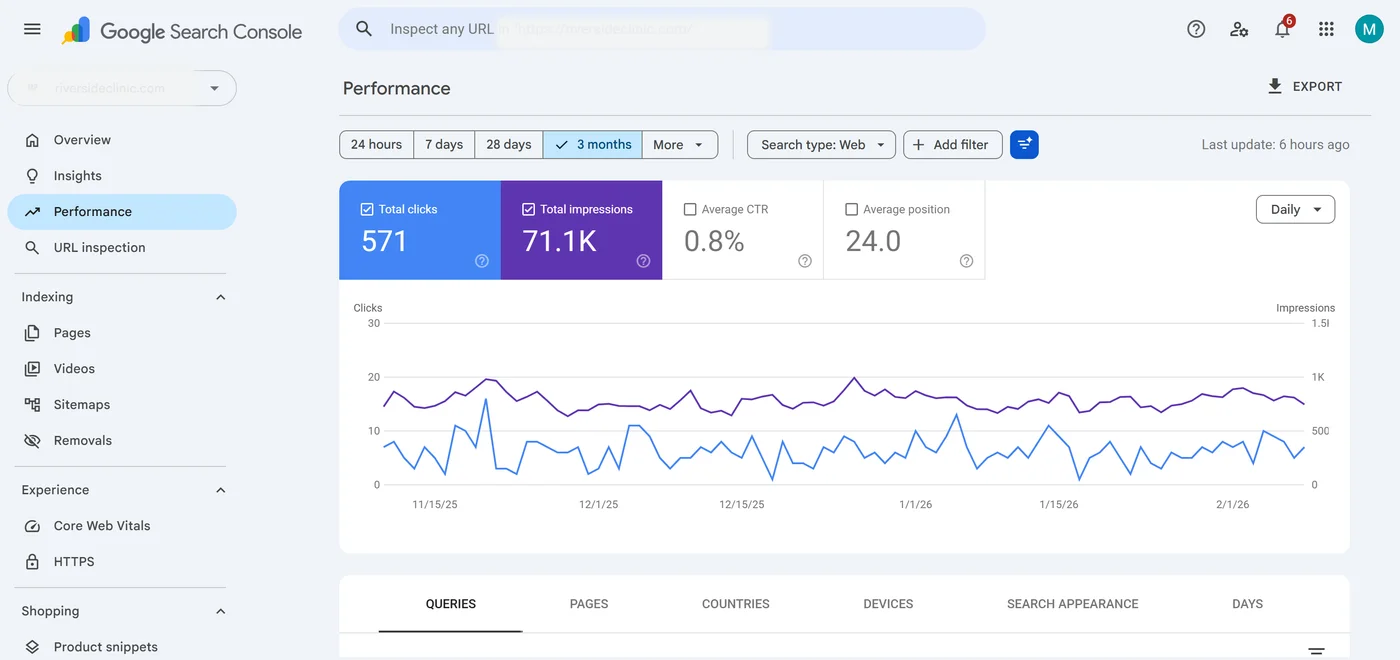
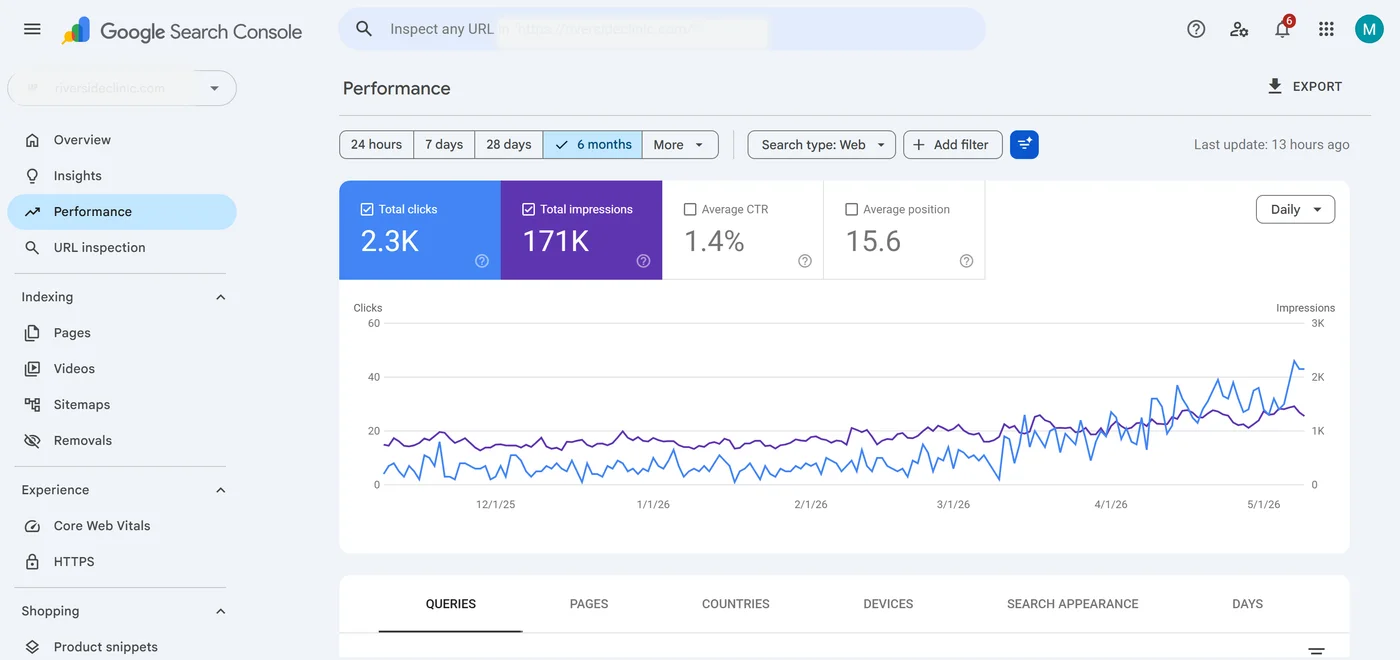
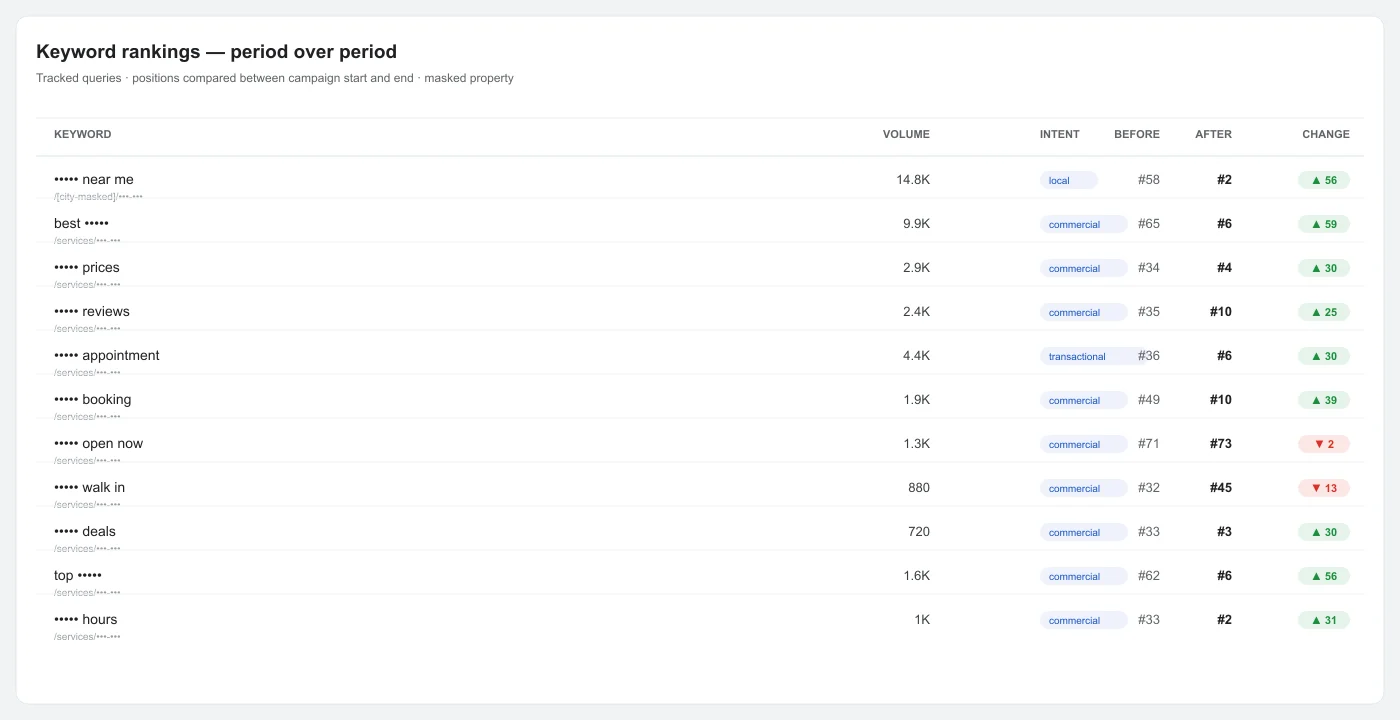
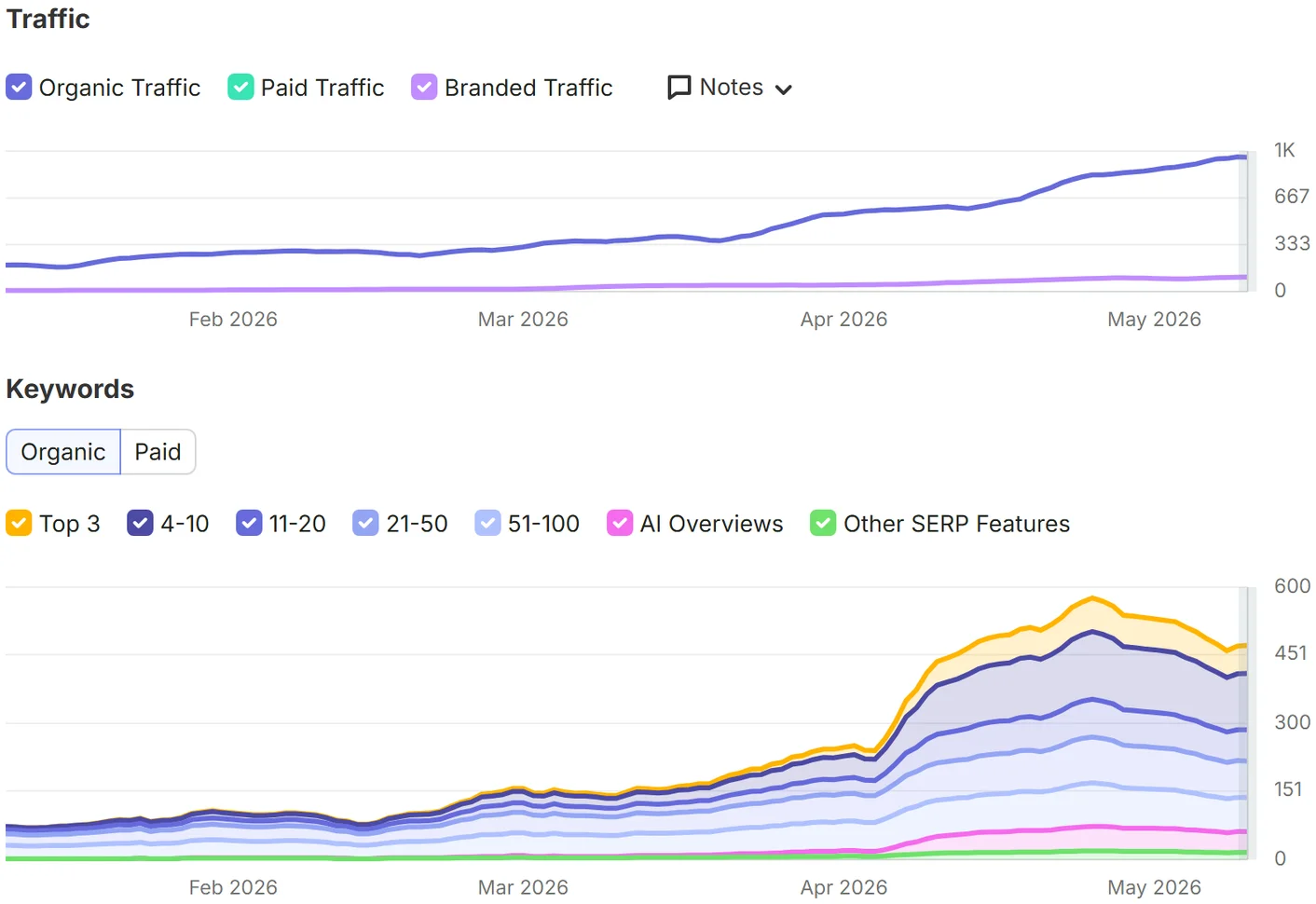
The work was organized as connected stages so new content did not sit on top of unresolved technical or structural ambiguity.
Technical SEO and indexation review (month 1, stage 1 to month 3)
Crawl and indexation triage came first, followed by canonical and redirect cleanup, template duplication review, renderability checks, and validation of existing schema and internal status codes. The objective was not to promise a ranking lift from technical cleanup. It was to make priority URLs easier to crawl, interpret, and maintain before expanding the editorial footprint.
Intent mapping and page ownership (phase 2, month 1 onward)
Tracked queries were assigned to the page best suited to answer the underlying need. Local searches were mapped to the existing city destination (a masked city-level hair salon page), while commercial and transactional needs were routed toward the service and conversion pages. Where pages overlapped materially, consolidation or redirection was considered so the site presented a clearer destination rather than multiple weak alternatives.
Stage 3: authority content and topical coverage (months 2 to 4)
The editorial plan recorded 13 articles across 5 topic clusters. Those clusters addressed the kinds of questions that can arise before a salon visit, including cuts and styling, color and treatments, pricing and value, booking preparation, and local or seasonal considerations. The value of those pages was judged by whether they answered a distinct question and created a sensible next step, not by an assumption that publishing volume automatically produces rankings.
The internal topical-authority index moved from 35 to 73, and the modeled site recorded 82 informational keywords by the end of the period. Those are observations inside the scenario. They show that broader topic coverage and commercial-page movement occurred together, but they do not establish a simple causal formula.
Stage 4: information architecture and internal linking (months 2 to 4)
Support pages were connected to relevant service and booking destinations through contextual links. Competing pages were consolidated where appropriate, important commercial pages were made easier to reach, and weak or orphaned pages were reviewed rather than kept by default. This made internal linking serve reader navigation and page clarity instead of acting as a mechanical ranking tactic.
Stage 5: entity, schema and AI presence review (months 3 to 4)
Existing Organization and Service schema was cleaned up, author and reviewer references were aligned, and citation consistency was checked. Clear summary blocks were added where they improved readability. Well-structured, supportable content can also be easier for Google AI Overviews and other AI systems to interpret, but there is no special markup or guaranteed citation mechanism implied here.
Stage 6: digital PR and editorial QA
Link work in month 4 focused on recovering relevant lost links, cleaning citations, and evaluating suitable resource placements. Editorial QA ran throughout the project so claims stayed within available evidence and public copy did not overstate services or outcomes.