
The modeled realtor scenario began around average position 35 with 105 non-branded clicks, then ended at average position 5.5 with 2,565 clicks. Tracked conversions moved from 2 to 46. The decision-useful part is not the size of the curve by itself. It is the sequence: clarify indexation and page ownership, expand useful buyer and seller information, connect that information to commercial destinations, and then shift effort toward the pages contributing most clearly to enquiries. Because the study uses masked synthetic metrics, these figures trace one coherent campaign shape; they do not show that any single tactic caused the outcome.
Case Study at a Glance
Starting Conditions
The site is represented as a local real estate lead-generation property in a competitive metro market. Its average positions were around 35, while supporting content outside the commercial pages was limited. The scenario records Domain Rating at 12, 32 referring domains, and 148 total backlinks. Those third-party figures describe the starting authority profile; compare them with your own before deciding how much link work to plan.
The business constraints mattered: local competitors already had visibility, publishing capacity was finite, and the client did not want claims that could not be defended. In real estate, that made claim discipline part of editorial quality, especially for comparative language, superlatives, local market statements, and other assertions that could affect trust.
The program therefore treated technical SEO, support content, internal linking, entity clarity, selective authority work, and editorial QA as connected parts of the same lead-generation system.
What Needed to Change
The audit surfaced three connected problems. First, overlapping commercial destinations made it unclear which URL should answer each high-intent search. The existing /services/realtor page was one of the destinations being evaluated, while several tracked terms sat in the 40 to 50 position range.
Second, the informational layer was too thin to answer the range of questions buyers and sellers research before contacting an agent. Without useful support content, the site had fewer relevant internal paths into its commercial pages.
Third, low-value URLs and repeated template elements created indexation noise. The practical priority was therefore to clean the base before scaling publication, because adding more pages without resolving ownership would have increased complexity rather than usefulness.
How the Program Was Sequenced
Foundation before scale (months 1 to 3)
The first stage covered crawl and indexation triage, canonical and redirect review, template-level duplication, Core Web Vitals and renderability checks, and validation of internal status codes and existing schema. The aim was to give search engines a cleaner set of priority pages before expanding the content footprint.
In parallel, each important buyer, seller, local, commercial, or transactional intent was mapped to a primary destination. Overlapping pages were reviewed for consolidation so the site did not ask multiple URLs to compete for the same role.
Buyer and seller support content
The scenario records 63 articles across 8 topic clusters. The coverage focused on practical real estate questions such as buying process, selling and listing, costs and fees, local markets, choosing an agent, financing, first-time buyer guidance, and paperwork. Each support page was intended to answer a distinct question and provide a relevant internal path to the page where a visitor could evaluate or contact the realtor.
The internal topical-authority index moved from 20 to 58, while the site was associated with 1,354 informational keywords. Those are modeled observations. They are useful for showing that broader subject coverage and commercial visibility developed together, not for claiming that article volume automatically causes rankings.
Entity, schema and AI readiness (months 3 to 5)
Existing Organization and Service schema was reviewed, author and reviewer references were aligned, and citation consistency was checked. Answer-ready summaries were written to be clear and supportable. This can make content easier for Google AI Overviews and other AI systems to interpret, but there is no special markup or guaranteed citation outcome implied.
Editorial QA
Every public page passed a claim-boundary review before publication. That process kept statements tied to available evidence and avoided unsupported superlatives, fabricated proof, or overconfident market claims while maintaining consistency across the 63 published articles.
Stage-by-Stage Progress
Months 1 to 2: foundation
The study begins with 20,954 impressions, 105 clicks, and 2 conversions. The next measured period records 28,381 impressions and 170 clicks, with the first 4 then 8 articles in place. Average position moved from 34.7 to 30.6. Technical cleanup, intent mapping, and early support content overlapped, so this movement should not be assigned to one cause.
Month 3: consolidation
The program had 13 articles, 38,842 impressions, 272 clicks, average position 27.2, and 5 tracked conversions. Commercial overlap had been reduced and the support layer was expanding around the surviving destinations.
Months 4 to 5: reinforcement pivot
The earlier period records 41,660 impressions and 333 clicks. The following period records 50,341 impressions, 403 clicks, average position 22.6, and conversions holding at 6. That plateau led the team to reduce emphasis on publishing pace and strengthen internal paths and priority conversion pages instead.
Months 6 to 8: stronger movement
The next stage records 58,361 impressions, 584 clicks, and 10 conversions. The following click observations were 589 and 661, while referring domains in the scenario moved from 54 to 63. External authority work was kept gradual and quality-gated rather than treated as a guaranteed ranking lever.
Months 9 to 12: later-stage compounding
The sequence records 890 clicks and 15 conversions, then 1,038 clicks with average position 10.7. The next period records 1,381 clicks, 26 conversions, and CTR at 1.7 percent. The final period ends with 106,856 impressions, 2,565 clicks, average position 5.5, and 46 conversions. These observations describe the scenario's later-stage curve and are not a forecast for another market.
What the Data Shows
Across the modeled period, impressions move from 20,954 to 106,856, clicks from 105 to 2,565, average position from 34.7 to 5.5, and CTR from 0.5% to 2.4%. The pattern is consistent with more of the site's visibility occurring in positions where searchers were more likely to click, but it does not isolate position as the only cause.
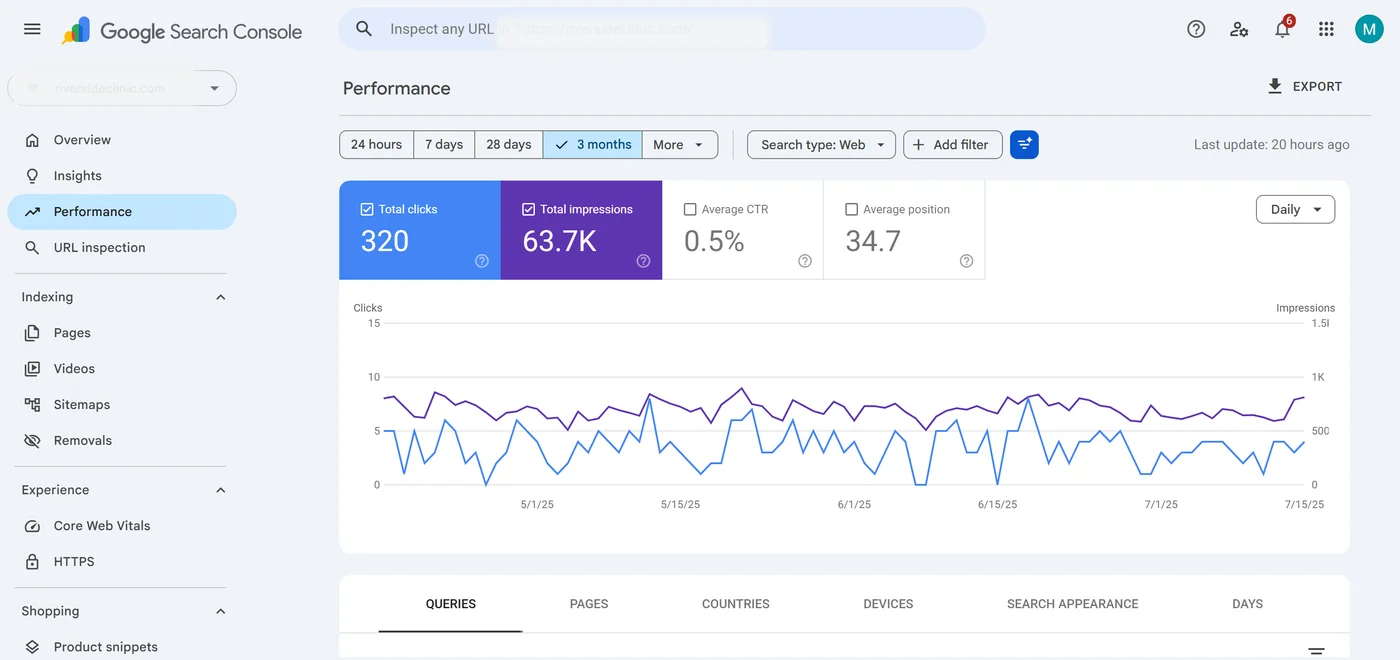
The baseline image shows the starting point of the masked scenario: impressions already present, but average positions too deep to earn many clicks.
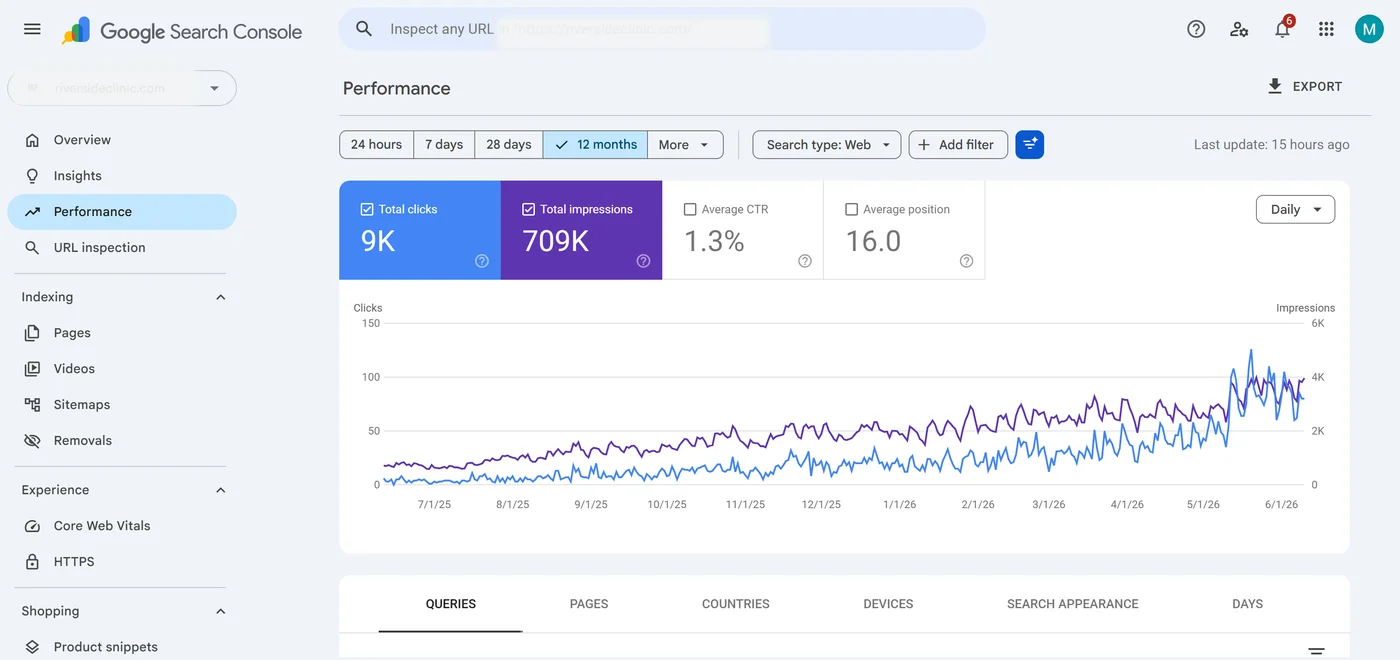
The end-state image provides the same scenario's comparison point. The scenario also records Domain Rating moving from 12 to 24, referring domains from 32 to 81, and backlinks from 148 to 405. Read those third-party metrics alongside the search figures above: authority grew gradually over the same months, so no single change is credited with the result.
How Query Visibility Shifted
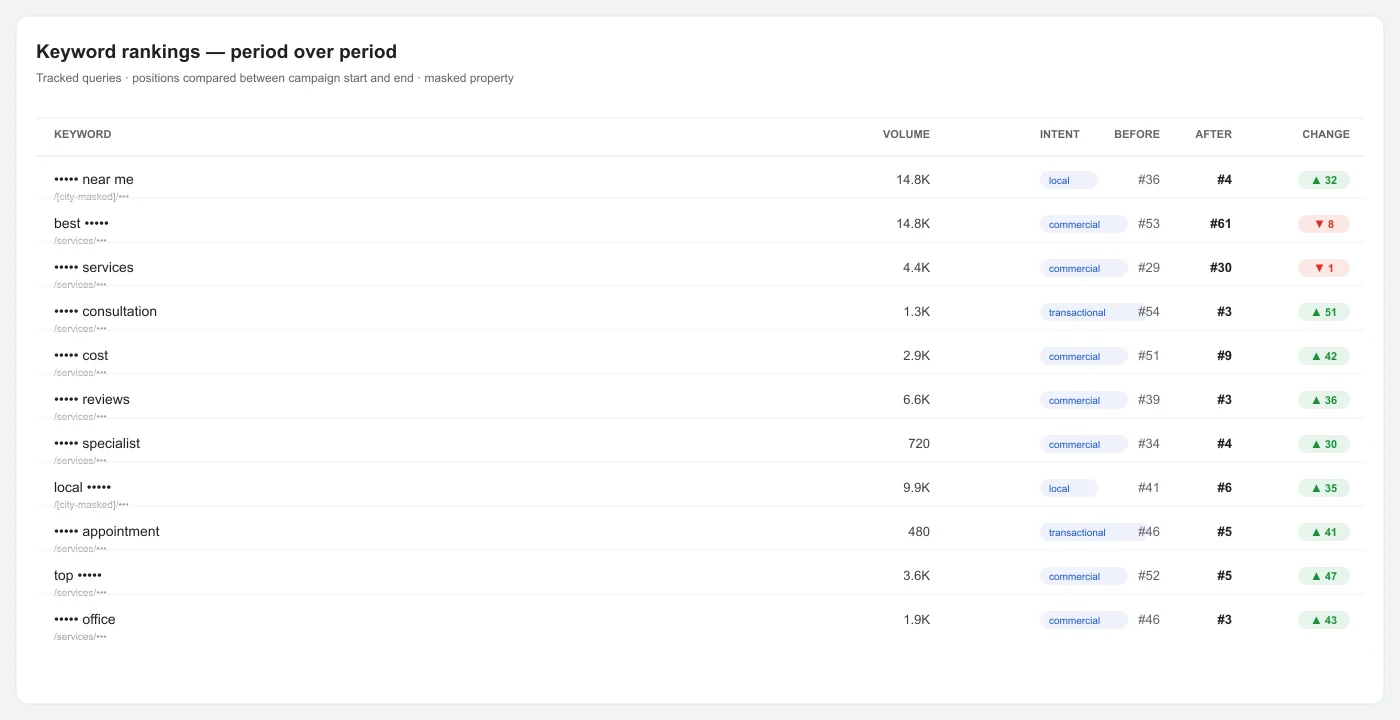
The query set includes strong gains, flat results, volatility, and regressions. That mix makes it useful for deciding which page or intent should receive more attention rather than treating the campaign as a uniform improvement.
| Query structure | Intent | Volume | Position before | Position after | Result |
|---|---|---|---|---|---|
| ••• near me | local | 14,800 | 36 | 4 | Winner |
| local ••• | local | 9,900 | 41 | 6 | Winner |
| ••• near me open now | local | 1,000 | 24 | 4 | Winner |
| ••• reviews | commercial | 6,600 | 39 | 3 | Winner |
| top ••• | commercial | 3,600 | 52 | 5 | Volatile |
| ••• cost | commercial | 2,900 | 51 | 9 | Volatile |
| ••• fees | commercial | 2,400 | 48 | 5 | Winner |
| ••• office | commercial | 1,900 | 46 | 3 | Winner |
| affordable ••• | commercial | 1,300 | 44 | 5 | Winner |
| ••• consultation | transactional | 1,300 | 54 | 3 | Winner |
| ••• specialist | commercial | 720 | 34 | 4 | Winner |
| ••• experts | commercial | 590 | 55 | 2 | Winner |
| ••• appointment | transactional | 480 | 46 | 5 | Winner |
| ••• services | commercial | 4,400 | 29 | 30 | Stable |
| best ••• | commercial | 14,800 | 53 | 61 | Decliner |
| ••• guide | informational | 880 | 51 | 69 | Decliner |
The strongest recorded local movements include 36 to 4 and 41 to 6. The tracked portfolio also contains movement across positions in the 50 range, while two weaker end states are recorded at 40-range starting visibility followed by 53 to 61 and 51 to 69. Those regressions matter because consolidation and prioritization can improve one part of the portfolio while weakening another.
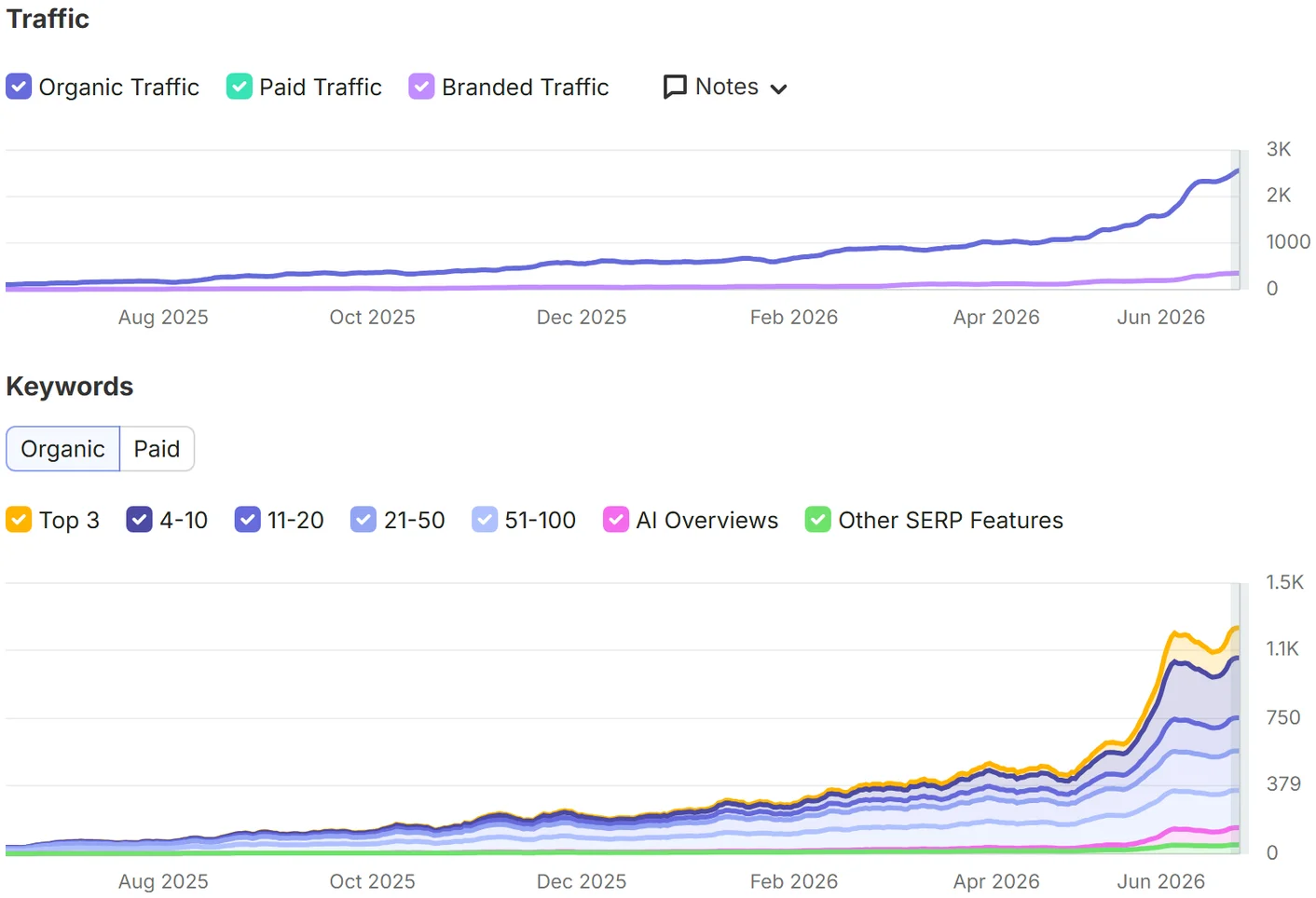
The third-party visibility graphic adds a modeled trend line to the case study; use it to check that the overall direction matches the query-level gains and regressions in the table.
What the Movement Meant for Lead Generation
The business-facing metric is tracked lead activity rather than traffic alone. Conversions moved from 2 to 46 per month, while the modeled lead-value proxy moved from 500 to 11,500. Before using the value proxy in a budget, replace it with your own value per closed lead and your enquiry-to-client rate.
The support-content system recorded 63 articles and later-stage click observations of 890, 1,038, 1,381, and 2,565. The practical value of that content is that it can answer buyer and seller questions before contact, reduce uncertainty, and provide relevant routes to consultation or service pages.
Clear entity information and concise answers may also make the site easier for Google AI Overviews and other AI systems to interpret. That is an eligibility and clarity objective, not a promise of citations, recommendations, or leads.
Evidence Limits
This is a masked illustrative case study built from coherent synthetic metrics. It is not a verified client export, and exact client identity, market, raw queries, revenue attribution, and CRM close-rate data are not represented.
Tracked conversions held at 6 during the plateau stage, but several workstreams overlapped before and after that point. Technical cleanup, consolidation, content expansion, internal linking, external authority work, competitor movement, seasonality, and SERP changes can all affect the observed curve.
The query table also contains regressions and volatility. Those outcomes are part of the evidence and should remain visible when deciding whether a page needs stronger content, a clearer role, consolidation, or simply more time.
How to Interpret the Sequence
The sequence is more transferable than the exact figures.
Resolve overlap before scaling. Several commercial terms started in the 40 to 50 range, and the support-content program eventually recorded 63 articles across 8 clusters. Clear page ownership gives new coverage a destination rather than adding more competition inside the site.
Use content to answer real real-estate questions. The internal topical-authority index moved from 20 to 58, while informational visibility reached 1,354 tracked terms. These observations support the usefulness of broader subject coverage without proving a fixed causal formula.
Reinforce pages based on business evidence. The external-authority figures in the scenario move from DR 12 to 24 and referring domains from 32 to 81, while tracked conversions end at 46. Those are concurrent observations, not proof that link growth produced the conversion change.
The practical rule is to diagnose, assign each intent to a page, publish where a genuine information gap exists, connect support pages to decision pages, and change the plan when conversion evidence says reinforcement is more valuable than additional breadth.
Practical Lessons
- Fix structure before scaling. New content is more useful when the site already has clear page ownership and a cleaner index.
- Consolidate overlapping intent. One strong destination is usually easier to maintain than several pages competing for the same real-estate search need.
- Treat informational content as decision support. Buyer and seller guides should reduce uncertainty and create natural paths to commercial pages, not exist merely to increase article count.
- Watch lead actions alongside traffic. A plateau in enquiries can justify a different next step even while clicks continue rising.
- Grow authority at a believable pace. External metrics should be treated as supporting observations, not guaranteed ranking mechanisms.
- Build for clear interpretation across search surfaces. Useful, structured, supportable content can improve clarity for search and AI systems without promising a citation or recommendation.