Case Study

Bodybuilding Supplement Store SEO: From Position 33 to 13 With Clearer Commercial Ownership and Support Content

The store had a single thin collection page fighting affiliate roundups with no in-house writers; we built 61 informational articles across nine clusters, merged the duplicate commercial landing pages into one URL, and took the main commercial term from position 42 to 7 while monthly orders went from 6 to 64.

What made the collection page more competitive than simply adding more product copy?

  1. The main 4,400-volume commercial term moved from position 42 to 7 after overlapping commercial destinations were consolidated and the collection page became the clearer target.
  2. The first 16 articles went live while crawl and canonical cleanup was still underway, which is why publishing volume by itself was not treated as a sufficient success metric.
  3. The pruning decision accepted visible losses on the subscription query, from 38 to 85, and the comparison query, from 41 to 61, instead of trying to preserve every weak commercial page.
  4. Revenue was modeled using a $90 average order value, while conversion rate moved from 1.84% to 1.76% at the end as the traffic mix shifted toward more informational sessions.

Case Study at a Glance

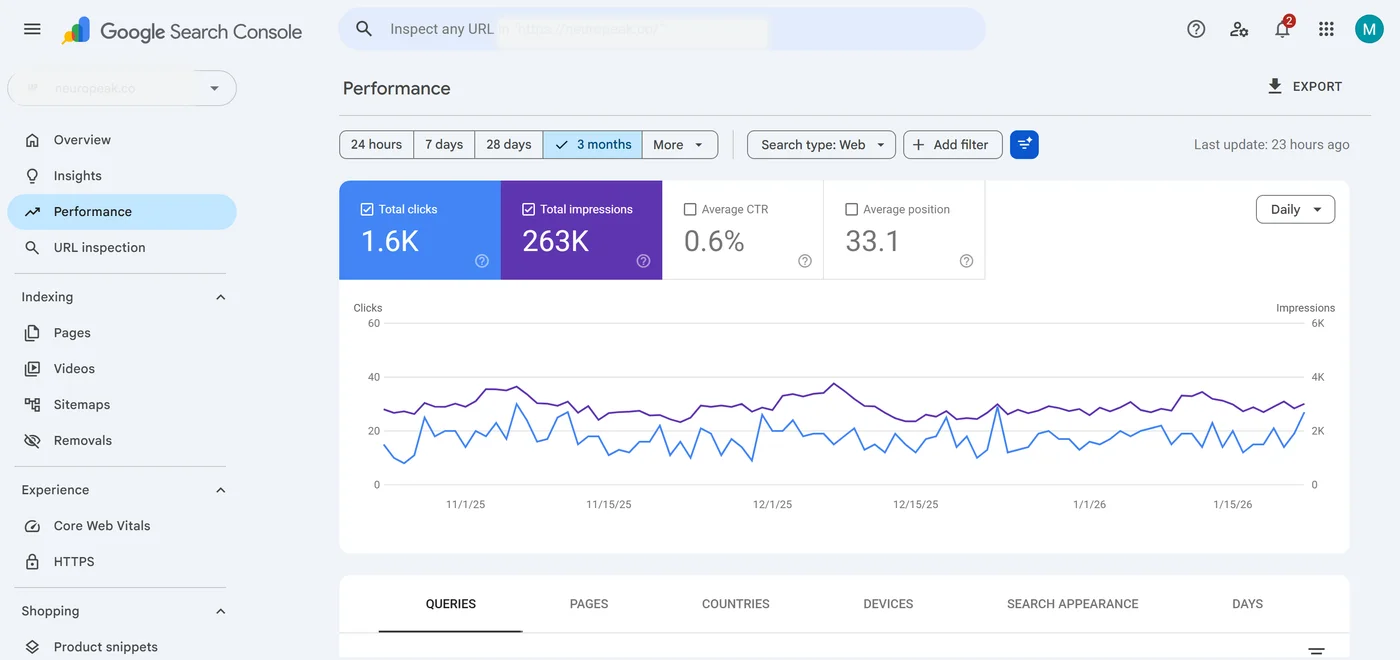
The starting point was 86,840 impressions, 521 clicks, CTR at 0.6%, and average position 33.1. The store was already appearing for relevant demand, but usually too deep in the results to capture much of it. That distinction matters because the first job was not to invent demand; it was to make the site a clearer and more useful answer for searches it was already entering.

By the end of the measured period, the modeled scenario records 3,342 clicks from 238,737 impressions, average position 13, and orders moving from 6 to 64. The decision-useful lesson is the sequence: reduce crawl noise, consolidate commercial overlap, build informational support around real shopper questions, and then prune weak destinations when they dilute the internal structure. These figures describe the scenario and are not a guaranteed outcome for another retailer.

Starting Conditions

The retailer is represented as a national ecommerce store selling sports nutrition and training supplements. The scenario starts with Domain Rating 15, 34 referring domains, 139 total backlinks, and about 456 analytics sessions in the first measured period. With no supporting source URL in the immutable source, those third-party authority metrics should remain framed as internal modeled observations.

The competitive problem was not only larger retailers. Commercial result pages also contained editorial roundups and comparison destinations, so the store needed useful information around the buying decision rather than assuming a collection page could win on inventory alone. A shopper evaluating products may compare ingredients, testing standards, format, price, shipping, or whether a category is appropriate for a particular goal before deciding where to buy.

Editorial capacity was limited, and supplement content also required careful claim boundaries. The program therefore treated unsupported physiological promises as content-quality failures and used review to keep explanations factual, qualified, and tied to the available source material. The purpose of the content library was to reduce uncertainty and improve navigation, not to imply that any supplement would deliver a guaranteed health or performance outcome.

What Needed to Change

The technical review found crawlable faceted and paginated URLs that repeated collection-level patterns and competed for crawl attention. The commercial architecture was also fragmented: several thin landing pages targeted closely related modifiers instead of giving the store one clear destination for the core buying decision.

That overlap is visible in the baseline: the main commercial term sat at 42, while Domain Rating in the scenario was 15. The store also had a tracking discrepancy, with 456 sessions against 521 clicks in the first measured period, so analytics was treated as imperfect rather than as a flawless source of truth.

The deeper editorial gap was shopper education. People comparing supplement products often want ingredient, testing, format, value, or usage-context information before purchasing. The program therefore focused on building a support library that could answer those questions without making unsupported health or performance claims. This also created a more coherent internal path from educational pages to the collection page instead of asking thin commercial variants to carry every modifier separately.

How the Program Was Sequenced

Weeks 1 to 8: clean the crawl path first

The first stage focused on parameter handling, canonical review, redirect cleanup, status-code validation, and template render checks. The goal was to reduce avoidable crawl noise before publishing more pages, not to claim that technical cleanup alone would move rankings. Faceted ecommerce sites can generate many near-duplicate states, so the review concentrated on whether search engines were being given a clear parent collection and whether internal links kept reinforcing useful destinations.

Tracked queries were also separated into commercial intents the collection could credibly own, informational questions better served by guides, and result types where third-party editorial formats were structurally stronger than a retailer page. This distinction prevented the team from building pages simply because a modifier existed; each proposed URL had to justify why a shopper would need a separate destination.

Months 2 to 4: build a useful informational library

The program developed support coverage around product-selection and category questions while avoiding unsupported physiological promises. The library reached 61 articles and 2,076 informational keywords, while the internal topical-authority index moved from 26 to 48. Cumulative publishing was recorded at 7, 16, 22, 34, 47 and 61.

The editorial standard was practical rather than promotional: explain evidence limits, compare formats where useful, keep claims qualified, and answer the question implied by the page. Internal links connected supporting content to relevant products, cluster hubs, and the primary collection page only when the relationship made sense to the reader. That meant an educational article could help a shopper move from a research question to a product category without turning every paragraph into a sales funnel.

Month 3: consolidate the commercial destination

Duplicate commercial landing variants were merged into the collection page so the site had a clearer primary URL for the main purchase intent. The separate buying guide remained informational instead of being forced into a commercial role. Useful details from removed pages were incorporated where they helped a shopper evaluate the store, while redundant keyword-targeted copy was not preserved merely for length.

Months 3 to 5: clarify entities and claims

Existing Organization and product schema was reviewed alongside entity and citation consistency. Each hub also received a concise answer block using the same qualifiers as the supporting material. These blocks can make content easier for Google AI features and other summarizing systems to interpret, but they do not create a special markup requirement or a citation guarantee. Answer blocks were kept within a 40 to 60 word range so each could stand alone without forcing a summarizer to combine separate claims. Editorial review also checked that product-related statements described evidence carefully and did not convert uncertain or context-dependent findings into promises.

Months 4 to 6: selective authority reinforcement

Lost-link recovery, relevant mention review, and quality-gated citations were layered in after the site structure and support library were established. The scenario records referring domains moving from 34 to 51 and Domain Rating from 15 to 19. With no source URL proving those third-party metrics, they remain internal observations. The authority work was treated as reinforcement around pages that already had a clearer purpose rather than as a substitute for fixing the catalogue and editorial structure.

Stage-by-Stage Progress

Phase one: foundation

Clicks moved from 521 to 722 while the first 16 articles went live. Modeled revenue moved from 540 to 1,080. The early period was dominated by crawl cleanup, canonical rules, redirects, and initial publishing, so modest visible movement was expected. The important operating question was whether priority collection and article URLs were becoming easier to crawl and whether newly published pages were entering the index cleanly.

Phase two: consolidation

Impressions moved from 103,105 to 144,780 and clicks reached 1,303 while the library reached 22 published articles and average position moved below 25. Commercial-page consolidation and the growing support structure overlapped during this stage, so the case study does not assign the change to one intervention.

Phase three: library expansion

The content program reached 34 published pieces, clicks reached 1,832, and average position reached 18.9. Entity and schema review also occurred in this period. The useful signal was that informational pages were becoming discovery points in their own right while the collection page also strengthened.

Phase four: pruning pivot

At the next review, clicks reached 2,329 and orders 36. Weak commercial pages were pruned and editorial effort was shifted toward under-covered informational areas rather than creating more near-duplicate landing pages. The pivot accepted that fewer, clearer destinations could be more useful than maintaining every legacy page simply because it had once ranked for a modifier.

Phase five: later-stage reinforcement

The final measured period records the library at 61 articles, 238,737 impressions, 3,342 clicks, CTR at 1.4%, average position 13, 3,628 sessions, and 64 orders. Those figures summarize the scenario's end state and should not be treated as a forecast for another store.

What the Data Shows

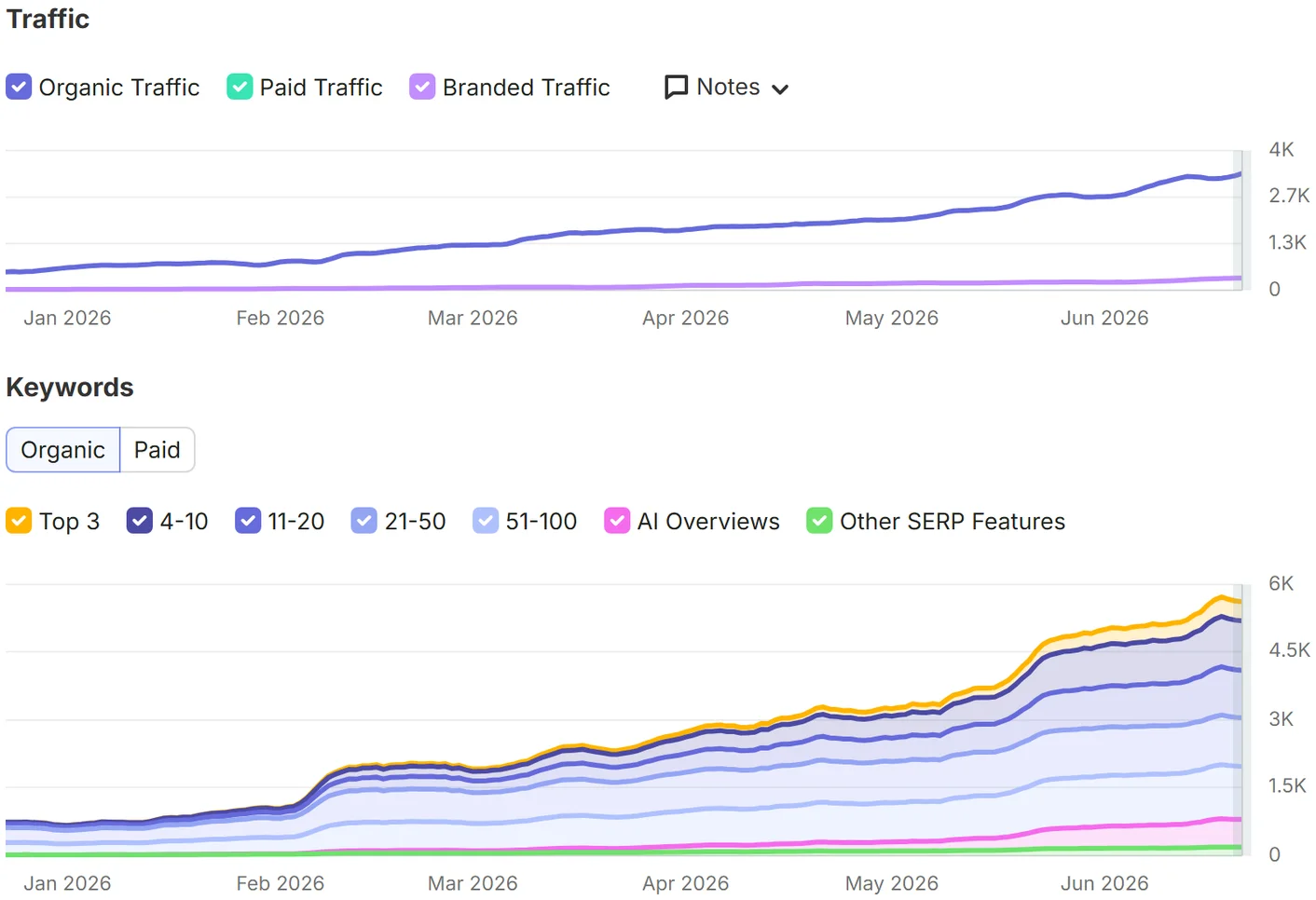
Across the measured period, impressions moved from 86,840 to 238,737, clicks from 521 to 3,342, average position from 33.1 to 13, and CTR from 0.6% to 1.4%. The pattern is consistent with more of the store's existing demand becoming visible at stronger positions, but it does not prove that any single intervention caused the full movement.

Bodybuilding Supplement Store SEO baseline search performance

The baseline image is retained as part of the anonymized scenario and should not be presented as a verified external export. It is most useful as a visual representation of the relationship between a broad impression base and limited click capture.

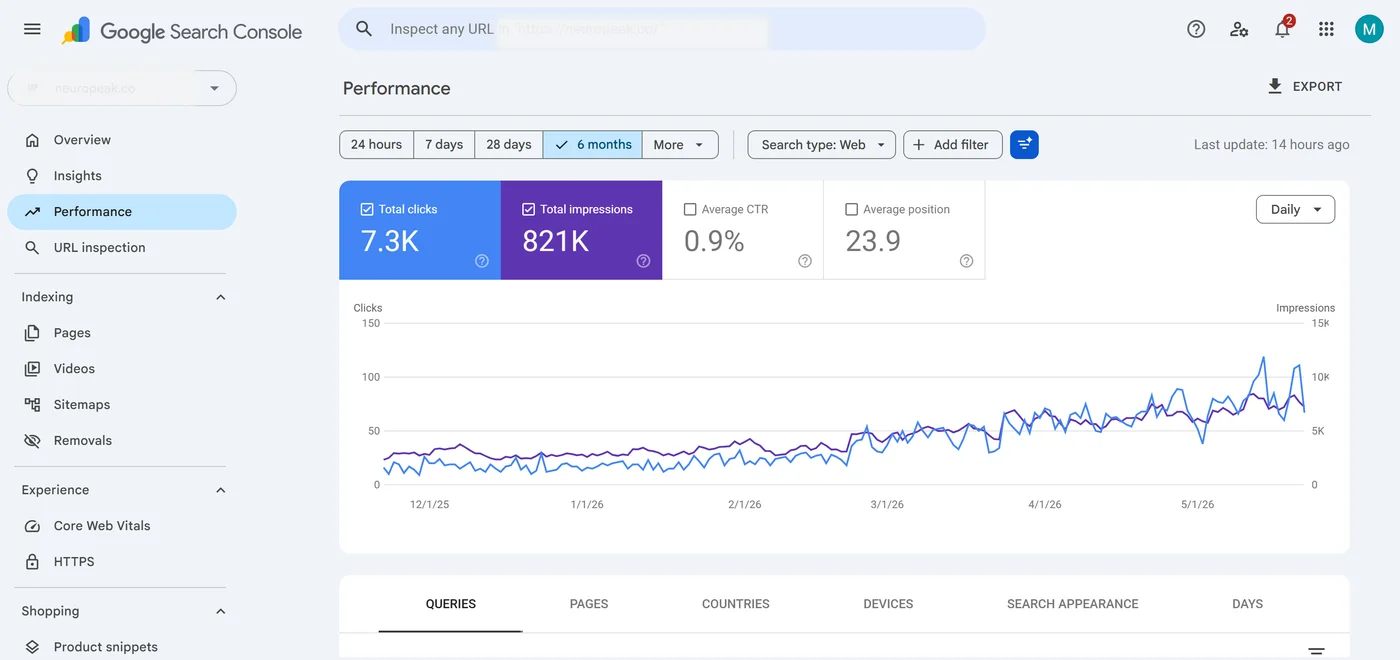
Bodybuilding Supplement Store SEO end-state search performance

Analytics sessions moved from 456 to 3,628 and monthly orders from 6 to 64. Modeled revenue moved from 540 to 5,760 at a 90 average order value, while the full period recorded 169 orders and approximately 15,210 in modeled revenue. Those value figures are directional and do not include returns, discounts, repeat-purchase behavior, or margin.

Bodybuilding Supplement Store SEO screenshot

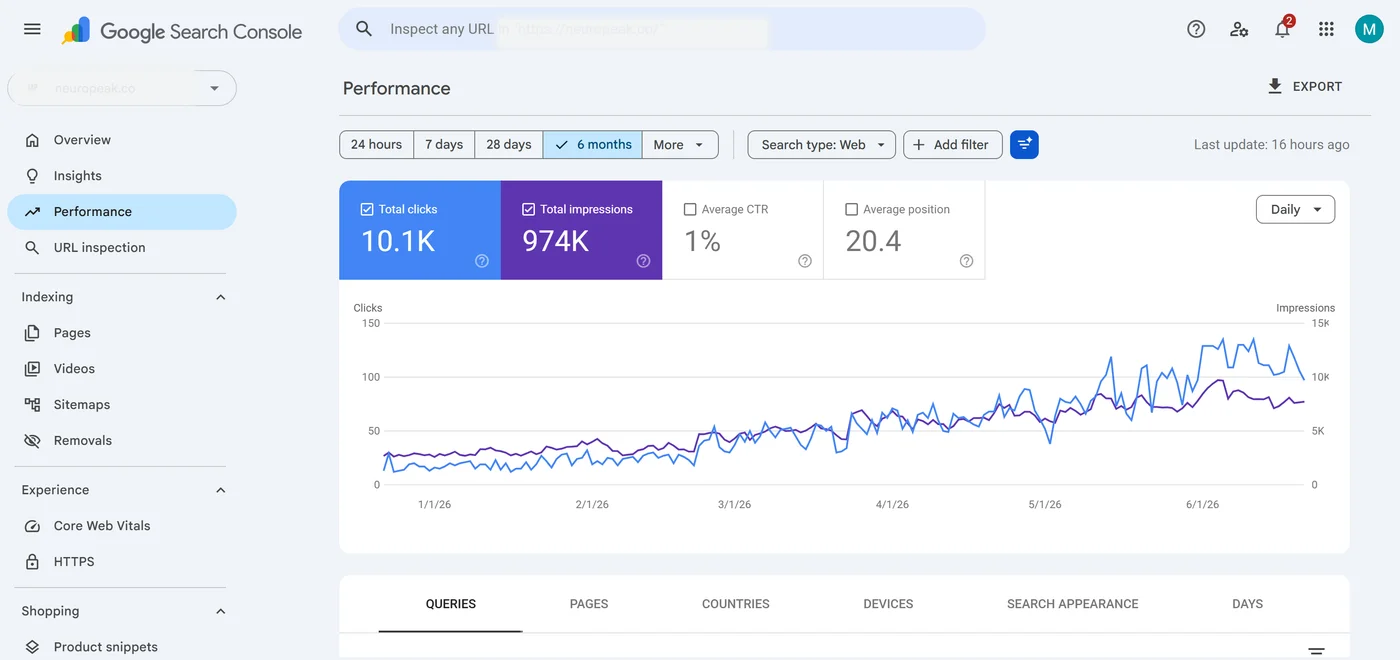
The intermediate snapshot provides context for the first major change in the traffic curve after consolidation and wider support coverage. It should be read alongside the overlapping technical and editorial work rather than as evidence for one isolated cause.

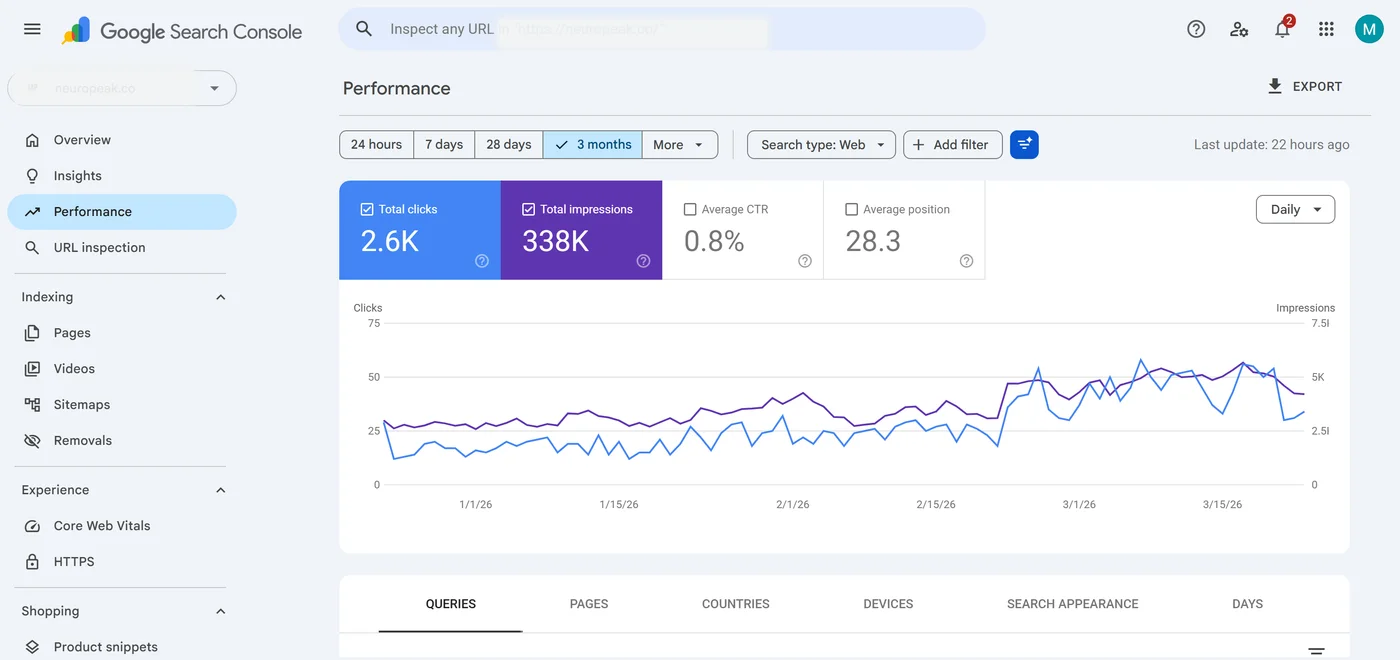
Bodybuilding Supplement Store SEO screenshot

The later snapshot records average position at 17.2 versus 18.9 in the prior period, which helped prompt a page-level review rather than another round of indiscriminate expansion.

How Query Visibility Shifted

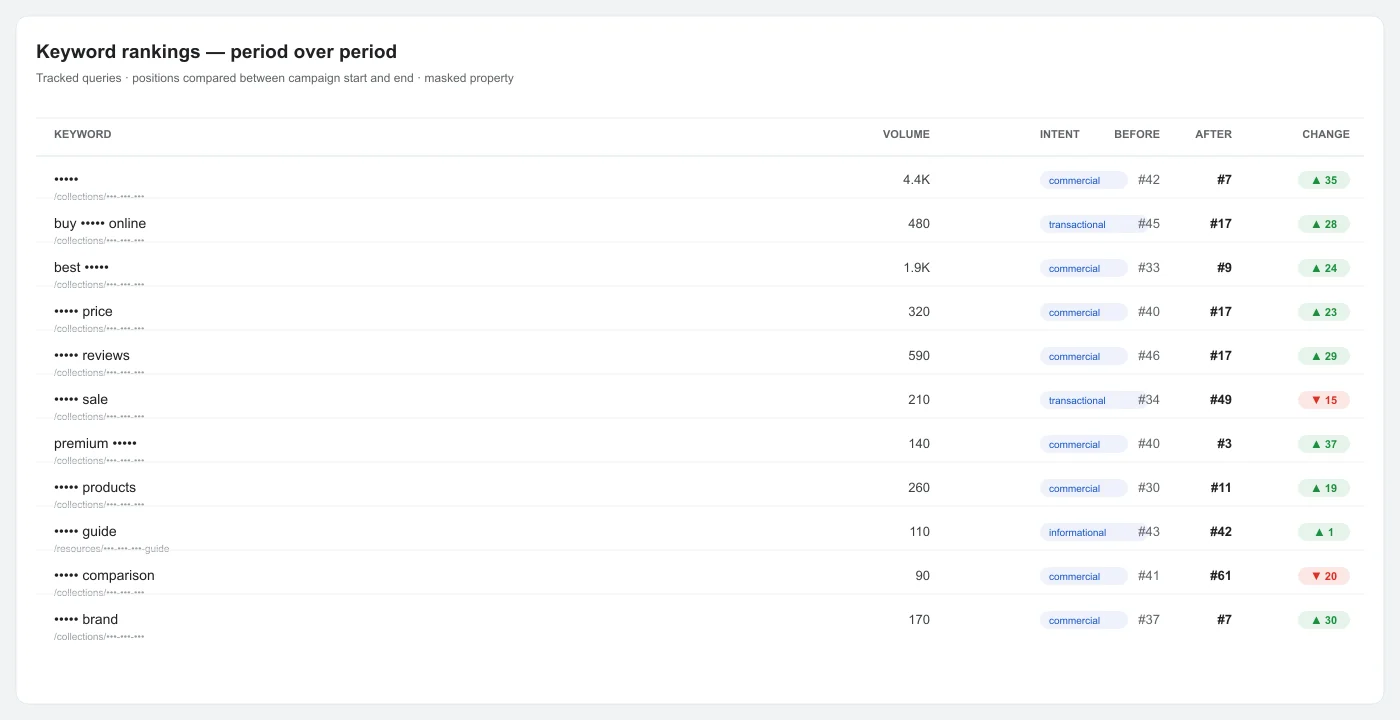
The tracked query set contains clear winners, regressions, and one near-flat informational term. That mix is useful because it shows where the consolidated collection page became more competitive and where retailer intent remained a poor fit. The niche wording remains masked; volumes, difficulty scores, and positions are retained from the modeled scenario.

Bodybuilding Supplement Store SEO rankings comparison
Query structure (masked)IntentVolumeKDBeforeAfterMovement
•••Commercial4,40058427+35
best •••Commercial1,90061339+24 (volatile)
••• reviewsCommercial590544617+29
buy ••• onlineTransactional480524517+28
••• priceCommercial320484017+23
••• discountCommercial26049418+33
••• productsCommercial260503011+19
••• saleTransactional210463449-15
••• brandCommercial17051377+30
premium •••Commercial14055403+37
••• guideInformational110384342+1
••• subscriptionCommercial110443885-47
••• comparisonCommercial90424161-20
••• ingredientsCommercial90353011+19
••• alternativesCommercial9041506+44
••• shippingCommercial7040497+42

Where the collection page became more competitive

The strongest gains cluster around evidence-led modifiers: ingredient, alternatives, brand, premium, and shipping intents all moved into the top ten. Those are questions the informational library now answers in depth, and the consolidated collection page inherited the relevance. The head commercial term at 4,400 monthly searches followed the same path, from 42 to 7, roughly one month after consolidation.

The roundup-style query at 1,900 volume is marked volatile for good reason. It reached position 9 but oscillated between single digits and the low twenties week to week, because that result page constantly reshuffles between editorial lists and retailers. We report the endpoint, not a stable position.

Where the retailer accepted losses

The deals-oriented transactional query fell from 34 to 49. When we merged the standalone deals variant into the collection page, we gave up the dated, frequently updated format that this particular result set rewards. Coupon aggregators refresh daily; a collection page does not, and we were not going to fabricate a promotional cadence to chase 210 monthly searches while a 260-volume discount query was climbing to position 8 on the merged URL.

The comparison query dropped from 41 to 61 after we redirected a thin comparison page. That result page is populated almost entirely by third-party editorial, and a retailer comparing itself to rivals is an intent mismatch that Google resolves against us. We accepted the loss rather than rebuild a page we did not believe would hold.

The subscription query is the worst number in the set, 38 to 85, and it is a direct consequence of the month-five pruning. That page was removed because the client's subscription offer was not differentiated enough to defend, and the ranking collapsed accordingly. The informational guide query barely moved (43 to 42) because it sits on a standalone resource URL that never received the internal-link support the cluster hubs got. That was an oversight in our hub mapping, not a strategic choice.

Bodybuilding Supplement Store SEO screenshot

The third-party visibility graphic is retained as part of the modeled scenario. Without a supporting source URL for the underlying third-party data, it should not be presented as independently verified evidence. Its role here is comparative context alongside the internal query table, not proof of causation.

What the Movement Meant for Orders

Using a modeled average order value of 90, monthly modeled revenue moved to 5,760 from 540, and the full measured period recorded approximately 15,210. Conversion rate moved from 1.32% to 1.76%. Those figures are directional because they do not include returns, refunds, discounts, shipping economics, or repeat-purchase value.

The support library also changed the traffic mix. Sessions reached 3,628 against 3,342 clicks in the final measured period, consistent with a mix that included returning or direct visits as well as new organic arrivals. For a supplement retailer, that matters because research can precede purchase: a shopper may compare ingredients or testing information before returning later to place an order.

The store ended with 61 articles and 2,076 informational keywords in the modeled dataset. The durable value of that footprint is that it can continue answering product-selection questions and linking shoppers toward relevant commercial destinations. It does not guarantee rankings, orders, or AI citations, and it still requires periodic review as evidence, product assortments, and guidance change.

The claim-review process also has operational value beyond search. A retailer that publishes category education needs a consistent way to separate what available evidence supports from what marketing language might imply. Keeping that boundary explicit reduces the risk that useful informational content turns into unsupported performance promises.

Evidence Limits

The modeled revenue calculation uses an average order value of 90. The earliest analytics baseline also contains a tracking discrepancy, with 521 clicks but 456 sessions, so session growth should not be interpreted as perfectly measured.

The blended conversion rate reached 1.84% before moving to 1.76%, while orders moved from 36 to 64. That mix shift matters because more informational traffic can increase total orders while reducing the blended conversion rate. It is therefore more useful to inspect absolute orders, traffic composition, and commercial-page performance together than to force every metric into a uniformly rising story.

Seasonality, competitor changes, SERP composition, returns, discounts, and repeat-purchase behavior are not isolated in this scenario. Domain Rating and referring-domain figures are third-party estimates without supporting source URLs in the immutable source, so they remain observational rather than verified evidence.

The content itself also needs maintenance. Ingredient evidence, product availability, testing standards, and regulatory expectations can change, so pages should be revisited when their factual basis changes. The case study does not imply that publishing a library once makes it permanently accurate or permanently competitive.

How to Interpret the Sequence

The strongest lesson is procedural rather than causal. After the initial crawl work, the later content batch from article 17 through 61 was published into a cleaner architecture. The head commercial term moved from 42 to 7, while the discount-intent term reached position 8.

The support library expanded the modeled topical-authority index from 26 to 48 and informational visibility to 2,076 tracked keywords. Average position moved from 33 to 13 and CTR from 0.6% to 1.4%, while monthly orders moved from 6 to 64. These observations happened within the same program, but they do not isolate a single cause.

The transferable decision sequence is to remove crawl waste, choose one clear commercial destination, publish support content where shoppers have genuine questions, keep claims qualified, and prune weak pages when their maintenance cost exceeds their value. The same sequence also helps editorial teams avoid confusing product education with product promises: useful content should explain what a shopper needs to evaluate, while unsupported efficacy claims remain outside the page.

Practical Lessons

  • Fix crawl allocation before scaling. The first 16 articles went live before the later batch of 45, so publishing pace should be judged in the context of crawl and indexation quality.
  • Give the main purchase intent one destination. The 4,400-volume term reached position 7 after the commercial architecture was simplified.
  • Use informational depth to answer real shopper questions. The library reached 61 articles and 2,076 informational keywords without relying on unsupported health or performance promises.
  • Accept visible losses when the intent is a poor fit. The subscription query moved from 38 to 85 after pruning.
  • Report conversion-rate mix honestly. The modeled rate moved from 1.84% to 1.76% even as order volume increased, so a smooth success narrative would hide useful information.

For another retailer, the transferable value is not the exact article count or query movement. It is the discipline of deciding which URLs deserve to exist, which questions genuinely help shoppers, which claims need evidence, and when a weaker page should be removed instead of defended indefinitely.

Related service
See the strategy behind this result.
Explore the SEO strategy for health wellness store businesses.
Health Wellness Store SEO services

Frequently Asked Questions

Why publish 61 informational articles instead of only expanding product and collection copy?

The program treated shopper questions around ingredients, testing, formats, and evidence as a separate information need from product inventory. The library reached 61 articles while the internal topical-authority index moved from 26 to 48.

Those observations support the role of useful informational coverage, but they do not prove that article volume alone caused the commercial ranking changes.

How much did external authority change during the measured period?

The scenario records referring domains moving from 34 to 51 and Domain Rating from 15 to 19. Because the immutable source contains no supporting URL for those third-party figures, they should be treated as internal observations rather than independently verified proof.

What triggered the pruning review?

A page-level review showed average position at 17.2 while several commercial landing pages were contributing little visibility and still consuming internal-link attention. The response was to stop expanding that overlap and redirect editorial effort toward under-covered support topics.

Why did the subscription query move from position 38 to 85?

The subscription page was removed because the offer did not justify maintaining a thin standalone destination. The query had 110 monthly searches in the modeled dataset, and the loss is reported as a direct trade-off of that pruning decision.

Does this type of support library help with AI assistants and Google AI features?

Clear answer blocks, consistent qualifiers, and well-structured evidence can make content easier for summarizing systems to interpret. What this case study can support is that the structure exists. It cannot support a verified citation count or a guaranteed appearance in any AI answer surface.

How durable is the commercial visibility after the active engagement?

The informational library and internal-link structure remain after active production ends, but positions can still move. The 1,900-volume roundup-style query was already volatile, so the practical expectation is continued maintenance and evidence updates rather than permanent rankings.

THIRTY SECONDS TO START

You've read enough.Your own data says more.

Connect your site and see it yourself: your rankings, your gaps, your blockers, and what AI tells your buyers. The plan and the priced options follow within 36 hours.

Your access code by SMS. We never call.No payment