Case Study

Nootropic Brand SEO Case Study: 58 Articles Moved a Collection Page From Position 17 to 8

This case study follows 58 articles across 9 buyer-research clusters, with modeled monthly clicks moving from 1,040 to 4,938 and recorded scenario orders moving from 20 to 115 under the source evidence boundary.

What made the SEO plan more useful for this nootropic ecommerce store?

  1. Month 2 was allowed to look worse before it looked better: the modeled average position moved from 16.7 to 17.8 and clicks settled at 980 while duplicate and low-value URLs were being removed.
  2. The study's content asset reached 58 articles across 9 clusters, while its internal topical-coverage index moved from 23 to 46 and the scenario ended with about 2,599 informational keywords represented.
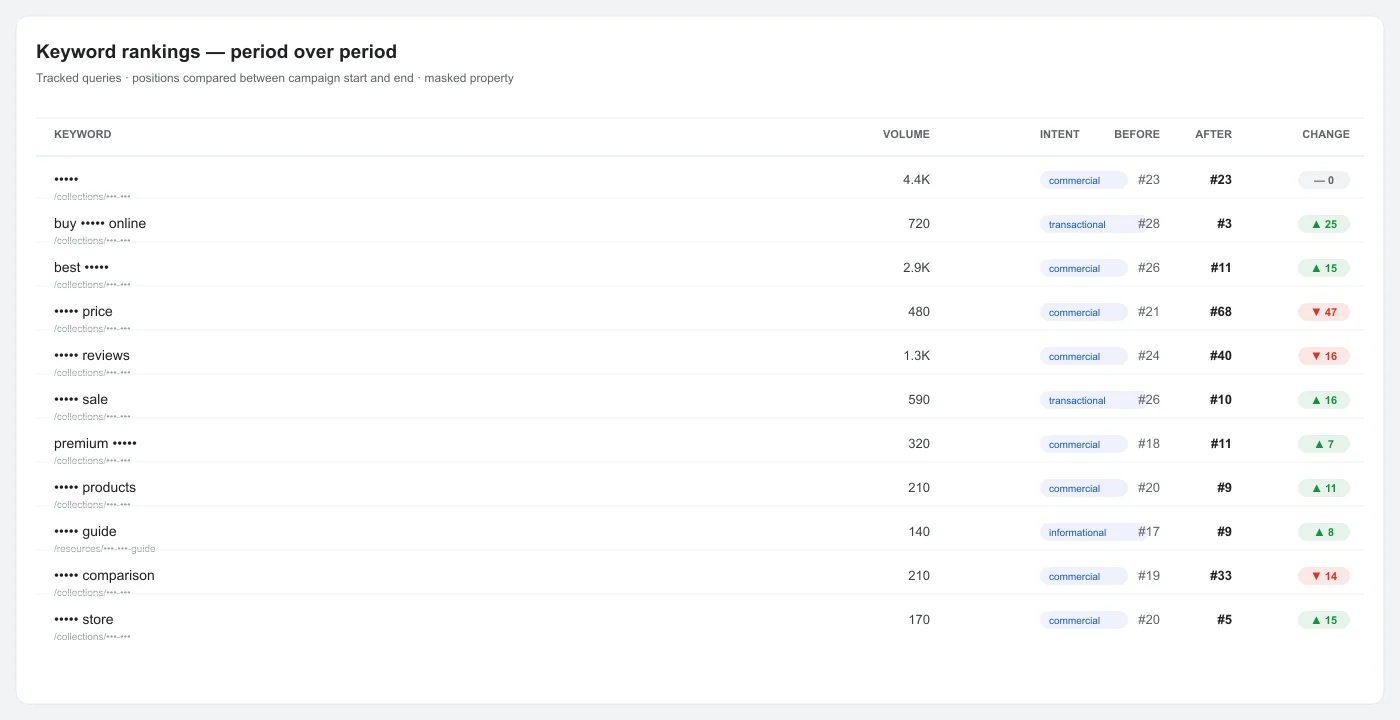
  3. The case does not hide weaker query outcomes: price intent moved from 21 to 68, while comparison and alternatives ended at 33 and 31, illustrating the cost of concentrating effort on merchant-led transactional intent.
  4. The month 5 editorial pivot coincided with orders moving from 62 to 59 before the scenario's month 6 close at 115 orders and 4,938 clicks; the figures are useful for sequencing, not proof that the pivot alone caused the later lift.

Executive Summary

This case is most useful when read as a sequencing example rather than a promise of a repeatable curve. The opening cleanup deliberately reduced surface area: modeled clicks moved from 1,040 to 980, sessions from 905 to 741, and orders from 20 to 17, while average position shifted from 16.7 to 17.8. Those changes appeared while overlapping commercial pages, inconsistent canonical handling, and low-value URLs were being consolidated.

The later scenario is materially different. The same property closes with 4,938 clicks, 4,504 sessions, and 115 orders after the research library, internal-link structure, and consolidated collection destination were in place. The decision-useful takeaway is not that content automatically creates this outcome. It is that technical cleanup, intent consolidation, compliant educational coverage, and contextual internal linking were treated as dependencies rather than isolated tactics, while weaker query classes were allowed to remain weaker instead of being disguised as wins.

Context

The study models a national ecommerce seller of nootropic supplements operating through one storefront. At the start, tracked queries averaged position 16.664, the property showed 94,540 monthly impressions, and 905 organic sessions were associated with 20 orders. The study applies a modeled average order value of $90, producing $1,800 in modeled monthly organic revenue. Those commercial figures are scenario calculations, not audited payment-processor data.

The search problem was not a lack of product inventory. It was a lack of useful research coverage around the questions buyers consider before choosing a supplement: ingredient purpose, dosing context, stacking, testing, sourcing, caffeine, sleep, and purchase logistics. That left the storefront dependent on product and collection pages without enough supporting information to explain the category or create strong internal paths from research intent to commercial intent.

Two constraints changed what a sensible plan looked like. Publishing capacity was limited, so topic selection had to be selective rather than volume-led. The category also required conservative claim boundaries: educational copy could explain sourced product and ingredient information, but it could not promise treatment, certainty, or guaranteed cognitive results. Competition for evaluation queries was also materially stronger than the site's own authority footprint, which the source records at DR 18 and 29 referring domains.

The Challenge

The keyword map showed a store trying to make too many thin commercial URLs answer closely related buying questions. Several of those pages sat between position 16 and 30, which created visibility without enough placement strength to generate dependable clicks. The practical question was whether to keep expanding those variants or concentrate commercial relevance in one clearer collection destination.

The crawl pointed in the same direction. Template-generated variants, inconsistent canonical handling on filtered views, and redirect chains made the indexed footprint look larger than the genuinely useful footprint. That meant new content could have been added onto an architecture that still distributed internal signals across pages with little independent value.

Authority was the third constraint. The source scenario starts with 166 backlinks from 29 domains, while one tracked head term carried 4,400 monthly volume. Rather than treating outreach as a shortcut, the plan prioritized relevance and coverage first: simplify the commercial architecture, build educational depth that fits the supplement evidence boundary, then use modest link acquisition as reinforcement rather than as the primary explanation for movement.

Methodology

Foundation work before scale (months 1 to 3)

The first operating choice was to reduce ambiguity before increasing publishing. Indexed URLs were classified by whether they served a commercial destination, a supporting research need, or neither. Template sources of duplication were addressed, filtered collection views were aligned to the intended canonical destination, redirect chains were shortened, and internal links were updated to point directly to live targets. Rendering and internally linked status codes were checked on the templates that mattered most.

Query mapping then separated merchant intent from independent-evaluation intent. That led to a narrower architecture: pricing, comparison, and alternatives material would be folded into one collection destination rather than expanded into multiple weak commercial pages. The short-term cost appears in month 2; the architectural objective was a single URL with a clearer job.

Research coverage as the growth asset (months 2 to 6)

The informational plan focused on nine research areas already present in the source: ingredients, dosing and stacking, cognitive-goal topics, safety and interactions, testing and sourcing, caffeine and energy alternatives, sleep and recovery, ingredient-class comparisons, and purchase logistics. The library reached 58 published articles on a cumulative sequence of 8, 16, 22, 34, 45, and 58. The study's internal coverage index moved from 23 to 46, and by month 6 the scenario closed with roughly 2,599 informational keywords represented.

The practical rule was that each article had to do two jobs: answer its research question within the evidence available to the page, and provide a contextual path toward the relevant commercial or hub destination without forcing repetitive anchors. That makes the library useful even if a reader never buys immediately, while also giving the collection page a coherent internal neighborhood around the topics buyers investigate before purchase.

Editorial claim control

From month 1, editorial QA was treated as part of production, not a final polish. Approved product language was used to define tone and claim boundaries, and drafts were reviewed for wording that could imply treatment, certainty, or guaranteed effect. The goal was publishable educational content that could remain useful to shoppers and potential citing publishers without outrunning the evidence available on the page.

Entity and answer structure (months 3 to 5)

Organization data, author and reviewer identity signals, and citation consistency were reviewed so explanatory pages were easier to attribute. Cluster hubs received concise summary passages that could stand on their own. This is best understood as content clarity and entity consistency, not a special markup path to Google AI Overviews or other Google AI features.

Link reinforcement after useful assets existed (months 4 to 6)

Outreach began after there were substantive pages worth referencing. The source describes lost-link recovery, unlinked mention work, and relevant resource outreach. Referring domains moved from 29 to 48, total backlinks from 166 to 250, and DR from 18 to 23. These are study figures and should be read as supporting context rather than proof that link growth caused the search curve.

Timeline

Months 1 and 2: reduce duplication before chasing growth

The opening stage removes overlap and crawl waste while the earliest research pieces are published. The source timeline shows impressions moving from 94,540 to 89,110. That decline is consistent with retiring low-value surfaces, but it should not be treated as proof that cleanup necessarily causes a dip on every site.

Month 3: the consolidated architecture begins to show stronger visibility

Once the collection destination, the internal linking pass, and the first body of supporting content were present together, reporting checkpoint 3 showed that the study's average position moved from 17.8 to 13.2. Impressions passed 137,000, clicks reached 2,055, sessions reached 1,800, and orders reached 44. The numbers move in the same direction, but the case cannot isolate the contribution of any single change because several workstreams overlapped.

Month 4: deepen the strongest supporting topics

With 34 articles live, production shifted toward the research areas most directly connected to purchase diligence, including logistics, testing, and sourcing. The scenario records 173,166 impressions, 2,597 clicks, and 62 orders at this stage.

Month 5: consolidate the weak editorial tail

At month 5, the plan stopped prioritizing short net-new posts that had shown little traction and reallocated writing capacity toward merging, expanding, and pruning. The cumulative library still reached 45 articles, but the editorial objective changed from topic count to stronger surviving pages.

The same month is mixed rather than cleanly positive. Impressions moved from 173,166 to 169,833, orders from 62 to 59, clicks reached 2,887, CTR reached 1.7%, and average position reached 10.7. That combination is exactly why the pivot should be described as an operating decision, not credited as the sole cause of what followed.

Month 6: the combined system reaches its strongest point in the window

The closing stage records 58 articles, 48 referring domains, an average position of 8.0, and 214,691 impressions. Compared with month 5, CTR is 2.3%; clicks close at 4,938, sessions at 4,504, and orders at 115. The most defensible reading is cumulative: technical cleanup, intent consolidation, editorial depth, internal linking, and later link reinforcement were all in place by this point, while much of the groundwork had occurred during months 3 through 5.

Results

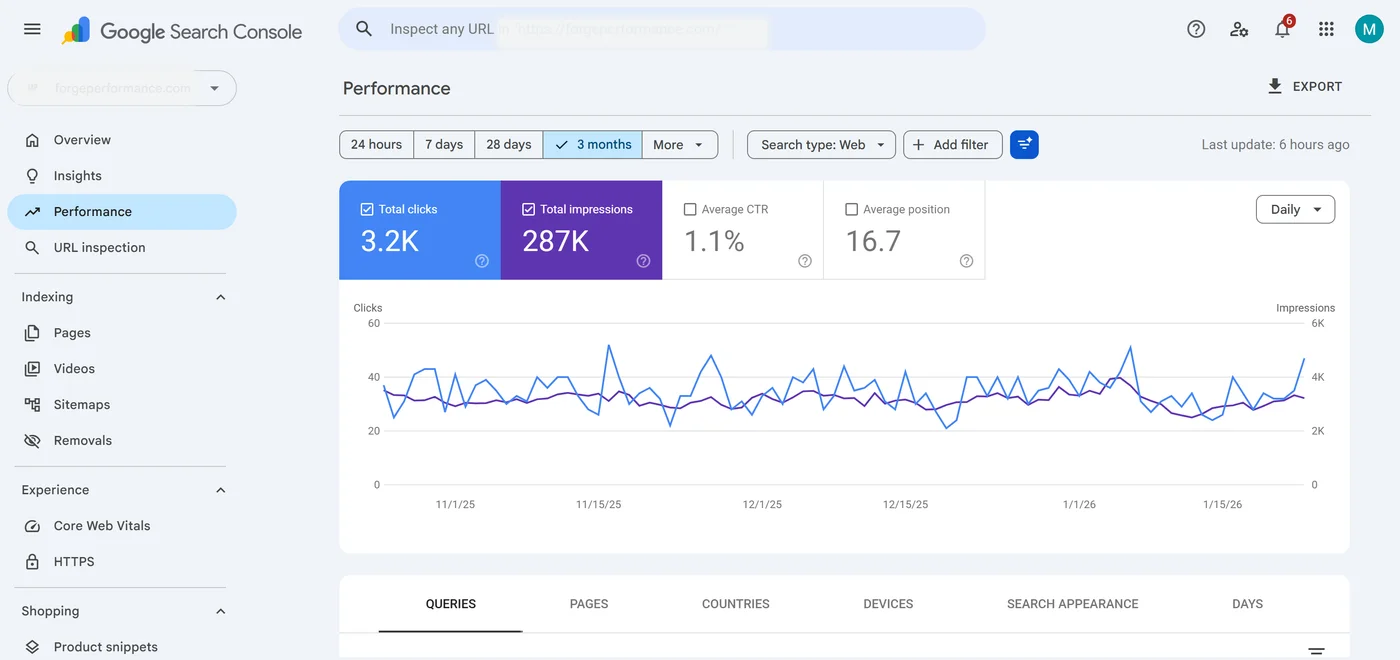
The screenshots should be read as anonymized case-study illustrations, not as independently verified third-party exports. Their value is in showing how the source scenario defines the beginning and end of the observation window.

Nootropic brand SEO baseline search performance

Month 1 records 94,540 impressions, 1,040 clicks, 1.1% CTR, and average position 16.664. The practical baseline was therefore still around position 17. The operational issue was therefore not simply getting indexed or generating impressions; it was improving the usefulness and placement of the pages already receiving visibility.

Nootropic brand SEO end-state search performance

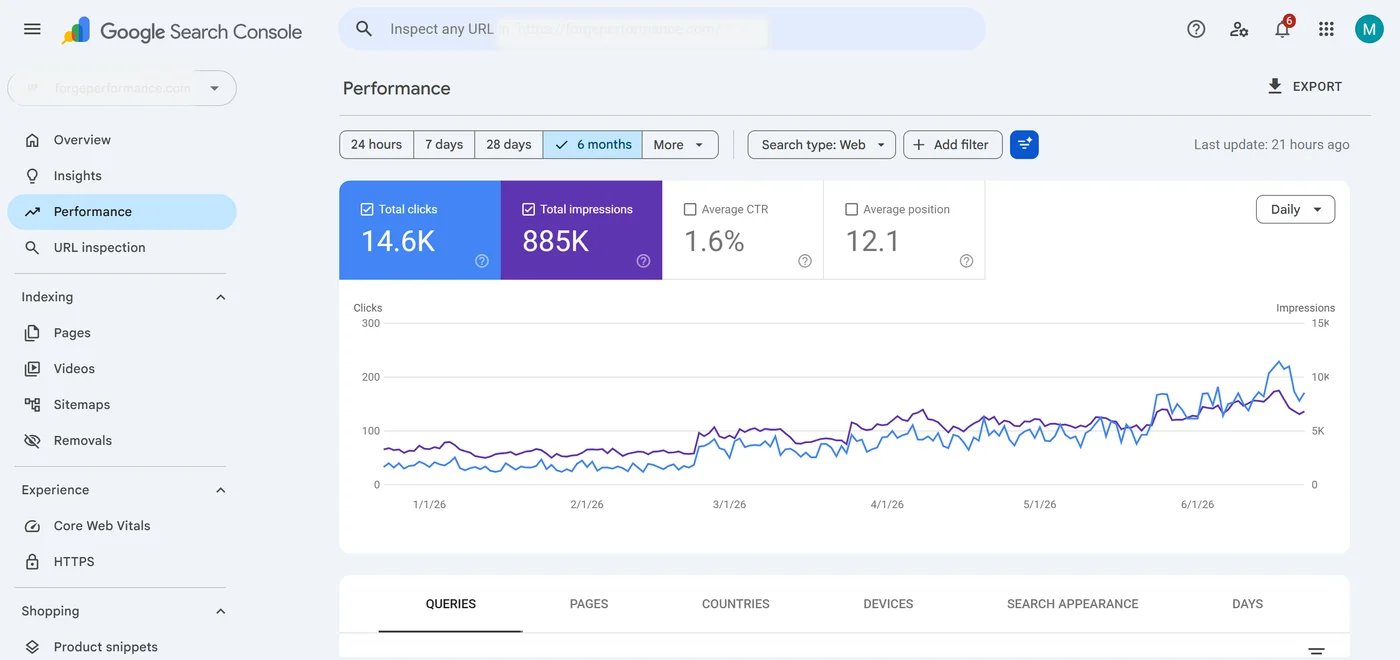
Month 6 records 214,691 impressions, 4,938 clicks, 2.3% CTR, and average position 8.0. In the scenario, impressions grew 2.3x while clicks grew 4.7x. That relationship is consistent with stronger positions and better intent alignment, but it should not be converted into a guarantee or attributed to any one implementation detail.

Across the full window, the case totals 14,497 organic clicks, 12,679 sessions, and 317 orders. Session-to-order conversion moves from 2.2% in month 1 to 2.6% in month 6. For decision-making, that is more useful than traffic growth alone because it tests whether the added organic audience remained commercially relevant inside the study model.

Keyword Movement

Nootropic brand SEO rankings comparison

The brand and category wording remains masked in the study. The table is useful for separating merchant-friendly transactional intent from evaluation queries where an independent publisher may be a more natural result type.

Query structureIntentVolumeKDBeforeAfterOutcome
buy [masked] onlineTransactional72052283Winner
[masked] ingredientsCommercial17040163Winner
[masked] discountCommercial32047303Winner
[masked] shippingCommercial9035234Winner
[masked] storeCommercial17044205Winner
[masked] subscriptionCommercial11041197Winner
[masked] productsCommercial21046209Winner
[masked] guideInformational14038179Winner
[masked] saleTransactional590502610Winner
best [masked]Commercial2,900612611Winner
premium [masked]Commercial320541811Winner
[masked] head termCommercial4,400582323Stable, no movement
[masked] alternativesCommercial170431931Decliner
[masked] comparisonCommercial210421933Decliner
[masked] reviewsCommercial1,300552440Volatile
[masked] priceCommercial480482168Volatile

Where merchant intent improved

Transactional and logistics-adjacent queries are the clearest positive cluster in the table. The useful interpretation is architectural: those searches can plausibly be served by a merchant's own collection or purchase-support pages, so consolidating overlapping commercial URLs gave the site a clearer destination for them, with several entries ending in the top 3. The study also records the high-volume evaluation term at 2,900 searches moving from 26 to 11, while the collection page ends at position 23 for the head term.

Where evaluation intent stayed difficult

Price is the sharpest negative case, ending at 68. The source describes comparison, alternatives, price, and review queries as harder fits for a merchant-owned page because those SERPs can favor independent evaluation. The case therefore treats these outcomes as tradeoffs rather than hiding them behind average growth.

Resource allocation followed that distinction. The four weaker evaluation queries carry 2,160 combined volume in the source, compared with 1,720 for the transactional cluster that was already responding. With constrained writing capacity, the project chose to keep investing in ingredient, testing, and purchase-intent support instead of building a new comparison asset during the observation window.

Nootropic brand SEO visibility screenshot

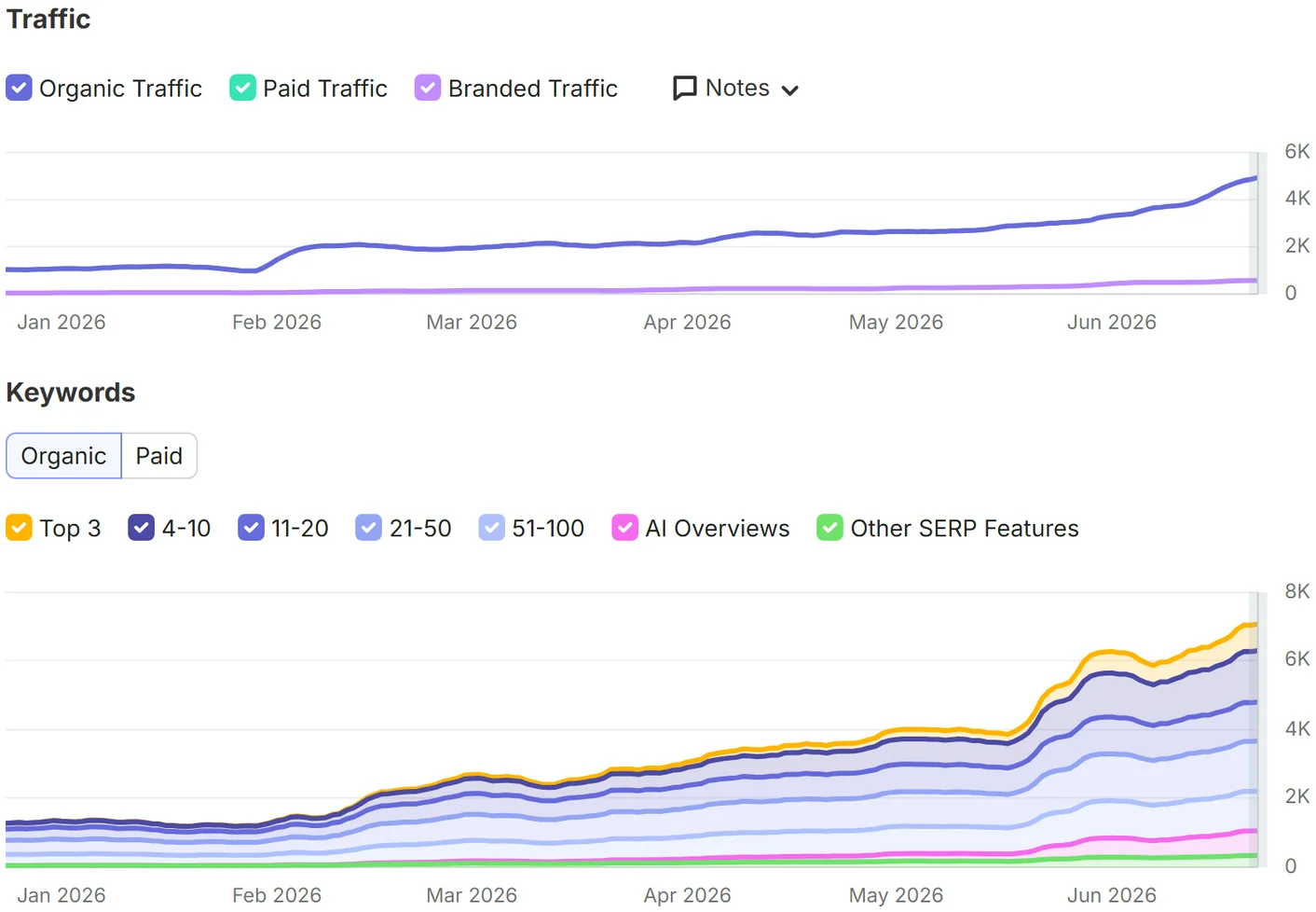
The external visibility image is best treated as supporting context. The study says the curve turns upward in month 3 and closes with about 2,599 informational keywords represented, but the source does not provide an external URL that would let a reader independently verify that third-party trend here.

Business Impact

The revenue figures are modeled rather than audited. Using the study's fixed average order value, modeled monthly organic revenue moves from $1,800 to $10,350 at an assumed $90 per order, while orders move from 20 to 115. Cumulative modeled organic revenue across the window is $28,530, with month 6 representing the closing reporting stage. Those values are useful for comparing stages inside the case, not for projecting what another store will earn.

The more transferable commercial question is where the traffic entered the journey. Ingredient, testing, dosing, shipping, and other research pages address diligence questions that can occur close to purchase. When those pages link clearly to the relevant collection or product destination, informational sessions can support product discovery without pretending every reader is immediately transactional.

The source closes with 58 articles and an internal coverage index moving from 23 to 46. That library remains an owned publishing asset after the observation window, but its future rankings are not guaranteed. Search competition, content freshness, product changes, and the strength of competing sources can all change what the same pages earn later.

There is also an AI-search consideration, but it should be stated narrowly. Clear authorship, consistent entity information, and self-contained summaries can make explanatory pages easier for systems to parse and attribute. This case does not provide a measured Google AI Overviews or AI-assistant citation rate, so the appropriate conclusion is readiness and clarity, not a claimed visibility outcome.

Limitations

The observation window closes with average position 8.0, so it does not establish a long-run ceiling. The source also notes a lag between publishing and meaningful search visibility, which means work from earlier months can influence later reporting and material published near the end may not have had time to mature.

Revenue is modeled rather than read from a payment processor. Subscription-related orders can have future value that the model does not capture, while returns, cancellations, and order-value variation can reduce realized value. Organic attribution also cannot prove that search was the first or only touchpoint for every purchaser.

Seasonality remains unresolved because month 7 is outside this study, while the observed window ends at month 6. Within that window, month 6 overlaps a promotional period in the source, so the final-step increase should not be treated as purely structural. The timeline also includes work in month 4 and month 5 whose effects cannot be cleanly separated from the later month 6 result. The month 6 close therefore remains partly confounded by timing.

The weakest query remains price at position 68. In month 5, orders moved from 62 to 59, which is too little evidence to prove the editorial pivot either harmed or improved order volume by itself. The case is therefore better for understanding tradeoffs and sequencing than for claiming a controlled causal test.

Causal Explanation

The evidence supports a dependency story more strongly than a single-cause story.

  • Consolidation reduced commercial overlap. The source records the main commercial destination moving from position 2 contexts into a cleaner single-page architecture around a DR 18 site whose topical index later moved from 23 to 46. The defensible claim is that fewer overlapping URLs made intent ownership clearer, not that redirects alone created the final rankings.
  • Research coverage increased the amount of relevant supporting content. The library supplied pages on ingredients, dosing, safety, testing, sourcing, recovery, alternatives, comparisons, and purchase logistics, then connected those pages through contextual internal links; one supported ingredient-detail query reached position 3.
  • Search visibility and click behavior improved together. In the scenario, impressions grew 2.3x while clicks grew 4.7x, as average position moved from 16.7 to 8.0 and CTR from 1.1% to 2.3%. That is consistent with stronger placement and intent fit, but not proof that one formatting or on-page change caused the shift.
  • Commercial quality did not collapse as traffic expanded. Orders move from 20 to 115 while session-to-order conversion moves from 2.2% to 2.6%, supporting the study's view that the added traffic remained relevant within its own model.
  • The editorial pivot concentrated limited capacity. Work in month 5 was redirected toward merging, deepening, and pruning, while month 6 contains the strongest combined metrics. Because several workstreams overlapped, this sequence should be treated as an operating hypothesis rather than a controlled attribution.
  • Links acted as reinforcement. Referring domains moved from 29 to 48 while DR moved from 18 to 23. The source places outreach after substantive content existed, which supports the practical lesson that link work had something relevant to point toward.

Key Takeaways

  • Make room for a temporary dip when removing overlap. Month 2 is valuable because it shows that a cleaner architecture can look worse before the retained pages establish stronger visibility.
  • Use publishing capacity where buyer research and commercial intent connect. The month 5 pivot favored consolidation and depth over more short articles, which is a sensible choice when editorial capacity is finite.
  • Do not force merchant pages to impersonate independent evaluation content. The study leaves 2,160 combined volume in weaker evaluation queries rather than claiming every intent must be won by the same domain.
  • Measure commercial quality with traffic growth. The study's 4.7x click growth is more decision-useful when read beside the 2.6% closing session-to-order rate rather than in isolation.
  • Keep supplement claims inside the evidence available to the page. Conservative editorial review makes the library more durable, more useful to shoppers, and less likely to require later cleanup.
Related service
See the strategy behind this result.
Explore the SEO strategy for ecommerce store businesses.
Ecommerce Store SEO services

Frequently Asked Questions

Why did performance soften in month 2?

The cleanup removed low-value and overlapping URLs before the consolidated collection page had fully absorbed their role. In the source scenario, impressions moved from 94,540 to 89,110 while average position shifted from 16.7 to 17.8.

By month 3, the architecture and early content were operating together, but that later improvement should not be treated as proof that every cleanup produces the same pattern.

How could 58 research articles support a commercial collection page?

The articles were organized into topic clusters and linked contextually toward hubs and the main commercial destination. The source's internal coverage index moved from 23 to 46, while one ingredient-detail commercial ranking reached position 3. The useful mechanism is topical support plus internal routing, not the article count by itself.

Why were weaker comparison-style queries not rebuilt during the study?

Editorial capacity was limited, and the source records roughly 2,160 combined monthly volume across the weaker evaluation queries. The project chose to deepen ingredient, testing, and transactional support instead of creating a new comparison asset inside the same window. That was a prioritization decision, not evidence that comparison content can never work.

Did link acquisition explain the ranking changes?

The source treats links as reinforcement rather than the primary engine. Referring domains moved from 29 to 48 and DR from 18 to 23, while outreach began in month 4 after substantive content existed.

Month 3 already contained stronger search movement, so the safest interpretation is that consolidation, content, internal links, and later authority work overlapped rather than any one factor acting alone.

Does the case prove visibility in Google AI Overviews or AI assistants?

No. It documents clearer Organization information, author and reviewer identity signals, citation consistency, and self-contained summary passages. Those choices can make content easier to parse and attribute, but this dataset contains no independently verified AI citation rate and should not be used to claim one.

Would the same sequence work for another supplement ecommerce site?

The sequence can be evaluated elsewhere, but the figures should not be transferred. This case starts from an average position of 16.7 and includes an evaluation query moving from 26 to 11. Another store can have different authority, product depth, SERP competition, claim constraints, and content capacity, so the useful takeaway is the order of decisions rather than an expected outcome.

THIRTY SECONDS TO START

You've read enough.Your own data says more.

Connect your site and see it yourself: your rankings, your gaps, your blockers, and what AI tells your buyers. The plan and the priced options follow within 36 hours.

Your access code by SMS. We never call.No payment