Case Study

It Service SEO Case Study: 87 to 808 Clicks in 6 Months

A 6-month case study showing how it service seo performance can improve through technical SEO, content, and internal linking without relying on impossible growth claims.

What happened in this it service seo case study?

  1. It Service SEO organic clicks moved from 87 to 808 across 6 months.
  2. Average position improved from 26 to 6 while CTR moved from 0.6% to 2.2%.
  3. Conversions increased from 2 to 30, and revenue moved from $500 to $7,500.
  4. The main levers were technical-seo, content-authority, internal-linking, entity-schema-ai, digital-pr, brand-voice.
  5. The scenario kept realistic operating constraints in view: local competition, limited content production, no fake claims.
  6. Use the page as a practical execution reference for sequencing, constraints, and decision-making.

Executive Summary

When the client came to us, their IT services site was collecting impressions and almost nothing else: 14,503 impressions in month one produced just 87 clicks and 2 conversions worth about $500 in modeled lead value. Average position sat around 25.7, which is another way of saying the site ranked for a lot and won nothing. Six months later the same site pulled 808 clicks and 30 conversions at a modeled $7,500, with average position at 6. The lever was not a link blast or a technical trick. It was a large, well-structured body of informational content that earned the topical authority to push the money pages up.

Context

The client runs a local IT services lead-generation business in a competitive regional technology market. The site depended on a handful of commercial pages and a scattering of thin support content. Non-branded traffic was uneven, topical coverage was shallow, and the pages that were supposed to earn leads were stranded on page three and beyond.

The starting picture from the first month was not a broken site. It was an underpowered one. Average positions clustered around 26, meaning Google understood the pages were relevant but had no strong reason to trust them over the competition. Domain Rating was 17 with 41 referring domains and 102 backlinks, a modest but clean profile with room to build honestly.

Our read was straightforward: the commercial pages could not win on their own because nothing around them signalled expertise. There was no informational base to establish that this business actually knew IT services in depth. That gap became the center of the engagement.

The Challenge

Three constraints shaped every decision. First, local competition was real: several established providers already held the high-intent local terms. Second, content production was limited, so we could not simply flood the site and hope. Every article had to earn its place in a cluster and pull weight for a money page. Third, the client held us to no fake claims, which suited us since the market is one where overstated promises get punished by both users and search engines.

The deeper issue was structural. The site had duplicate commercial pages competing for the same intent, a few orphaned support pages, and no clear hub-and-spoke architecture connecting informational content to the pages that generate leads. Rankings were unstable because Google kept swapping which of the near-duplicate pages to show. Before we wrote a single new article, we had to fix what the existing pages were doing to each other.

Methodology

We sequenced the work so that foundations were solid before content scaled, because publishing onto a broken architecture wastes the content. Six workstreams ran across the six months, each tied to a specific outcome.

1. Technical SEO and indexation cleanup (months 1 to 3)

We started with crawl and indexation triage: canonical and redirect cleanup, template-level duplication fixes, Core Web Vitals and renderability checks, and internal status-code validation. Crawl waste on low-value URLs was cut so that Google spent its budget on pages that mattered. This is what stabilized average position before we added anything new.

2. Authority content and intent alignment (months 2 to 4)

This is our flagship service and the heart of the campaign. We mapped SERP intent for every target query, wrote money-page rewrite briefs, and planned support-page clusters that would reinforce the commercial pages. Over the six months the client published 30 articles across 7 topic clusters: managed IT and support, network and infrastructure, cybersecurity, cloud and migration, backup and disaster recovery, IT cost and procurement, and compliance. By month six the site ranked for roughly 309 informational keywords.

The mechanism matters more than the count. A deep, well-organized body of informational content builds topical authority. That authority, plus the internal links flowing from support articles into the commercial pages, is what lifted the money pages. Content is the cause; the ranking gains on the commercial pages are the effect.

3. Information architecture and internal linking (months 2, 3, 5)

We built hub-and-spoke mapping, distributed anchor text deliberately, consolidated cannibalizing pages, shortened the click path to conversion pages, and pruned orphan and weak pages. When three pages competed on the same commercial intent, we merged the strongest signals into one and redirected the rest.

4. Entity, schema and LLM presence (months 3 to 5)

We cleaned up Organization and Service schema, aligned author and reviewer entities, checked citation consistency, and added answer-ready summary blocks written to be quotable by AI assistants. Every claim in those blocks was tied to evidence already on the page, so nothing risky got surfaced.

5. Digital PR, citations and link recovery (months 4 to 6)

We recovered lost links, cleaned up relevant citations, and pursued a small number of genuinely relevant industry placements. We deliberately kept authority growth inside plausible monthly caps and rejected low-trust placements.

6. Brand voice and editorial QA (months 1, 2, 4)

We sampled tone and claim boundaries from approved pages, built a reviewer checklist, and ran a pre-publication guideline review so nothing overstated the client's capabilities.

Our data sources were Google Search Console for impressions, clicks, CTR and position; analytics for sessions and conversions; and a third-party tool for Domain Rating, referring domains and organic visibility.

Timeline

Months 1 to 2, foundation. The numbers barely moved on the surface: clicks held at 87 both months, conversions crept from 2 to 3, and average position actually drifted from 25.7 to 27.2 as we consolidated duplicates and Google reshuffled which pages to trust. This dip was expected. We were fixing indexation, merging cannibalizing pages, and setting the brand-voice guardrails. Impressions dipped slightly to 13,278 because we removed low-value URLs from the index on purpose.

Month 3, architecture and content start compounding. With the technical base clean and the first support clusters live, impressions jumped to 19,761, clicks doubled to 178, and average position improved sharply to 18.4. Conversions reached 6. The topical authority index had climbed from 27 to 40 and the internal links from new articles were starting to feed the money pages.

Month 4, growth phase. Clicks rose to 294, sessions to 293, conversions to 10. Average position tightened to 13.3. Content volume hit 18 articles and entity and schema work was in flight.

Month 5, the pivot. Clicks reached 366 and conversions 13, but we could see some pages plateauing. We stopped pushing raw article volume and reinforced the pages that actually convert: more consolidation, more internal links into the winners, and pruning of weak pages that were diluting the clusters. This is the tactical turn described below.

Month 6, authority pays off. Clicks nearly doubled again to 808, CTR hit 2.2%, average position reached 6, and conversions tripled to 30 at a modeled $7,500. The topical authority index finished at 61, from a start of 27.

Results

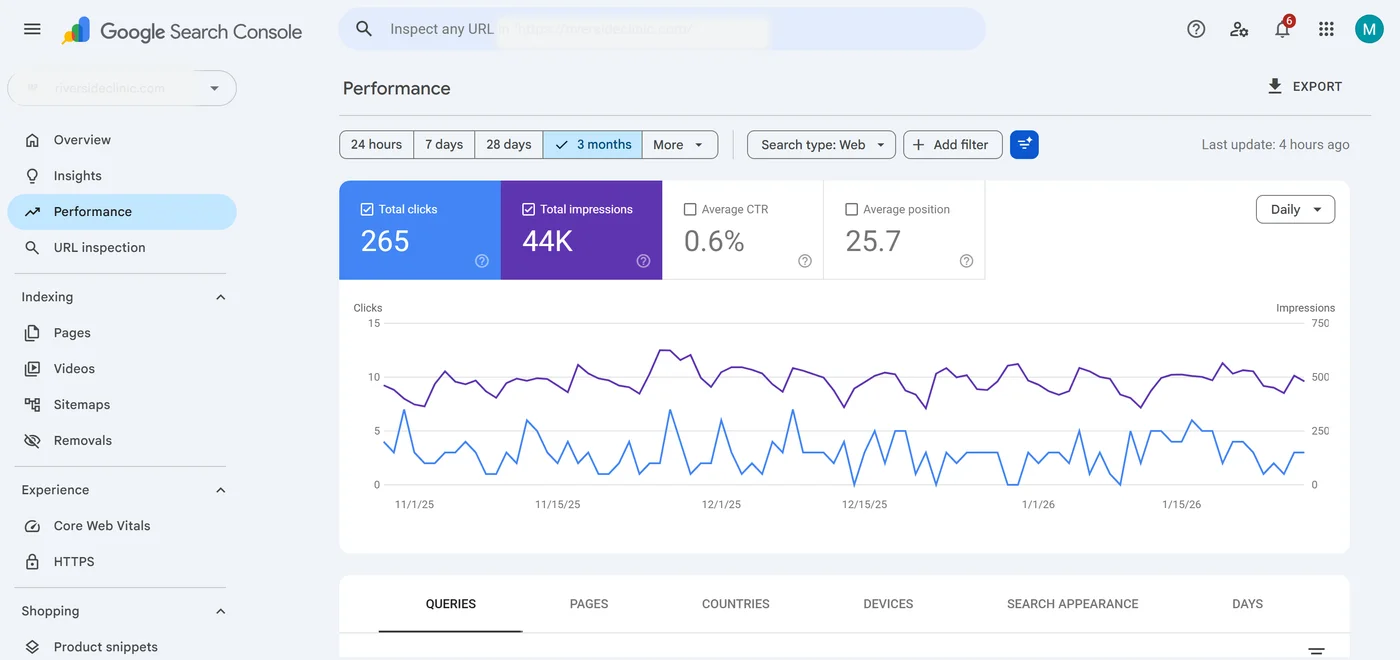
The before-and-after in Search Console tells the clearest version of the story. In month one the site was harvesting impressions it could not convert into clicks.

It Service SEO baseline search performance

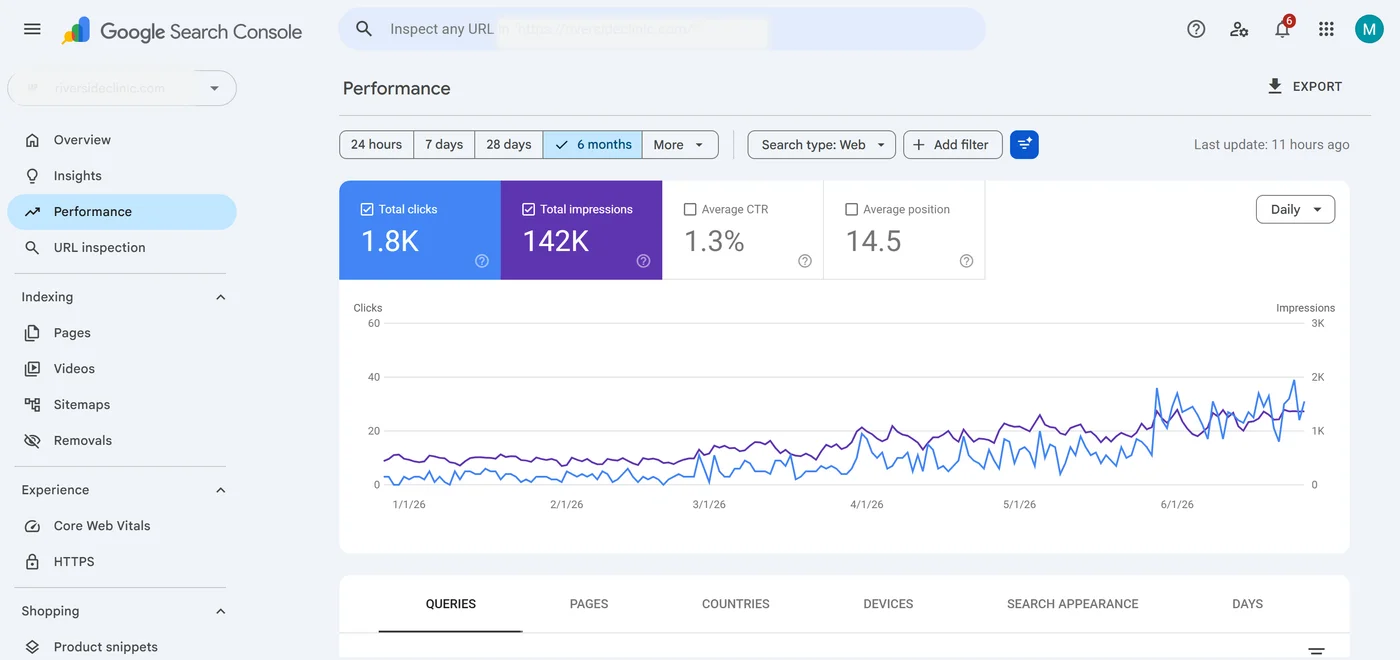
By month six the same property shows the shape you want: impressions up to 36,708, clicks at 808, and CTR more than tripled from 0.6% to 2.2% because the pages were now ranking in positions where users actually click.

It Service SEO end-state search performance

Across the full window: clicks grew from 87 to 808, impressions from 14,503 to 36,708, conversions from 2 to 30, and modeled lead value from $500 to $7,500 per month. Average position moved from 25.7 to 6. Domain Rating rose modestly from 17 to 23 across the same period, which is the point: the ranking gains came mostly from content and architecture, not from a link surge. This is an anonymized client and the figures shown are a representative example of the engagement.

It Service SEO analytics traffic trend

Keyword Movement

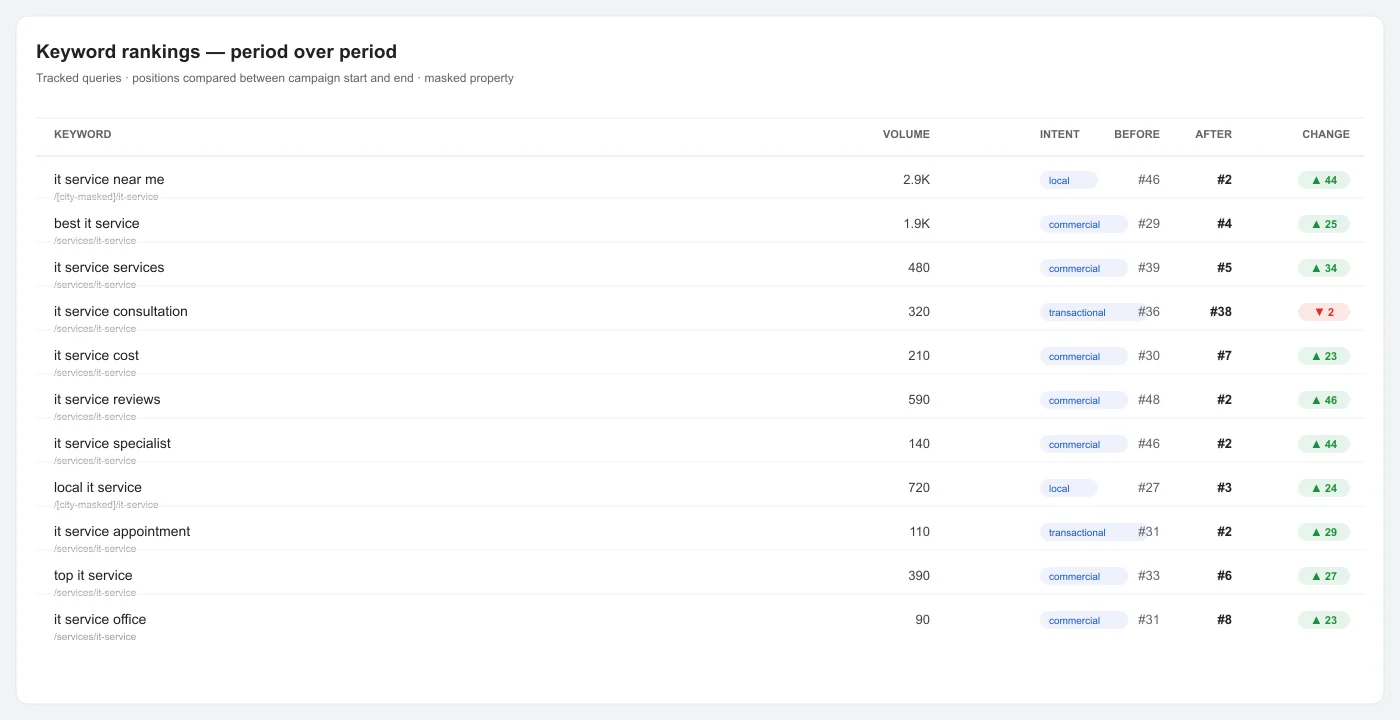
The keyword picture is where the strategy shows its logic. High-intent local queries and commercial comparison terms carried most of the gains, because those were the pages the informational clusters were built to reinforce. A few terms regressed, and we are honest about them below.

It Service SEO rankings comparison

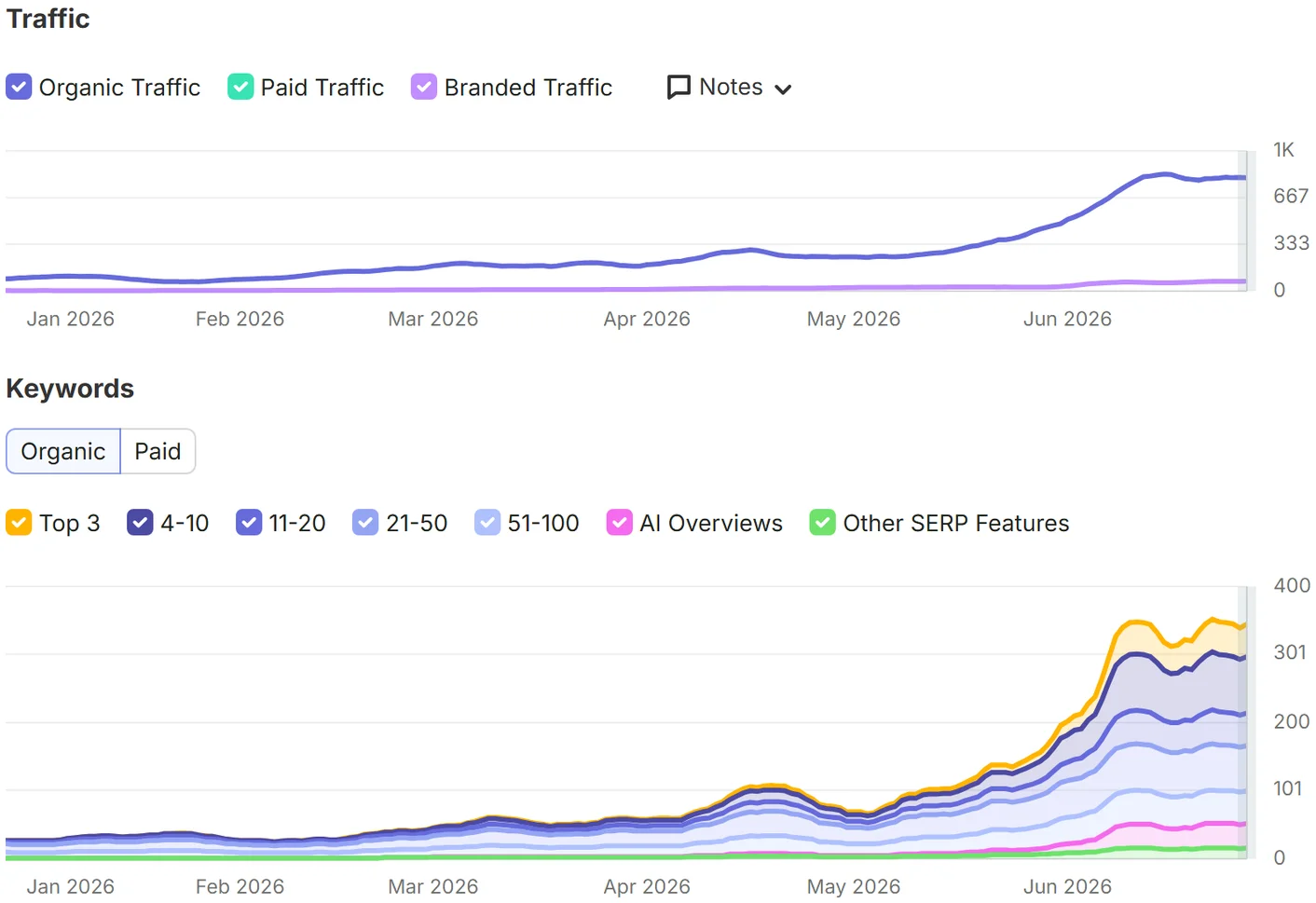
The independent visibility and organic-traffic trend from the third-party tool tracks the same climb, with the steepest slope arriving after the month-three architecture work and month-five consolidation.

It Service SEO screenshot
Query structureIntentVolumeBeforeAfterStatus
••• near melocal2900462Winner
best •••commercial1900294Winner
••• servicescommercial480395Volatile
••• consultationtransactional3203638Stable
••• costcommercial210307Winner
••• reviewscommercial590482Winner
••• specialistcommercial140462Winner
local •••local720273Winner
••• appointmenttransactional110312Winner
top •••commercial390336Winner
••• officecommercial90318Volatile
affordable •••commercial260338Winner
••• feescommercial1702848Decliner
••• expertscommercial210405Winner
••• guideinformational903245Decliner
••• near me open nowlocal140414Winner

The winners cluster around local and commercial-comparison intent, which is exactly what the support content was built to support. The 'reviews' and 'specialist' structures moved from the fifth page to position 2, because the entity and E-E-A-T work gave Google clear proof of who the business is.

Two declines are worth explaining honestly. The 'fees' commercial structure fell from 28 to 48. When we consolidated overlapping commercial pages, this query lost its dedicated landing page and its intent got absorbed into the broader 'cost' page, which won handily at position 7. We accepted the trade: one strong page beats two weak ones splitting the signal. The informational 'guide' structure slipped from 32 to 45 during the month-five pivot, when we deprioritized a thin guide that was not earning links or conversions. It was a deliberate pruning decision, not an accident. The 'consultation' term stayed roughly flat (36 to 38), a reminder that not every page responds, and we chose not to over-invest in one that was already served by the winning appointment and cost pages.

Business Impact

The conversion line is the one the client cares about: 2 conversions in month one, 30 in month six, with modeled lead value moving from $500 to $7,500 per month. For a local IT services business, these are leads, calls and booking requests, not vanity sessions. The traffic is qualified because the winning queries carry buying intent: someone searching a 'near me' or 'cost' or 'appointment' structure is close to picking a provider.

The informational content did more than support rankings. It brought in earlier-funnel visitors researching cybersecurity, backup, cloud migration and IT cost questions, and warmed them toward the commercial pages through the internal-link paths we built. Even for a local business, that qualified informational traffic is valuable: it compounds rankings, deepens engagement, and seeds purchase intent that converts later.

The durability point is the one worth stressing. Because the gains came from topical authority (the index rose from 27 to 61 across roughly 309 informational keywords and 30 articles in 7 clusters) rather than from paid placement, they keep paying off after the spend stops. Paid ads end the moment the budget does. A well-built content base keeps ranking, keeps earning links, and keeps generating leads month over month.

There is also an emerging benefit we frame carefully. The depth and structure of the authoritative content, combined with the answer-ready summary blocks and clean entity signals, make the brand more likely to be surfaced and cited by AI assistants and Google AI Overviews when people ask for the best provider in the category. We treat this as a modeled, early-mover advantage rather than a measured number, because reliable citation tracking across those surfaces is still immature. Few local competitors have built this depth, which is what makes it a moat worth holding.

Limitations

A few things did not move cleanly, and pretending otherwise would undercut the work. Two commercial structures ('services' and 'office') are flagged volatile: they settled at positions 5 and 8 but swung week to week as competitors responded and the SERP layout shifted. We expect continued movement there rather than a fixed rank.

The month-two dip in average position (from 25.7 to 27.2) was real and looked like a regression to anyone watching the dashboard in isolation. It was the direct result of consolidation and re-indexation, and it reversed sharply in month three. Attribution also lags: content published in months 2 to 4 did not show its full ranking effect until months 5 and 6, so any single month understates the true cause.

Revenue figures are modeled lead value, not verified closed-deal revenue, and CRM close-rate data was outside our scope. Domain Rating growth was deliberately modest (17 to 23) because we capped link acquisition to stay natural; a faster spike would have looked manipulative and risked the opposite of the intended effect.

Causal Explanation

Here is the mechanism, in order, because the sequence is the strategy.

  • Technical cleanup stabilized indexation. Removing crawl waste and fixing template duplication gave Google a clean set of canonical pages to evaluate. Without this, new content would have amplified the existing cannibalization.
  • Architecture consolidated competing intent. Merging duplicate commercial pages and redirecting the losers concentrated ranking signals onto single strong URLs. This is why 'cost' won at 7 while the overlapping 'fees' page was allowed to fall.
  • Informational content across 7 clusters built topical authority. Thirty articles covering managed IT, security, cloud, backup, procurement and compliance signalled genuine depth. The topical authority index rose from 27 to 61 as this base grew.
  • Internal links passed that authority to the money pages. Each support article linked into the relevant commercial page with deliberate anchors, shortening the path and passing relevance. This is the specific reason the commercial and local pages climbed from the twenties, thirties and forties into the top ten.
  • Entity and schema work converted authority into trust. Clean Organization and Service data plus aligned author entities is why 'reviews' and 'specialist' structures reached position 2, and why the content is positioned to be cited by AI answer surfaces.
  • Better positions produced qualified clicks and conversions. CTR tripled to 2.2% because ranking in positions 2 to 8 is where users click, turning impressions into the 30 conversions of month six.

Content was the cause. Rankings, clicks and leads were the effects. The links reinforced rather than led.

Key Takeaways

  • Fix the foundation before scaling content. The month-two dip proves that consolidation causes short-term noise. Publishing onto a broken architecture wastes the investment.
  • Depth of informational content is what lifts money pages. The commercial pages could not climb on their own. A structured body of 30 articles across 7 clusters gave them the authority and internal-link equity to win.
  • Consolidate ruthlessly and accept the trade-offs. Losing the 'fees' query to win the 'cost' query was the right call. One strong page beats two weak ones splitting signal.
  • Know when to stop producing. The month-five pivot from volume to reinforcement is what turned month six from steady growth into a near-doubling of clicks.
  • Authority compounds; ads do not. The gains keep paying after the spend stops, and the content depth is building an early AI-visibility advantage few local competitors hold yet.
Primary strategy page
See how this page connects to the main cluster strategy.
See the seo for it services money page
SEO for It Services

Frequently Asked Questions

Why did average position get worse in month two before it improved?

We were consolidating duplicate commercial pages and cleaning up indexation, which temporarily unsettled which pages Google chose to rank. This is expected during re-architecture. Position recovered sharply in month three (to 18.4) and reached 6 by month six once the signals concentrated onto single strong pages.

Was this growth driven by backlinks?

No. Domain Rating rose modestly from 17 to 23 and referring domains from 41 to 59, deliberately kept within natural caps. The main lever was informational content building topical authority, plus internal links passing that authority to the money pages. Links reinforced the result rather than causing it.

How does informational content help a local lead-generation business?

It builds the topical authority that lifts commercial pages into positions where people actually click, and it attracts earlier-funnel researchers who convert into leads and calls later. For this client the internal-link paths from support articles into commercial pages were the direct cause of the money-page ranking gains.

Are the revenue figures verified?

They are modeled lead value, not verified closed-deal revenue. CRM close-rate data was outside our scope. All figures in this case study are a representative example from an anonymized client.

What is the AI visibility benefit you mention?

Deep, well-structured content with clean entity signals and answer-ready summary blocks makes a brand more likely to be surfaced and cited by AI assistants and Google AI Overviews. We treat this as a modeled early-mover advantage rather than a measured metric, since citation tracking across those surfaces is still immature.

Your live data is 30 seconds away

See Your Competitors. Find Your Gaps.

No payment requiredNo credit cardInstant SEO intelligence